Introduction
Multimedia filtration can be a practical RO pretreatment option for relatively stable water with a manageable suspended-solids and colloidal load, sufficient backwash capacity, and a well-controlled chemical program. Ultrafiltration is often the stronger candidate when the source is variable, when a defined membrane barrier to particles and colloids is valuable, or when treated wastewater and challenging surface water make RO fouling control more demanding.
Neither option is automatically better. UF adds membrane integrity, backwash, chemically enhanced backwash, and concentrate-management requirements. Multimedia filtration uses a simpler depth-filtration principle, but its filtrate quality can change with raw-water conditions, media condition, filter loading, coagulation, and backwash performance.
Most importantly, neither UF nor media filtration solves every RO pretreatment problem. Dissolved hardness, silica, barium, strontium, alkalinity, dissolved organics, oxidants, oil, microbiological growth, iron and manganese chemistry, and incompatible coagulants may require separate controls. The correct selection is therefore based on the complete feedwater and RO design—not on turbidity alone.
The Direct Answer
Shortlist multimedia filtration when:
- source-water turbidity and particle load are relatively stable;
- upstream coagulation, clarification, or other solids control is reliable;
- the RO supplier’s feed-quality requirements can be met across the operating envelope;
- backwash water and waste handling are available; and
- the project favors a familiar, lower-complexity depth-filtration step.
Shortlist ultrafiltration when:
- surface water, clarified water, or treated wastewater varies in particle and colloid content;
- a physical membrane barrier and integrity monitoring are important;
- available area is constrained;
- stable particle removal is valuable for downstream RO operation; and
- the plant can manage periodic backwash, air scour where applicable, chemically enhanced backwash, cleaning chemicals, and UF reject.
The selection should be confirmed through time-series feed data, an RO fouling-risk review, and pilot or demonstration testing when the source is variable or unfamiliar.
Why RO Pretreatment Cannot Be an Afterthought
Reverse-osmosis membranes concentrate rejected materials as water permeates through the membrane. Particles, colloids, precipitated salts, metals, organics, and biological material can accumulate at the membrane surface or in feed channels. Pretreatment aims to keep those risks within the design and operating assumptions used for the RO system.
The DuPont FilmTec technical manual states that effective pretreatment is required to minimize fouling, scaling, and membrane degradation and to optimize product flow, quality, recovery, and operating cost. It lists media filtration, ultrafiltration, and crossflow microfiltration among methods used to reduce silt density index, while also emphasizing that filtrate quality depends on the feedwater, particles, media, and operating parameters.
This leads to a useful procurement principle: specify the pretreatment duty in relation to the RO feed envelope. Do not purchase a filter only because it has worked on a different source.
How Multimedia Filtration Works
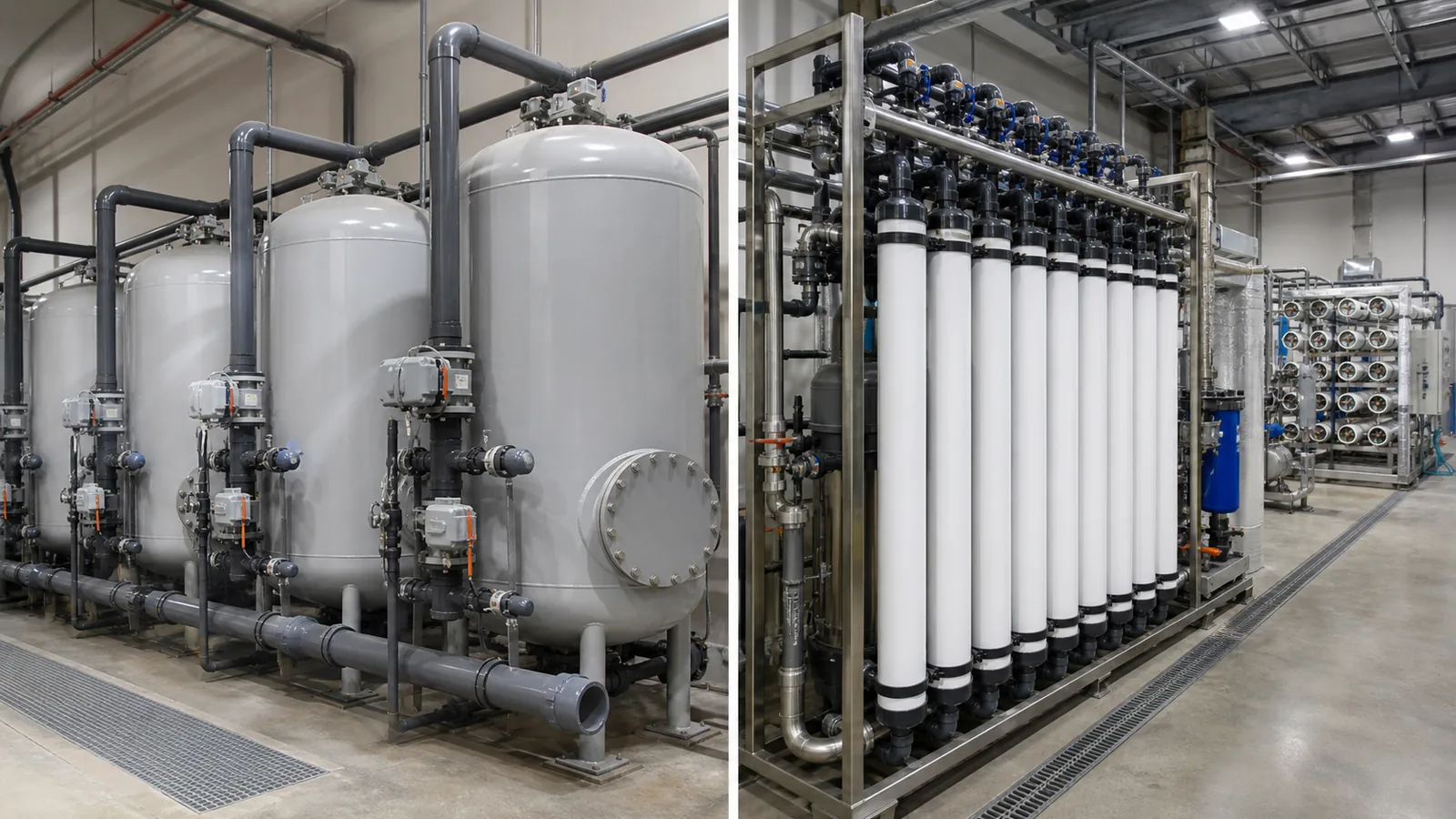
A multimedia filter uses layers of granular media with different sizes and densities to capture suspended particles through the bed depth. Common arrangements use coarser support layers and finer filtration media, but the exact combination, bed depth, vessel configuration, and loading rate are project-specific.
During filtration, head loss rises as solids accumulate. The filter is then backwashed—often with water and sometimes air scour—to expand and clean the bed. The media must settle back into an effective layered structure before the unit returns to service. Backwash frequency may be controlled by time, differential pressure, filtrate quality, or a combination.
Media filtration performance depends on:
- influent particle size and concentration;
- effectiveness of upstream coagulation or clarification;
- filtration rate and run length;
- media type, size, depth, age, and cleanliness;
- vessel and underdrain distribution;
- backwash flow, expansion, duration, and water quality;
- operation during startup and after backwash;
- biological growth or fouling within the bed.
Its apparent simplicity is an advantage only when these fundamentals are controlled.
How Ultrafiltration Works
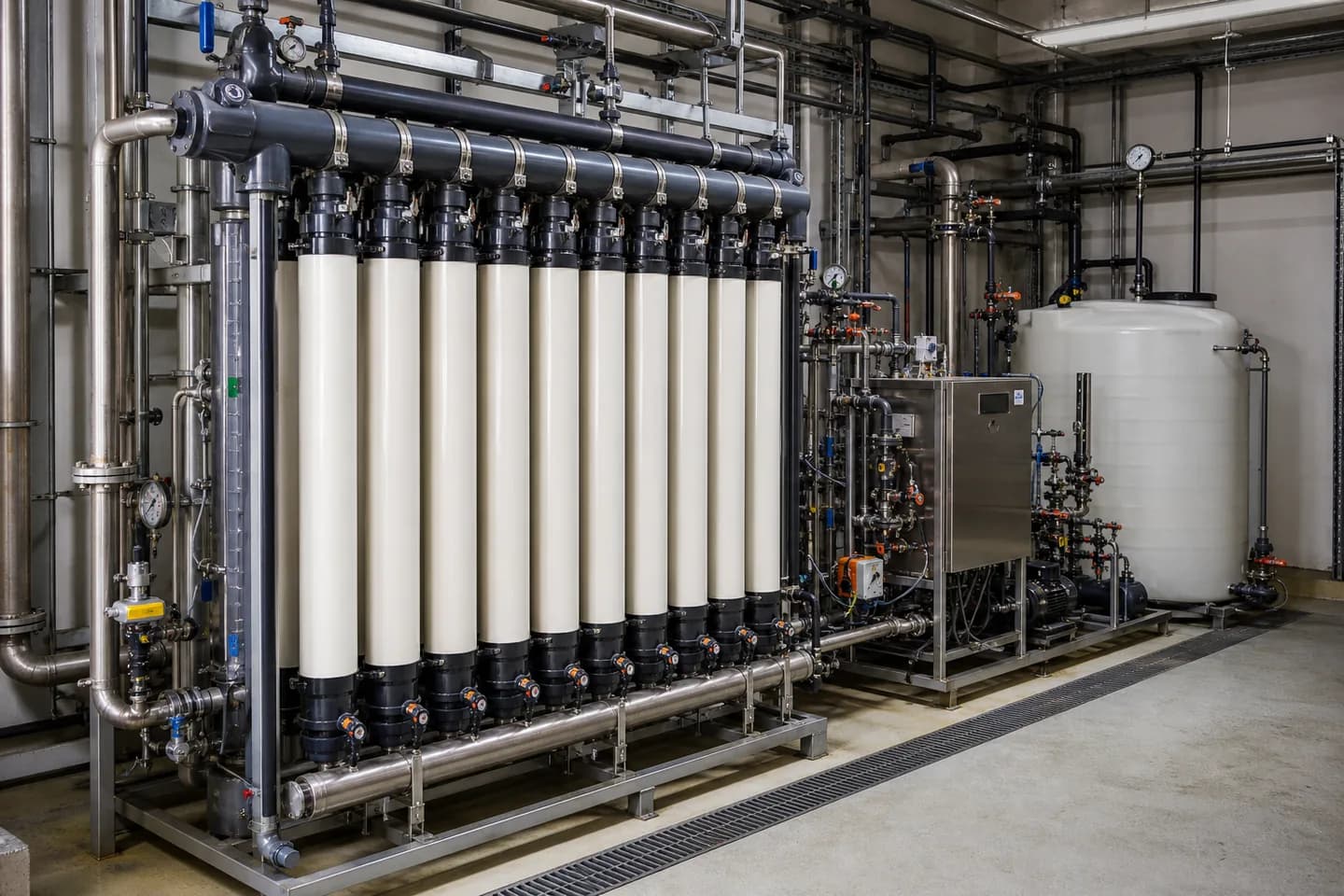
Ultrafiltration uses a pressure-driven porous membrane to retain suspended particles, colloids, and larger macromolecular material while allowing water and smaller dissolved constituents to pass. UF modules may operate outside-in or inside-out and may use dead-end or other hydraulic modes depending on the product and application.
DuPont describes its UF products as pretreatment for RO in desalination, industrial water, and water-reuse applications. The supplier cites a nominal pore-size range of approximately 0.02–0.05 micrometers for its own UF portfolio; that should not be treated as a universal specification for every membrane. Buyers should use the selected manufacturer’s verified membrane data.
UF operation normally includes:
- filtration cycles;
- periodic backwash;
- air scour for applicable module designs;
- chemically enhanced backwash at defined intervals;
- clean-in-place when normalized performance indicates it is required;
- integrity testing or monitoring;
- reject and cleaning-waste handling.
UF creates a more defined physical barrier than a granular bed, but membrane condition, integrity, fouling, cleaning, and recovery must be actively managed.
UF vs Multimedia Filter: Buyer Comparison
| Decision factor | Multimedia filtration | Ultrafiltration |
|---|---|---|
| Separation principle | Depth filtration through granular media | Porous membrane barrier |
| Strong screening fit | Stable particle load; reliable upstream clarification; familiar utility environment | Variable colloids/particles; surface water or treated wastewater; tighter particle barrier needed |
| Filtrate consistency | Can vary with feed, coagulation, bed condition and run cycle | Generally more consistent for particles when membrane integrity and operation are maintained |
| Footprint tendency | Vessel area and backwash arrangement can be substantial | Often compact per unit flow, but requires backwash/CIP and ancillary space |
| Main operating controls | Differential pressure, run time, backwash, filtrate quality | Flux, transmembrane pressure, backwash, air scour, CEB/CIP, integrity |
| Waste streams | Backwash water with captured solids | Backwash/reject plus chemical cleaning wastes |
| Failure indicators | Turbidity/SDI breakthrough, high head loss, short runs, media loss/channeling | Rising normalized pressure, falling permeability, integrity failure, short cycles |
| Chemical relationship | May depend on coagulation; carryover must be controlled | Coagulant compatibility and irreversible fouling risk require review |
| Performance proof | Time-series filtrate data under realistic loading | Pilot or demonstration data including cycles, recovery and cleaning response |
The table defines comparison categories, not guaranteed performance. Final values depend on the selected media or UF product and the actual water.
Feedwater Questions That Decide the Selection
What Is the Source?
Groundwater, municipal supply, surface water, clarified river water, seawater, cooling-tower blowdown, and treated wastewater have different risks. “Industrial water” is not a sufficient source description. Identify upstream treatment and whether the source changes seasonally or with plant operation.
How Variable Are Turbidity and SDI?
A few spot samples can miss storm events, algae periods, clarifier upsets, or cleaning discharges. Provide time-series turbidity and silt density index where available and connect peaks to operating conditions. DuPont’s manual gives an RO-feed guideline of SDI15 no greater than 5 and recommends less than 3 to minimize colloidal fouling for its membrane design guidance. This is useful as manufacturer guidance, not a universal performance warranty or a substitute for the selected RO supplier’s requirements.
Are the Particles Truly Particulate?
Turbidity, colloids, precipitated metals, biological material, and dissolved organics behave differently. A low turbidity value does not prove low organic or biological fouling potential. Filtered and unfiltered analyses, particle observations, SDI trends, and upstream chemical history help distinguish the risks.
Are Oil or Surfactants Present?
Oil, grease, defoamers, cleaners, and surfactants can foul media, UF, and RO in different ways. Source segregation, oil separation, adsorption, or chemical changes may be required before either filter. Do not assume UF is a protective barrier against every organic contaminant.
What Is the Microbiological Condition?
Surface water and reuse water may carry higher biological risk. Review disinfectant strategy, nutrient load, storage, dead legs, temperature, and compatibility with UF and RO materials. An upstream membrane can remove particles and microorganisms at a given integrity, but downstream regrowth remains possible if the system is not hygienically managed.
Which Dissolved Scaling Species Are Present?
Hardness, alkalinity, sulfate, silica, barium, strontium, fluoride, phosphate, and metals can precipitate as RO recovery increases. Multimedia filtration and UF do not remove most truly dissolved salts. Softening, pH adjustment, antiscalant, oxidation/filtration, ion exchange, or another process may still be needed based on the RO projection.
When Multimedia Filtration Is a Defensible Choice
Media filtration should remain on the shortlist when the source is stable and the upstream process already produces a consistent, filterable water. It can be attractive where plant personnel are familiar with vessel filters, backwash water is available, waste return is manageable, and footprint is not critical.
The proposal should define:
- number of filters and operating/standby philosophy;
- media specification and bed depth;
- design filtration rate and peak condition;
- expected run trigger and backwash sequence;
- air-scour requirement;
- backwash supply and destination;
- differential-pressure and turbidity monitoring;
- media loading, sampling, replacement, and disposal provisions;
- startup-to-service criteria after backwash.
Where coagulation is used upstream, confirm chemical identity, dose range, mixing, pH, and compatibility with the downstream RO. Coagulant carryover can change fouling behavior.
When UF Is a Defensible Choice
UF deserves serious consideration where water quality varies, RO fouling consequences are high, space is restricted, or a more defined particle barrier is required. It is commonly evaluated for surface water, seawater pretreatment, and water reuse, but the source still needs adequate upstream screening, oil control, and chemistry management.
The proposal should define:
- membrane manufacturer, module, material, and flow direction;
- design net flux and temperature basis;
- normal and peak feed conditions;
- filtration, backwash, air-scour, CEB, and CIP sequences;
- gross and net water production;
- integrity-test method and response to failure;
- chemical identities, concentrations, contact times, and waste route;
- normalized performance indicators and cleaning triggers;
- module isolation, replacement access, and preservation;
- UF filtrate storage and downstream hygiene control.
A high gross flow is not the same as usable RO feed. Compare net production after backwash, chemical cycles, downtime, and reject.
Neither Option Replaces Complete RO Pretreatment
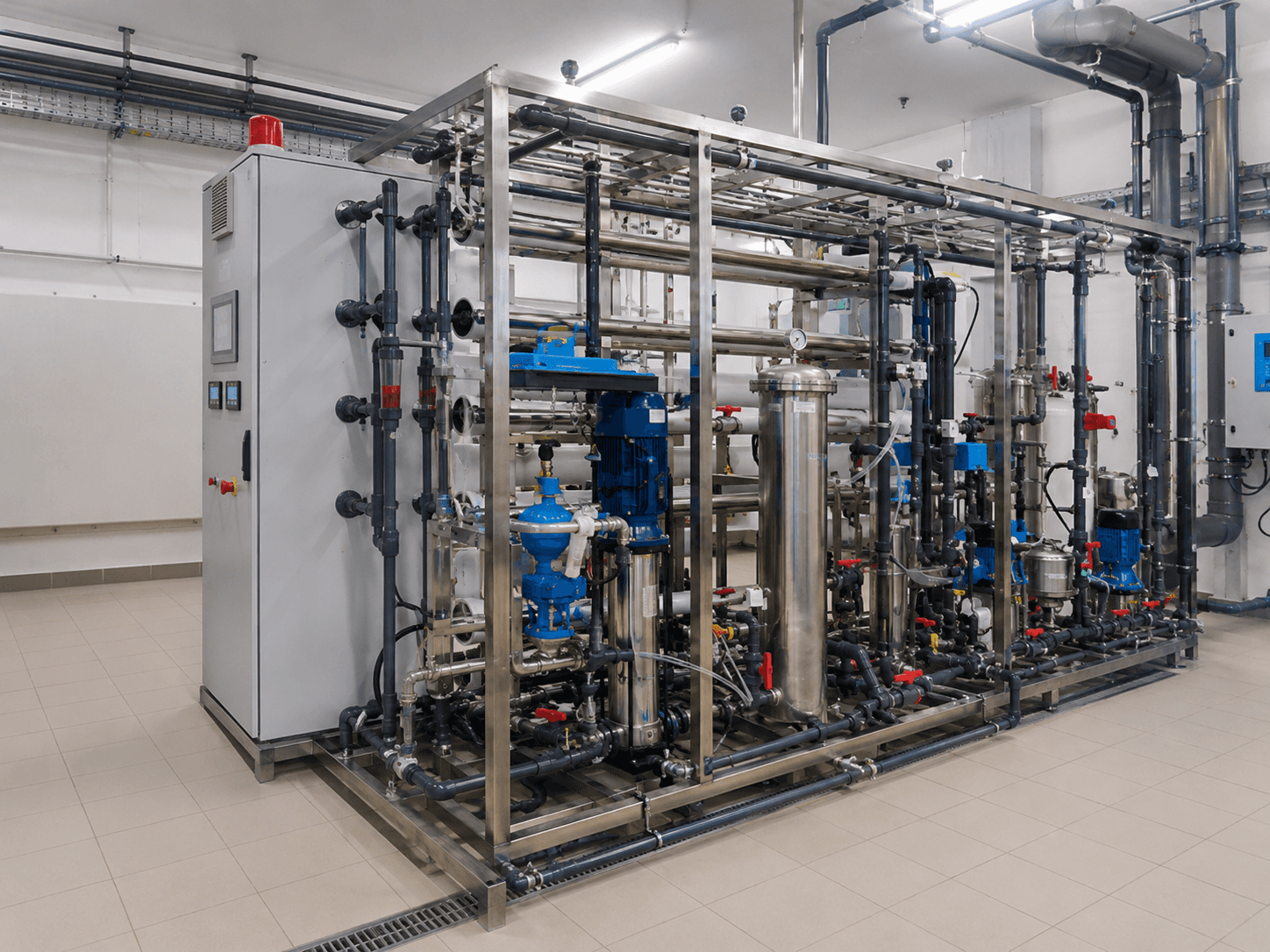
The train may still require screening, clarification or DAF, iron and manganese control, organic treatment, softening or antiscalant, pH adjustment, compatible disinfection/dechlorination, and final cartridge filtration. The RO projection should use the actual ion analysis, temperature, recovery, flux, and selected membrane. Pretreatment must then address the specific fouling, scaling, oxidation, and biological risks identified by that projection and the source-water history.
Compare Lifecycle Inputs, Not Only Filtrate Turbidity
Compare both options on the same net-production and availability basis:
| Lifecycle input | What to include |
|---|---|
| Water balance | Feed, usable filtrate, backwash, rinse, UF reject, cleaning solution, off-spec water and downtime |
| Waste quality | Suspended solids, upstream chemicals, pH, oxidants and the confirmed return or neutralization route |
| Utilities and chemicals | Feed/backwash pumping, air scour, chemical preparation, cleaning and waste neutralization |
| Replacement plan | Media, UF modules, cartridges, instruments, valves, cleaning parts and commissioning spares |
| Operator work | Backwash and media management, or UF trend review, integrity response and cleaning discipline |
Do not compare annual costs using different feed quality, net recovery, or availability assumptions.
Testing Strategy for a Defensible Decision
Establish Baseline Data
Collect source data across relevant seasons and operating modes. Include turbidity and SDI trends, temperature, pH, conductivity, major ions, alkalinity, hardness, silica, iron, manganese, organics where relevant, microbiological indicators, oil, and upstream chemicals. Mark detection limits and analytical methods.
Test the Proposed Pretreatment Train
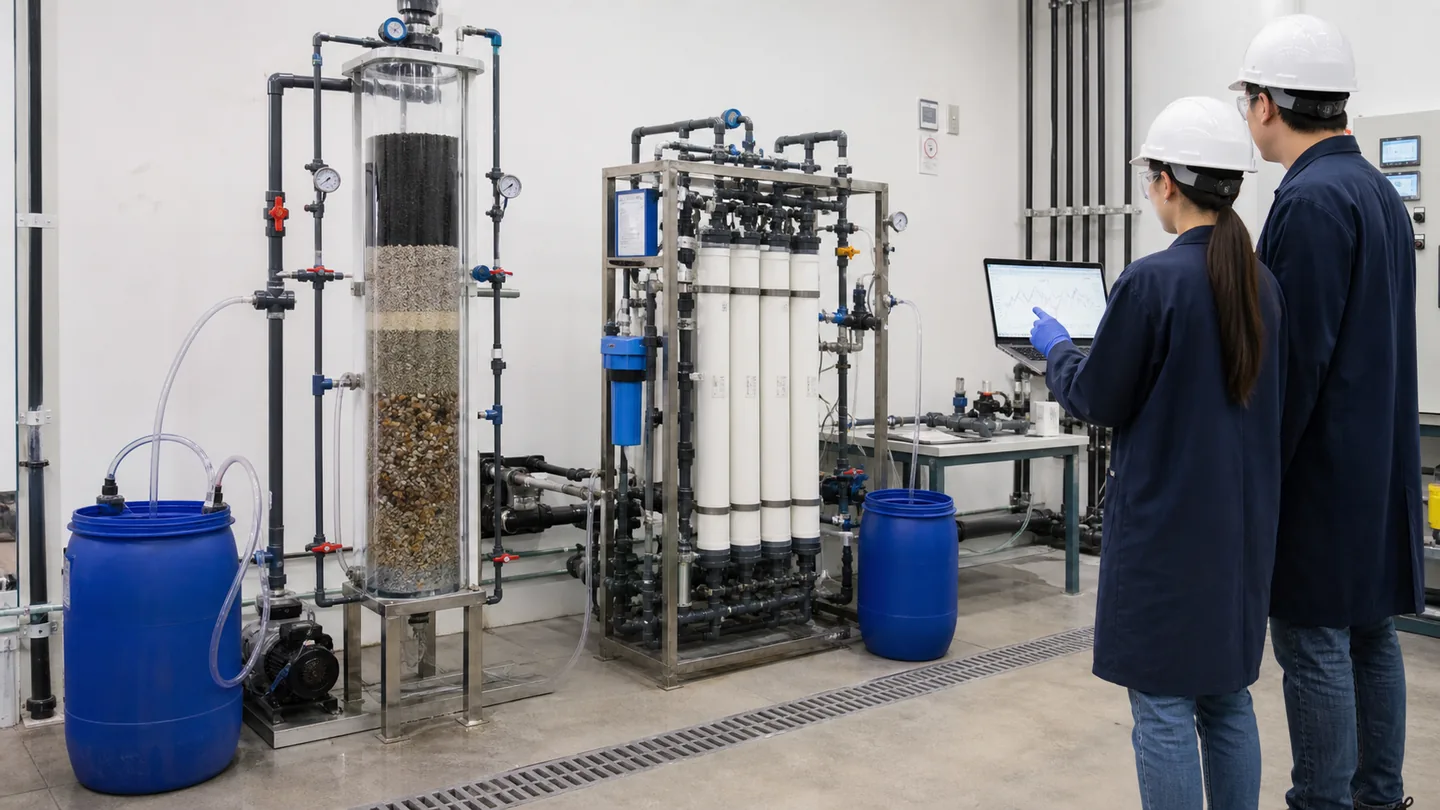
For media filtration, evaluate realistic loading, coagulation if used, run length, differential pressure, post-backwash ripening, filtrate quality, and backwash effectiveness. For UF, evaluate sustainable flux, transmembrane pressure, cycle recovery, integrity, CEB/CIP response, reject quality, and stable operation across feed changes.
Connect the Result to RO Operation
Do not stop at pretreatment turbidity. Review SDI or other agreed fouling indicators, cartridge-filter loading, RO normalized differential pressure, normalized permeate flow, cleaning frequency assumptions, and membrane-supplier guidance. A pilot should run long enough to encounter meaningful feed variation; a short demonstration on unusually clean water is not representative.
Write an Acceptance Basis
State the feedwater envelope, net production, availability basis, filtrate criteria, recovery calculation, chemical basis, permitted downtime, test duration, measurement method, and response to out-of-range feed. Separate factory functional checks from site performance testing.
Mid-article CTA
Review Your RO Pretreatment Basis Send the source-water analysis, turbidity and SDI history, required RO feed flow, recovery target, seasonal variation, and available waste-handling routes. Baihuipu can identify missing inputs before a UF or media-filtration configuration is selected. Send Your Requirements
Factory Testing, Shipment Inspection, and Installation Preparation
Factory testing can verify skid assembly, pressure testing where specified, valves, pumps, instruments, control sequences, alarms, interlocks, backwash logic, chemical-skid functions, and electrical documentation. UF integrity checks may be completed according to the selected module and test procedure. Clean-water testing does not prove long-term fouling rate or cleaning frequency on the buyer’s source.
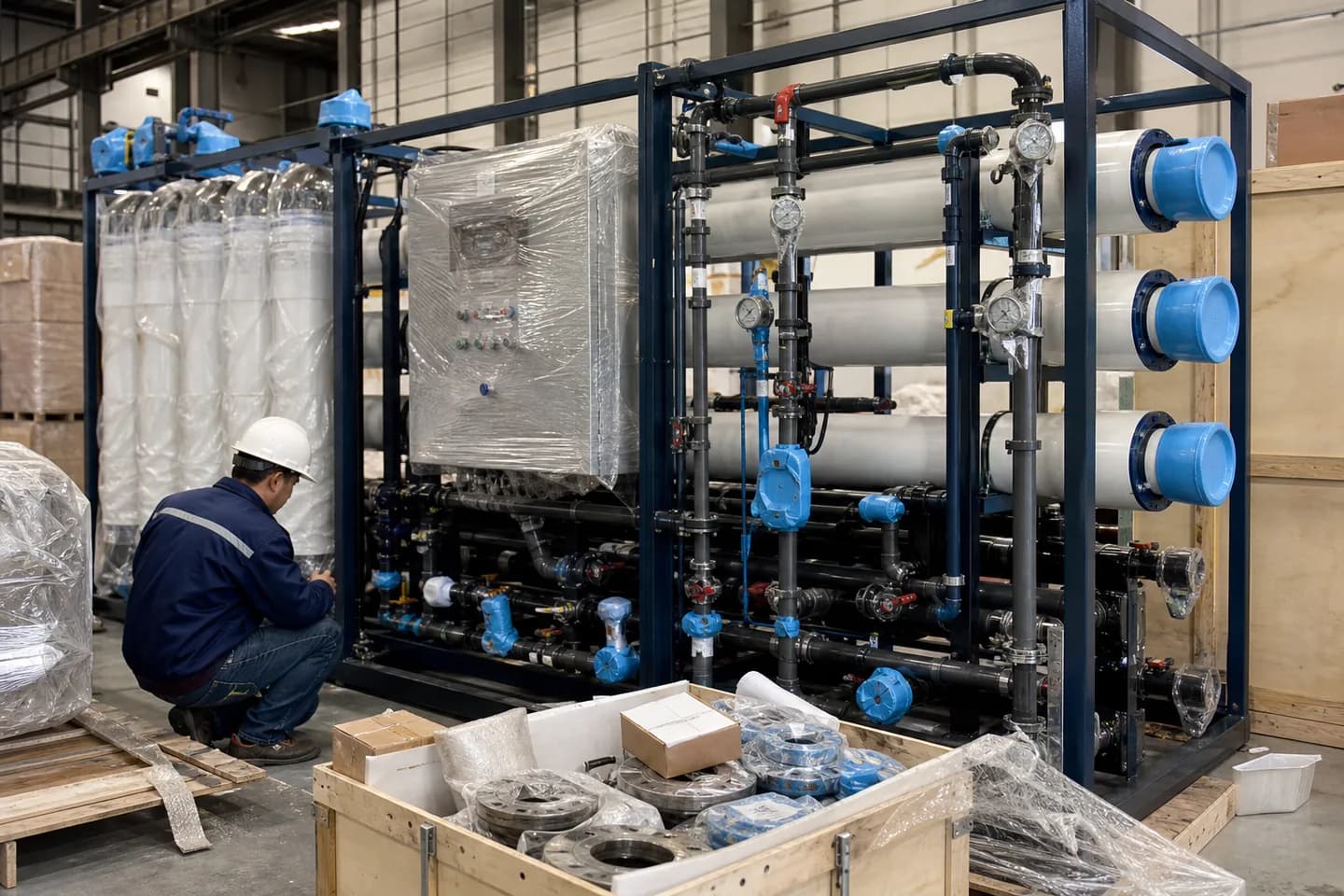
Shipment inspection should confirm membrane preservation where applicable, media packaging or loading plan, cartridge housings, instruments, chemical pumps, loose items, spare parts, capped connections, lifting points, packing lists, and storage conditions. Membranes and chemicals may have temperature or shelf-life limits that must be coordinated with transport and site storage.
Installation preparation should confirm feed and filtrate tank interfaces, drainage, backwash and CIP waste routes, chemical bunding, ventilation, power, instrument air if required, access for loading media or replacing UF modules, and preservation during delayed commissioning. The RO, pretreatment, and chemical-control teams should use one interface schedule.
Common Selection Mistakes
Treating a Single SDI Result as the Design Envelope
SDI is useful but sensitive to sampling, temperature, test practice, and changing water. Use a trend and source context. A low value on one day does not prove that storm, cleaning, algae, or clarifier-upset conditions are controlled.
Assuming UF Removes Dissolved Scaling Salts
UF mainly separates particles, colloids, and larger macromolecular material according to membrane characteristics. Dissolved hardness, silica, sulfate, and other ions generally pass through and must be controlled through the RO design and appropriate chemistry or upstream processes.
Comparing Gross UF Flow with Net Media-Filter Flow
Both systems lose production to backwash and maintenance. Compare net usable RO feed at the same availability, feed condition, and waste boundary. Include CEB/CIP downtime and post-backwash filter-to-waste where applicable.
Ignoring Cleaning-Waste Disposal
UF cleaning can generate chemically distinct waste. Media backwash can send a high solids pulse to headworks. Confirm that the receiving process can handle the hydraulic, solids, pH, oxidant, and chemical load.
Selecting by Capital Price Alone
The equipment price does not capture RO cleaning, cartridge replacement, water loss, chemicals, media or module replacement, labor, downtime, and waste treatment. Compare a transparent lifecycle basis without inventing unsupported annual savings.
FAQ
Is ultrafiltration always better than multimedia filtration before RO?
No. UF can provide a more defined particle and colloid barrier, which is valuable for variable sources, but it adds membrane operation, cleaning, integrity, and waste-management requirements. Stable, well-clarified water may be effectively treated by a correctly designed and operated media filter.
What SDI should RO feed have?
Use the selected membrane supplier’s current guidance. The DuPont FilmTec manual gives SDI15 of 5 or less as a guideline and recommends below 3 to minimize colloidal fouling for its membrane systems. This does not guarantee fouling-free operation and does not replace a complete feedwater review.
Can UF remove hardness or silica before RO?
UF does not normally remove truly dissolved hardness or silica. It may remove particulate or colloidal forms under specific conditions, but dissolved scaling risk still requires an RO projection and appropriate softening, antiscalant, pH control, recovery limits, or another process.
How should UF recovery be compared with media-filter recovery?
Use net usable filtrate over a common period. Subtract backwash, rinse, CEB/CIP solution, filter-to-waste, downtime, and off-spec water. State whether any waste is recovered elsewhere in the plant.
When is pilot testing justified?
Pilot testing is valuable for variable surface water, reuse water, unfamiliar industrial sources, uncertain coagulant compatibility, high RO-fouling consequence, or when lifecycle decisions depend on sustainable flux, run length, cleaning response, and net recovery.
What information belongs in an RO pretreatment RFQ?
Include source and upstream process, complete water analysis, turbidity and SDI trends, temperature, normal and peak flow, RO feed and recovery target, scaling projection inputs, chemicals, biological and oil risk, net availability, waste routes, utilities, space, automation, and acceptance-test requirements.
Conclusion
Multimedia filtration and ultrafiltration can both prepare water for reverse osmosis, but they manage particle risk differently. Media filters use a granular depth bed whose performance depends on loading, media condition, coagulation, and backwash. UF uses a membrane barrier whose performance depends on flux, integrity, fouling control, cleaning, and recovery.
The best choice is the one that meets the selected RO membrane’s feed requirements across the real source-water envelope while fitting the plant’s water balance, waste route, operator capability, footprint, and lifecycle plan. A defensible purchase therefore connects time-series water data, pretreatment testing, RO design projections, complete auxiliary scope, and measurable acceptance criteria.
Final CTA
Request an RO Pretreatment Review Share your source-water analysis, SDI and turbidity history, required net RO feed, recovery target, operating schedule, site constraints, and waste routes. Baihuipu can help structure the inputs needed to compare UF and multimedia filtration. Get a Quote