Introduction
A decline in reverse-osmosis performance does not immediately mean the membranes are worn out. It may reflect temperature change, feed salinity, recovery, pressure, instrument error, pretreatment upset, fouling, scaling, oxidation, mechanical damage or a combination of causes. Cleaning too late can make deposits harder to remove. Cleaning without diagnosis can waste chemicals or damage the elements. Replacing membranes before correcting the root cause can lead to another early failure.
The decision should be made from normalized operating trends, system inspection and cleaning results—not from one conductivity reading. This guide provides a buyer and operator framework for deciding when to clean, when to investigate further and when replacement becomes reasonable.
Always follow the installed membrane manufacturer’s current limits, chemical-compatibility instructions and safety documents. The examples here are decision principles, not a substitute for the membrane data sheet or a site-specific cleaning procedure.
First Separate Operating Change from Membrane Change
Raw permeate flow and conductivity move when operating conditions change. Colder feedwater reduces permeate production. Higher feed salinity increases osmotic pressure and can increase salt passage. Changes in recovery alter concentration within the array. A pressure adjustment can temporarily hide declining permeability.
Normalization mathematically compares current performance with a reference condition. At minimum, trend:
- normalized permeate flow;
- normalized salt passage or normalized rejection;
- differential pressure by stage and across the full array;
- feed pressure, permeate pressure and concentrate pressure;
- feed temperature and conductivity;
- permeate conductivity by stage or pressure vessel where available;
- recovery and concentrate flow;
- pretreatment indicators such as turbidity, SDI, dechlorination and chemical dose.
Use calibrated instruments and consistent sampling points. If a conductivity probe is dirty or a flowmeter is drifting, the maintenance decision can be wrong even when the spreadsheet looks precise.
What the Main Trends Usually Indicate
No single symptom proves one cause, but combinations can narrow the investigation.
| Observed normalized trend | Possible interpretation | Checks before action |
|---|---|---|
| Lower normalized permeate flow | Fouling, scaling, compaction or restricted feed | Pretreatment records, stage profile, pressure, temperature correction |
| Higher normalized salt passage | Oxidation, membrane damage, leakage, O-ring issue, severe fouling or scaling | Vessel conductivity, oxidant exposure, permeate tube and seal inspection |
| Higher differential pressure | Feed-channel fouling, solids, biofilm, scale or flow obstruction | Stage-by-stage pressure, cartridge filters, feed spacer evidence, concentrate flow |
| Rapid performance change | Pretreatment failure, dosing error, contamination, valve/instrument issue | Event logs, chemical systems, recent maintenance and calibration |
| Gradual recurring decline after cleaning | Incomplete cleaning, wrong chemistry or unresolved root cause | Cleaning records, foulant analysis and upstream control |
The stage in which a change appears matters. First-stage pressure-drop increase may point toward particulate or biological fouling. Last-stage scaling risk can rise as salts concentrate. A localized high permeate conductivity can indicate an element, interconnector or seal problem rather than uniform membrane aging.
When Cleaning Is Normally Considered
Membrane suppliers publish cleaning triggers based on change from established normalized baseline performance. DuPont’s FilmTec cleaning procedure guidance states typical criteria that include a decline in normalized permeate flow, an increase in normalized salt passage, or an increase in normalized pressure drop. Use the criteria for the actual membrane and system rather than copying a percentage from another plant.
Cleaning should be planned when:
- a validated normalized trend reaches the manufacturer’s trigger;
- the decline persists after confirming instruments and operating conditions;
- the suspected deposit is chemically or physically cleanable;
- the system can be isolated and cleaned with suitable flow, temperature, pH and materials compatibility;
- spent cleaning solution can be handled safely and lawfully.
Do not wait for severe production loss if the supplier’s criteria have already been reached. Heavy deposits can restrict cleaning flow and make recovery more difficult.
Diagnose the Likely Foulant Before Selecting Chemistry
Cleaning chemistry should match the deposit. A generic “acid wash” or “alkaline wash” can be ineffective or harmful.
Mineral Scale
Carbonate, sulfate, silica or metal scale can form when recovery, pH, temperature, antiscalant control or feed composition exceeds the design envelope. Review concentrate chemistry, dosing calibration, recovery and scaling calculations. Acid cleaning may suit some mineral deposits, while others need different chemistry and specialist advice.
Particulate and Colloidal Fouling
High SDI, filter breakthrough, corrosion products, coagulant carryover or disturbed piping can load the lead elements. Inspect cartridge filters and pretreatment records. Correct the source before returning the cleaned array to service.
Organic Fouling
Natural organics, oils, process contamination or incompatible pretreatment chemicals can adsorb to the membrane. Alkaline or detergent-assisted cleaning may be considered within manufacturer limits, but the exact procedure should follow foulant evidence.
Biological Fouling
Biofilm can increase pressure drop and become difficult to remove. Review nutrient entry, stagnation, preservation, sanitization compatibility and dead legs. Repeated biogrowth after cleaning indicates a system-control problem.
Metal Oxides
Iron, manganese or corrosion products may deposit when upstream oxidation, filtration or materials control is inadequate. Analyze the deposit and correct the pretreatment mechanism.
Membrane autopsy, foulant analysis or examination of a lead element may be justified when repeated cleanings do not solve the problem.
What a Complete RO Cleaning System Must Do
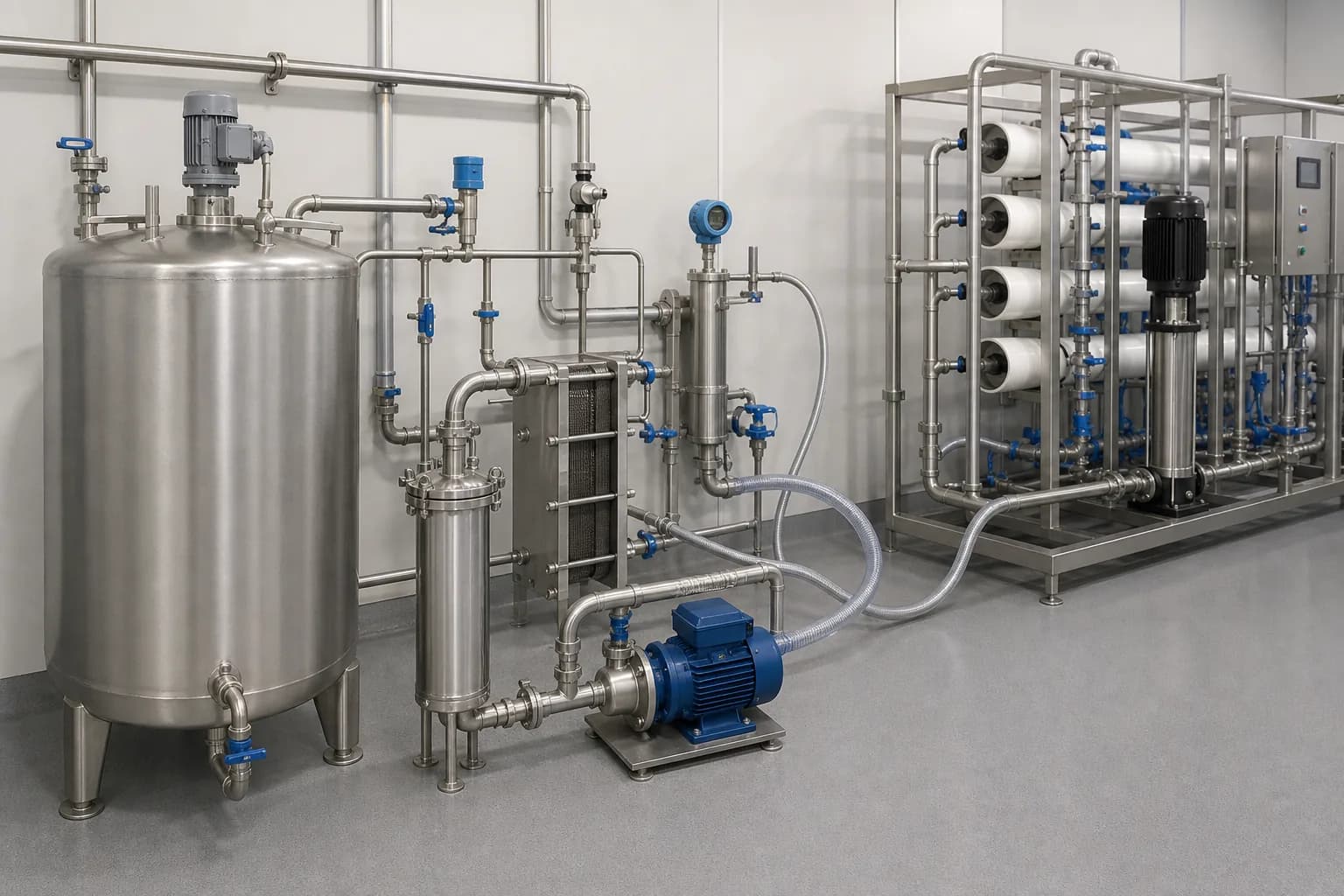
Effective clean-in-place is a hydraulic process as well as a chemical one. The cleaning system should provide the required solution volume, crossflow, temperature, filtration, mixing and return arrangement without exceeding element pressure limits.
A typical scope includes:
- compatible cleaning tank with mixer or recirculation;
- cleaning pump sized for low-pressure crossflow;
- cartridge filter for removed material;
- heater or temperature-control provision where approved;
- pH, temperature, flow and pressure measurement;
- sample points and safe chemical addition;
- connections that allow stages to be cleaned separately where required;
- drain and neutralization route for spent solution;
- rinse and preservation provisions.
Cleaning all stages together can redistribute foulants or prevent the correct flow from reaching each stage. Follow the membrane and system supplier’s procedure.
The DuPont Water Solutions FilmTec manual provides detailed operating and cleaning context for RO/NF systems. Other membrane brands have their own instructions and limits.
How to Evaluate Cleaning Success
Record conditions before cleaning, throughout each cleaning step and after stable restart. Useful records include:
- initial normalized flow, salt passage and differential pressure;
- solution pH, temperature, flow and pressure;
- circulation and soak duration;
- solution appearance and any laboratory results;
- chemical identity, concentration and lot;
- rinse endpoint and restart conditions;
- normalized performance after stabilization.
A successful cleaning should produce meaningful recovery toward the established clean baseline. Complete recovery is not always possible, especially after delayed cleaning, compaction or irreversible damage. Define the acceptance criterion before the work starts.
If flow improves but salt passage becomes worse, investigate chemical exposure, seal integrity and operating conditions rather than declaring success from production alone. If differential pressure remains high, flow channels may still be obstructed.
When Replacement Becomes the Better Decision
Replacement should be considered when evidence shows that cleaning cannot restore the required performance safely and economically.
Irreversible Chemical Damage
Oxidant exposure can damage many polyamide RO membranes and cause higher salt passage. Extreme pH, incompatible solvents or incorrect cleaning chemicals can also change membrane performance. Chemical damage is generally not repaired by cleaning.
Mechanical or Integrity Damage
Damaged permeate tubes, telescoping, crushed elements, failed interconnectors, displaced O-rings or pressure-vessel problems can create poor water quality or pressure loss. Identify and correct the mechanical cause before installing replacements.
Persistent Performance Loss After Correct Cleaning
If an appropriate cleaning procedure, conducted within supplier limits, does not restore acceptable normalized flow, rejection or pressure drop, the affected elements may have reached the end of practical service.
Product Water No Longer Meets the Requirement
Replacement may be necessary when the array cannot meet the agreed quality at allowable pressure, recovery and blending conditions. Confirm the instruments, sampling, feedwater and post-treatment before attributing the failure to membranes.
Cleaning Frequency Is No Longer Economical
Frequent cleaning consumes chemicals, labor, water and production time. However, replacement alone is not a root-cause solution. Correct inadequate pretreatment, excessive recovery, poor preservation or operating excursions first.
Replace All Membranes or Only the Affected Elements?
Partial replacement can be appropriate when testing identifies a localized problem and the remaining elements have compatible performance. Wholesale replacement may be simpler when degradation is widespread or when mixing old and new elements would create an unsuitable hydraulic or quality profile.
Before deciding, consider:
- vessel-by-vessel permeate conductivity;
- element probing or profiling results;
- age, membrane model and operating history;
- location of pressure drop or quality loss;
- compatibility of replacement elements;
- planned staging and array balance;
- cost and downtime of repeated diagnostic work.
Record the serial numbers and locations of new elements. After installation, flush, commission and establish a new normalized baseline according to supplier instructions.
Root-Cause Actions Before Restart
Cleaning or replacement is only the immediate intervention. Review why the decline happened.
Pretreatment
Check multimedia filters, ultrafiltration, cartridge filters, coagulant carryover, activated carbon, softening, antiscalant dose, pH adjustment and dechlorination. Confirm actual chemical concentration and dosing-pump calibration.
Recovery and Crossflow
Verify flows by stage. Excessive recovery or insufficient concentrate flow can increase concentration polarization and scale risk.
Shutdown and Preservation
Stagnant systems can support biological growth or membrane drying. Review flushing, short shutdown and long-term preservation procedures.
Instrumentation
Calibrate pressure, flow, conductivity, pH, ORP and temperature instruments. Trend quality is only as reliable as the measurements.
Operating Discipline
Document start-up, shutdown, valve sequencing and alarm response. A rapid pressure change or running outside the approved envelope can damage equipment and obscure the original cause.
What Buyers Should Specify for an RO System
An RFQ or service scope should define:
- feedwater analysis and variability;
- product-water quality and recovery target;
- membrane model or required compatibility;
- normalized performance reporting method;
- sampling and instrumentation by stage;
- pretreatment monitoring and interlocks;
- CIP tank, pump, filter, heater and connection scope;
- cleaning chemicals and disposal responsibility;
- spare elements, seals and cartridge filters;
- factory testing, shipment inspection and site commissioning boundary;
- training and maintenance documentation;
- acceptance conditions after start-up.
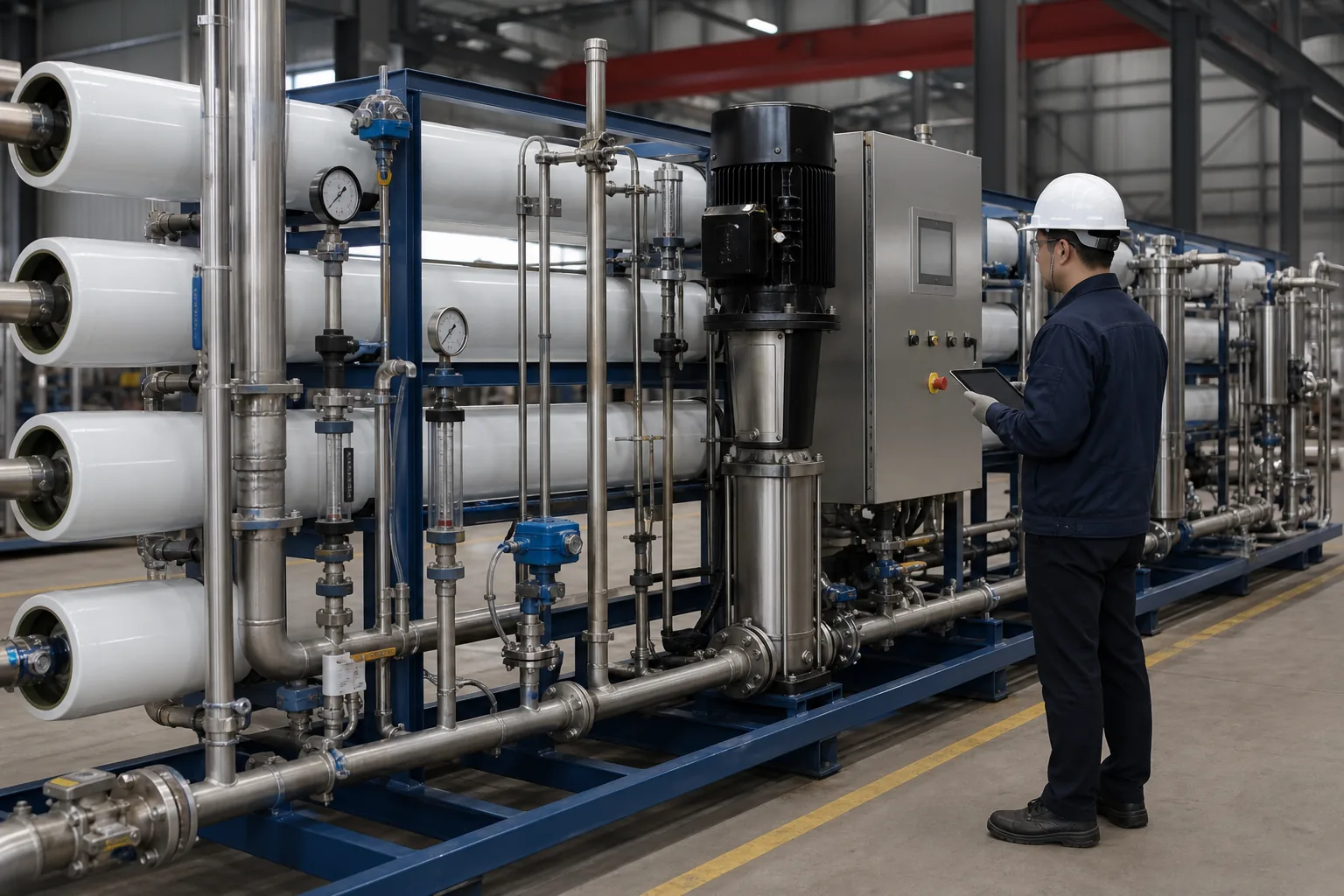
Factory inspection can verify skid configuration, piping, instruments, control logic, alarms and accessible hydraulic testing against the agreed scope. It cannot prove long-term membrane life without the real feedwater and operating history.
FAQ
How often should RO membranes be cleaned?
Clean according to normalized performance triggers and the membrane supplier’s guidance, not a fixed calendar alone. A system requiring unusually frequent cleaning needs root-cause investigation.
Can high permeate conductivity be fixed by cleaning?
Sometimes, if fouling or scaling is contributing to salt passage. Cleaning will not repair oxidation, torn membranes, failed O-rings or damaged interconnectors. Confirm the location and cause first.
Why did differential pressure remain high after cleaning?
Possible reasons include incorrect chemistry, insufficient cleaning flow, severe feed-spacer blockage, redeposition, biofilm, scale or a mechanical obstruction. Review the cleaning record and stage profile before repeating the same procedure.
Is membrane age enough to decide replacement?
No. Service life varies with feedwater, pretreatment, operating envelope, cleaning and preservation. Use normalized performance, integrity evidence and economics rather than age alone.
Can new and old RO membranes operate in the same array?
Sometimes, but hydraulic and rejection differences must be assessed. Confirm membrane compatibility, staging and array balance with the supplier before partial replacement.
What data should be collected before requesting help?
Provide the membrane model, array and staging, feed analysis, operating data, normalized trends, pretreatment records, cleaning chemicals and procedure, shutdown history and vessel-level conductivity if available.
Conclusion
The cleaning-versus-replacement decision is a structured diagnosis. Normalize the data, verify instruments, locate the change by stage or vessel, identify the likely foulant, clean within manufacturer limits and measure recovery. Replace elements when correct cleaning cannot restore the required performance or when integrity damage makes recovery impossible. Most importantly, correct the upstream and operating cause before the RO system returns to service.
Send your RO trend data, membrane model, feed analysis and cleaning history to request a focused technical review.