Introduction
A boiler feed water treatment system should not be selected from boiler capacity alone. Two plants with the same steam output can require very different makeup-water systems because their source water, condensate return, boiler pressure, steam use and tolerance for carryover are different.
This guide explains how an international buyer can define that treatment train, compare proposals and prepare for factory testing, shipment, installation and acceptance without assuming that one standard package fits every boiler house.
First Define the Boiler-Water System Boundary
“Boiler feed water treatment” is often used for several different scopes. A quotation may cover only the makeup-water purification skid, while the buyer expects a complete system including condensate handling, feed tank, deaeration and chemical dosing. That difference can create a large commercial and technical gap.
A practical system boundary may include:
- raw-water storage or transfer;
- clarification, media filtration or cartridge filtration;
- hardness, iron, manganese or organic control;
- reverse osmosis and its cleaning system;
- degassing or decarbonation where required;
- ion-exchange demineralization, mixed-bed polishing or EDI;
- treated-water storage and distribution;
- condensate return monitoring or treatment;
- feed tank or deaerator interfaces;
- internal chemical dosing interfaces;
- RO concentrate, filter backwash and resin-regeneration waste management;
- instruments, control panels, interlocks and communication with the boiler control system.
The RFQ should state which items are inside the supplier’s scope, which are by others, and where each battery limit is located. A proposal that lists equipment without defining these boundaries is difficult to compare reliably.
What Information Must Be Collected Before Technology Selection?
1. Boiler and steam requirements
Provide the boiler type, operating pressure, steam production, normal and maximum makeup demand, operating schedule, turndown, startup frequency and the boiler manufacturer’s allowable feedwater and boiler-water chemistry. If steam contacts a product or feeds a turbine, state the steam-purity requirement and any specific contaminant concerns.
Water-quality requirements normally become more demanding as steam conditions become more severe, but pressure alone is not a complete specification. The Council of Industrial Boiler Owners handbook published by the U.S. Department of Energy emphasizes that the appropriate treatment depends on both water-supply quality and boiler purity requirements. ASME and IAPWS guidance can also be relevant, but the applicable document and limit must be confirmed for the specific boiler and steam cycle.
2. Makeup-water analysis
Provide original laboratory reports and identify the source, sampling date and operating condition. Important parameters commonly include:
- pH, conductivity, TDS and alkalinity;
- total hardness, calcium and magnesium;
- silica, including the analytical method where relevant;
- chloride, sulfate, nitrate and other major ions;
- iron, manganese and aluminum;
- turbidity, TSS and SDI where membrane treatment is considered;
- TOC or other indicators of organic matter;
- free chlorine or other oxidants;
- temperature and seasonal variation;
- microbiological risk for stored or surface-derived water.
A single average analysis may be insufficient when the source changes seasonally, when multiple wells are blended, or when municipal supply and recycled water are alternated. The proposal should identify the design case and the maximum conditions used for scaling and pretreatment calculations.
3. Condensate return
Condensate return changes both quantity and chemistry. State the normal and minimum return percentage, temperature, pressure and possible contamination sources. A clean, hot return can reduce makeup-water and energy demand. A contaminated return can introduce oil, process chemicals, corrosion products or dissolved gases into the cycle.
Do not assume that all returned condensate is acceptable. Define how the plant detects contamination and whether questionable condensate can be diverted. The treatment supplier also needs to know whether condensate monitoring is inside the requested scope.
4. Site and utility conditions
Document available footprint and height, indoor or outdoor installation, ambient temperature, electrical supply, instrument air, chemical storage constraints, drainage, lifting access and treated-water storage. For an export project, include destination country, applicable electrical and pressure-vessel requirements, preferred component standards and the division of installation responsibility.
What Does Each Treatment Technology Actually Do?
Softening
A sodium-cycle ion-exchange softener exchanges calcium and magnesium for sodium. Its main role is hardness control. It does not substantially reduce total dissolved salts, chloride, sulfate or silica. That distinction matters: soft water is not the same as demineralized water.
Softening can be a complete external treatment step for some lower-severity boiler applications when permitted by the boiler and treatment program. It can also protect an RO system by reducing hardness-related scaling risk. Buyers should compare resin volume, service flow, regeneration basis, salt consumption, brine-tank scope, hardness monitoring and duty/standby philosophy.
Reverse osmosis
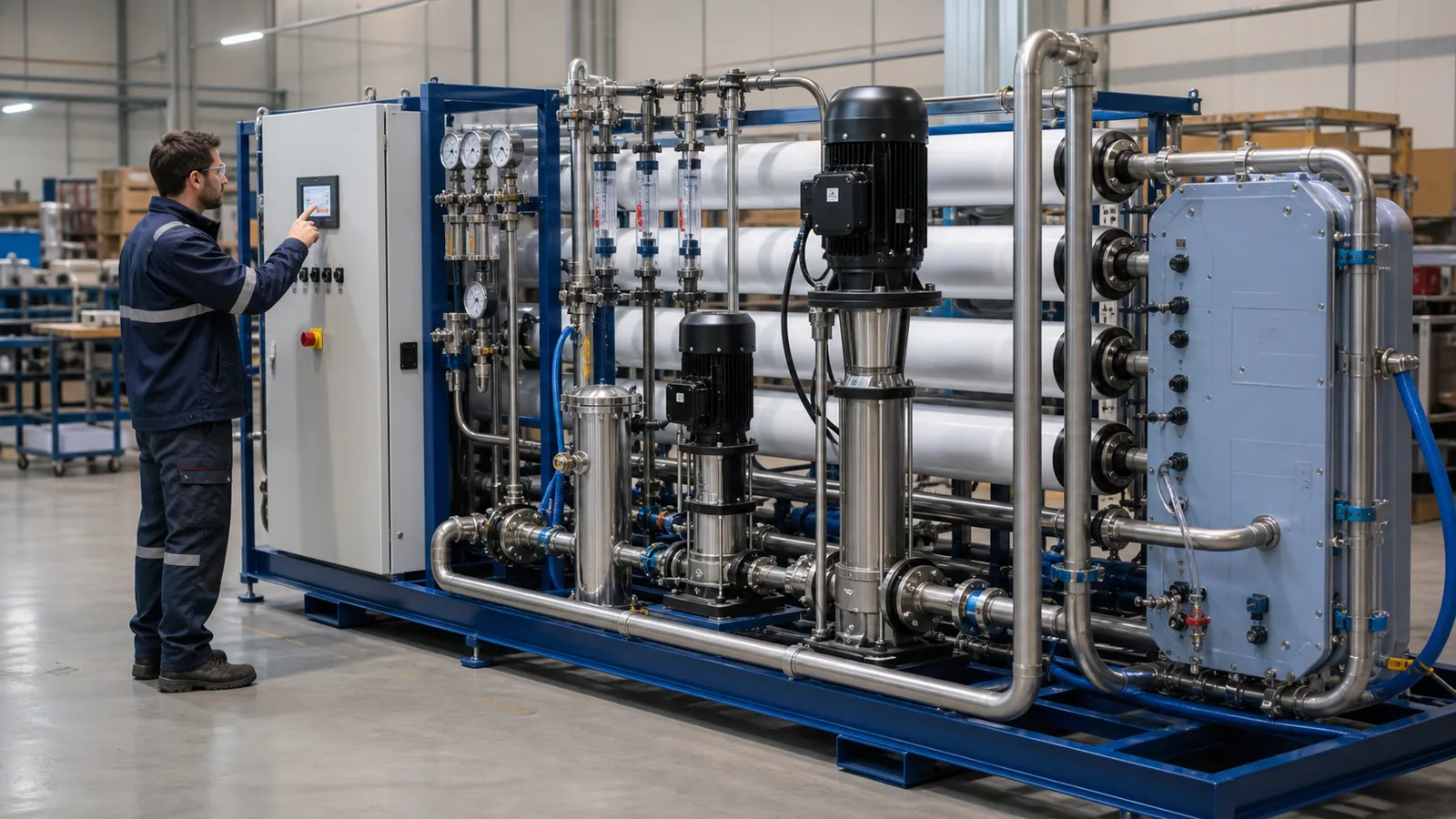
RO uses pressure and semipermeable membranes to reduce a broad range of dissolved ions and other constituents. In boiler makeup treatment, it can lower conductivity, alkalinity, hardness and silica loading before downstream polishing. It also produces a concentrate stream that must have a defined destination.
RO design requires more than a nominal flow rate. The supplier should state the feed conditions, membrane projection, design flux, recovery, number of passes, temperature basis, scaling assumptions, pretreatment, clean-in-place provisions and expected permeate range. A high recovery is not automatically better if it creates unstable scaling risk or an unmanageable concentrate.
Ion-exchange demineralization and mixed-bed polishing
Demineralization uses cation and anion resins to remove dissolved ions. A mixed bed can provide final polishing. These systems can achieve high purity, but chemical regeneration creates acid and caustic handling requirements as well as a regeneration waste stream.
Proposal review should cover resin type and quantity, operating run length, regeneration sequence, chemical concentration, neutralization scope, rinse-water demand, waste volume and the instruments used to verify exhaustion or breakthrough. If regeneration is manual or performed by a third party, that operating model should be explicit.
Electrodeionization
EDI combines ion-exchange media and electrical potential for continuous polishing, normally after RO. It is not a substitute for adequate pretreatment. Feed conductivity, hardness, silica, carbon dioxide, oxidants and organics must remain within the selected module’s operating envelope.
EDI can reduce routine chemical regeneration compared with conventional polishing, but it adds requirements for stable RO permeate, electrical power, concentrate flow and appropriate monitoring. Buyers should ask for the module supplier’s feed limits and the design response if feed quality moves outside them.
Deaeration and internal treatment
Removing hardness and salts does not remove every boiler risk. Dissolved oxygen, carbon dioxide, corrosion products and cycle contamination require separate consideration. Thermal or mechanical deaeration, chemical oxygen control, pH control and internal boiler treatment are part of the larger steam-water chemistry program.
The equipment supplier should not imply that an RO or EDI skid eliminates the need for qualified boiler-water chemistry management. The interface among makeup treatment, deaeration, chemical dosing, blowdown and condensate return must be defined with the boiler and chemical-treatment specialists.
A Practical Selection Framework
| Project condition | Treatment route to evaluate | Questions that decide the route |
|---|---|---|
| Hardness is the main external contaminant and boiler requirements permit softened makeup | Filtration + softening | Does softening meet all boiler/OEM limits? What happens to alkalinity, silica and TDS? |
| Broad dissolved-salt reduction is required | Pretreatment + single- or two-pass RO | What recovery is stable? Is post-treatment required? Where does concentrate go? |
| Very low ionic content is required and chemical regeneration is acceptable | RO and/or ion-exchange demineralization + mixed bed | What is the regeneration frequency, waste route and chemical-handling scope? |
| Continuous polishing with reduced regeneration chemicals is preferred | RO + EDI | Is RO permeate consistently inside EDI feed limits? How are CO₂ and silica managed? |
| Makeup source or condensate quality is variable | Segregation, monitoring, diversion and staged treatment | Which condition controls the design? Can contaminated condensate be isolated? |
This table is a screening tool, not a final design. The final route must be checked against the boiler manufacturer’s requirements, applicable chemistry guidance, full water analysis and mass balance.
How to Size the System Without Using Boiler Tonnage Alone
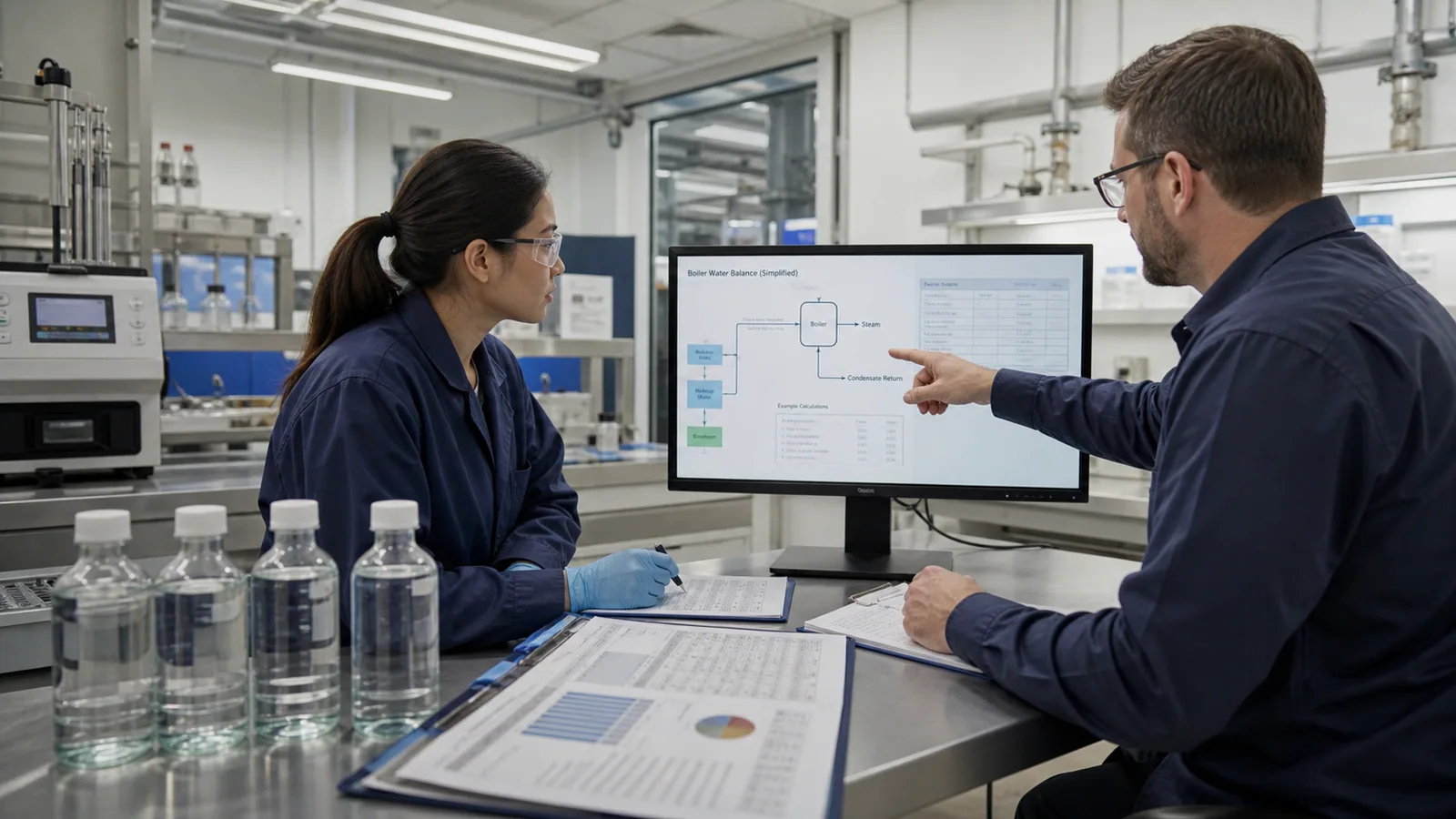
Begin with a water balance. Makeup demand depends on steam exported from the cycle, condensate not returned, blowdown, vents, leaks and other losses. Then review peak demand, refill after shutdown, simultaneous operation and treated-water storage.
The purification system does not always need to match the instantaneous boiler-feed rate. A treated-water tank can allow a smaller system to operate over more hours, but storage also introduces space, hygiene and redundancy considerations. Conversely, an undersized system may force the boiler house to consume stored water faster than it can be replenished during peak production.
For RO, distinguish feed flow, permeate flow and concentrate flow. For ion exchange, distinguish service flow from regeneration flow and define whether another train supplies water during regeneration. For EDI, define product, concentrate and electrode-rinse flows according to the selected module.
Ask each bidder to submit a complete mass balance at normal and design conditions. The balance should reconcile every inlet, product, recycle, drain and waste stream.
Factory Testing, Shipment Inspection and Installation Preparation
Factory testing
Factory testing should verify what can genuinely be demonstrated before site water and the boiler are available. Appropriate checks may include:
- workmanship, tagging and component verification;
- pressure or leak testing according to the agreed procedure;
- pump rotation and clean-water functional checks;
- valve, instrument, alarm and interlock simulation;
- control-panel operation and communication checks;
- calibration-document review;
- review of membrane, resin and chemical-system preservation;
- confirmation of manuals, drawings, spare parts and loose items.
A clean-water factory test does not prove final permeate quality under the customer’s raw water. The acceptance plan should separate factory functional acceptance from site performance acceptance.
Shipment inspection
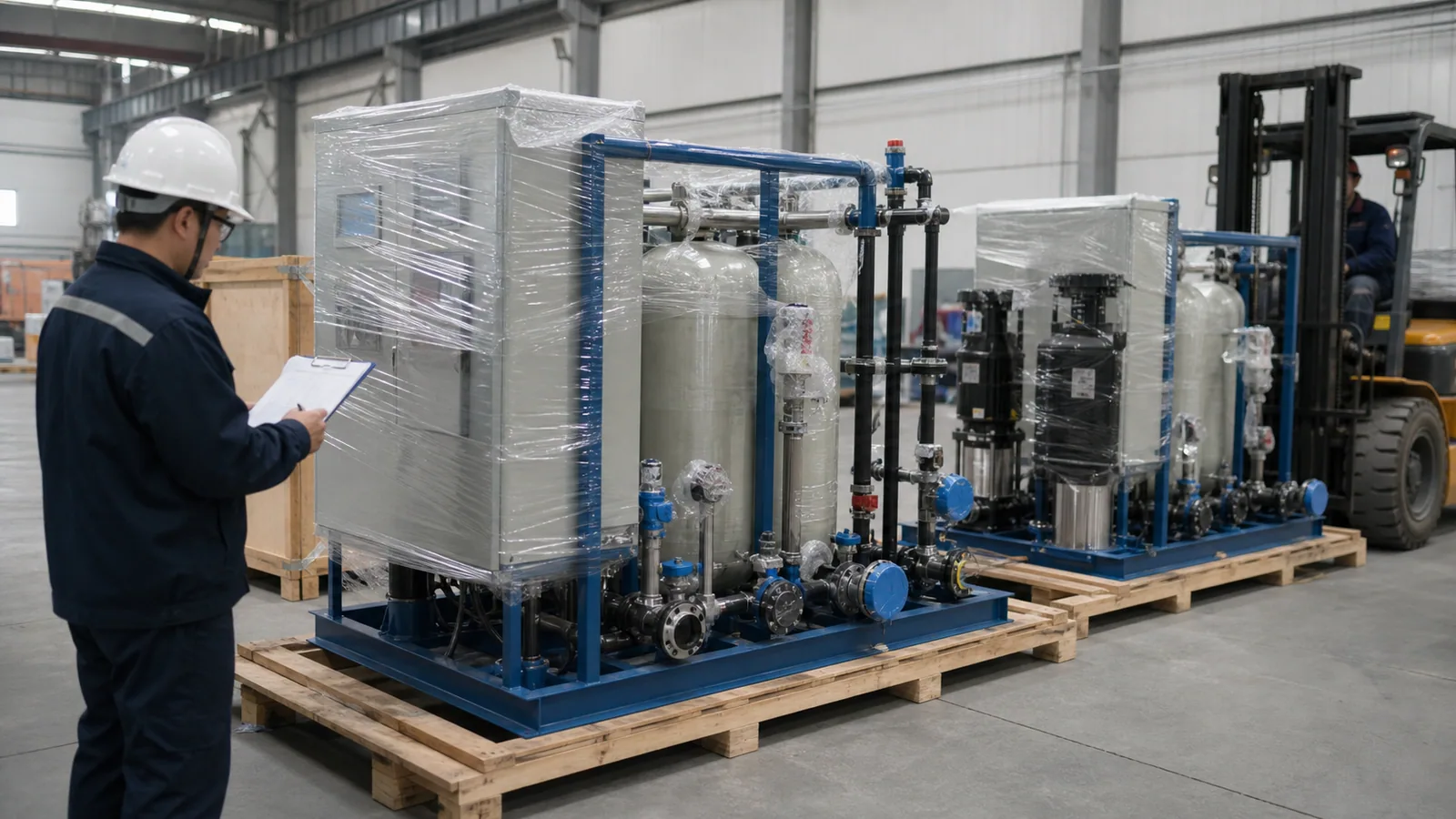
Before shipment, verify that membranes, resins and sensitive instruments are stored or preserved according to their requirements. Connections should be capped, loose parts identified, chemicals excluded unless legally and commercially arranged, and the packing method matched to sea freight, inland transport and storage duration.
Photographs can document module condition, protected openings, identification plates and container loading. These records support delivery control; they should not be presented as proof of treatment performance.
Installation preparation
Before equipment arrives, confirm foundations, drainage, pipe battery limits, electrical supply, ventilation, chemical containment, lifting route, access for membrane or resin replacement, and the availability of raw water for commissioning. The site should also prepare disposal routes for flushing water, RO concentrate and regeneration waste.
What Should Be in a Comparable RFQ?
A useful boiler makeup-water RFQ should include:
- Boiler data sheets and water-quality requirements.
- Steam use and whether product-contact or turbine steam is involved.
- Average and peak steam demand.
- Condensate return percentage, quality and contamination risk.
- Complete source-water reports with variation.
- Required treated-water flow, quality and availability.
- Operating hours, redundancy and storage philosophy.
- Concentrate, backwash and regeneration-waste constraints.
- Site utilities, climate, footprint and installation conditions.
- Destination standards and preferred component specifications.
- Required documentation, testing and acceptance points.
- Clear scope boundaries for tanks, pumps, deaeration and dosing.
Mid-article CTA
Need a boiler makeup-water proposal reviewed? Send the boiler data sheet, source-water analysis, condensate return information, required product-water quality and site utility schedule. Baihuipu can identify missing RFQ inputs and organize a treatment-train discussion around the defined conditions. Send Your Requirements
Common Proposal Mistakes
Treating softened water as demineralized water
Softening addresses hardness but leaves most other dissolved salts in the water. If silica, alkalinity or conductivity drives the boiler requirement, a softener-only proposal may not satisfy the duty.
Promising one permeate value without conditions
RO and EDI performance depends on feed composition, temperature, recovery, membrane age and operating condition. A credible proposal states the design basis and acceptance tolerance.
Ignoring condensate contamination
High condensate return is beneficial only when the return is suitable. The project needs monitoring and a response plan for contamination.
Omitting waste streams
RO concentrate, softener brine, filter backwash, neutralized regenerant and flushing water affect permits, drains and operating cost. They belong in the mass balance and scope table.
Combining factory and site acceptance
Factory tests can confirm assembly and function. Site performance testing confirms water quality and capacity under actual conditions. The contract should distinguish them.
FAQ
Is a water softener enough for boiler feed water?
Sometimes, but only when the boiler manufacturer and chemistry program permit softened makeup and other constituents such as silica, alkalinity and TDS are acceptable. A softener removes hardness; it does not demineralize the water.
When should a boiler makeup system use reverse osmosis?
RO is commonly evaluated when broad dissolved-salt reduction is needed, when raw-water chemistry would create excessive blowdown or scaling risk, or when downstream polishing needs a lower-conductivity feed. Selection still requires pretreatment and concentrate review.
What is the difference between RO and EDI?
RO is a membrane separation step that rejects a broad range of dissolved constituents and creates permeate plus concentrate. EDI is a polishing step normally fed with RO permeate and uses ion-exchange media with an electrical field to remove remaining ions continuously.
Does RO eliminate boiler chemical treatment?
No. RO improves makeup-water quality but does not replace the complete program for oxygen, pH, internal deposition, blowdown and condensate control.
Should the system be sized from boiler capacity?
Boiler capacity is one input. The actual makeup demand depends on steam losses, condensate return, blowdown, operating schedule, storage and peak conditions. A full water balance is required.
What should be tested during the factory acceptance test?
Factory acceptance can verify components, workmanship, leak tests, pumps, instruments, controls, alarms, documentation and clean-water function. Final product-water quality normally requires site water and site commissioning.
What data should a supplier guarantee?
Any guarantee should name the feed-water envelope, temperature, required flow, product-quality parameters, recovery, operating state, test method and acceptance duration. Avoid unconditional values disconnected from the design basis.
Conclusion
The best boiler feed water treatment system is not automatically a softener, RO skid, demineralizer or EDI package. It is a defined treatment train that connects actual source water and condensate conditions to the boiler and steam requirements while accounting for every waste stream, utility and operating responsibility.
Buyers can reduce proposal risk by requiring a water balance, technology-role explanation, boundary table, factory test plan and separate site acceptance criteria. This makes competing offers easier to compare and prevents a nominally complete system from arriving with unresolved chemical, drainage or performance assumptions.
Final CTA
Planning a boiler feed water or boiler makeup-water system? Send your water analysis, boiler requirements, capacity, condensate return, utility conditions and project location. Contact Baihuipu to prepare a technical RFQ review or request the relevant product information.