Introduction
“Pure water” is an imprecise purchasing term. In a food factory it may refer to water used as a product ingredient, water used to rinse fresh produce, final-rinse water for food-contact equipment, or utility water that never touches the product. These duties do not necessarily need the same quality or the same treatment train.
This distinction matters because purchasing an RO skid alone does not establish a safe water system. The feed source, pretreatment, product-water tank, piping, point-of-use condition, cleaning practices, operator controls, and verification program can all affect the water delivered to production.
Codex guidance treats water safety in food production as a risk-based question: water should be fit for its intended purpose, and water used as an ingredient should be potable. The U.S. food manufacturing regulation in 21 CFR 117.37 similarly requires water that contacts food, food-contact surfaces, or food-packaging materials to be safe and of adequate sanitary quality. These references are useful frameworks, but the project must still comply with the rules and competent authority in the country where the plant operates.
This guide explains how a B2B buyer can define the water duty, select a technically justified treatment route, evaluate an RO proposal, and prepare factory and site acceptance requirements without relying on vague claims such as “food-grade pure water.”
Start with Intended Use, Not a Generic Purity Label
The first step is to map every water user and classify its relationship with the product.
Water used as an ingredient
When water becomes part of a beverage, sauce, brine, prepared food, or another product, its safety, taste, mineral balance, and consistency may affect both consumer protection and product quality. Codex states that water used as an ingredient should be potable. The product owner should also define any tighter chemistry or sensory requirements created by the formulation.
Water that directly contacts food
Examples include washing fresh produce, rinsing raw materials, conveying food, making ice, and final rinsing of food-contact surfaces. The plant’s food-safety team should evaluate microbiological, chemical, and physical hazards, the possibility of cross-contamination, water reuse, contact time, temperature, and the process step that follows.
Water for non-product-contact duties
Cooling, floor cleaning, boiler feed, landscape irrigation, or other utilities may have different specifications. Combining all duties under one “potable pure water” requirement can oversize the treatment system and increase operating cost. It can also create unnecessary storage and residence time.
Prepare a water-use map that identifies each user, the required quality at that user, normal and peak flow, operating schedule, and whether the water enters, contacts, or remains separate from the food. This gives suppliers a defensible design basis.
Confirm the Regulatory and Acceptance Boundary
There is no single international equipment configuration that automatically makes water potable. Compliance is assessed against the applicable water-quality requirements, food-production rules, approved analytical methods, and local authority expectations.
WHO’s drinking-water guidelines provide a health-based framework covering microbial, chemical, radiological, and acceptability considerations. WHO also promotes water safety plans that manage risks from source to consumer. Codex CXG 100-2023 applies similar risk-based thinking to the safe use and reuse of water in food production and processing.
Before requesting quotations, confirm the installation jurisdiction, applicable criteria, source-water type, regulatory responsibility, contractual sampling point, analytical method, laboratory, and whether the supplier’s responsibility ends at the RO outlet, product-water tank, loop return, or each point of use.
This boundary prevents a common dispute: an equipment supplier may verify RO performance at the skid outlet, while the buyer expects a potability guarantee after a storage tank and piping system supplied by others.
Build the Design Basis from Representative Source-Water Data
A treatment route should be calculated from representative water analysis and expected variation. A single conductivity reading is not enough.
The analysis should normally cover parameters relevant to health requirements, membrane operation, scaling, fouling, taste, corrosion, and disinfection. Depending on the source and jurisdiction, these may include:
- turbidity and suspended solids;
- pH, temperature, conductivity, total dissolved solids, and alkalinity;
- hardness, calcium, magnesium, silica, iron, and manganese;
- chloride, sulfate, nitrate, fluoride, and other regulated ions;
- free chlorine or another residual disinfectant;
- total organic carbon or identified organics when relevant;
- microbiological indicators required by the applicable standard;
- any source-specific contaminants identified by the water-risk assessment.
Use data from an appropriate sampling location and season. Groundwater chemistry can change with the well or operating pattern; municipal water can vary with source blending and disinfection; surface water can change rapidly with weather. The design should state which ranges are guaranteed and which conditions require further testing or a treatment adjustment.
Demand information is equally important. Provide average and peak hourly flow, batch volumes, shifts, simultaneous users, planned expansion, and acceptable interruption. A plant using 20 cubic metres per day in short cleaning and production batches needs a different hydraulic design from a plant drawing the same volume continuously.
How to Select a Practical Treatment Train
The correct treatment route is the shortest train that reliably controls the identified hazards and produces the required quality across the design envelope. More equipment is not automatically safer.
1. Source protection and preliminary treatment
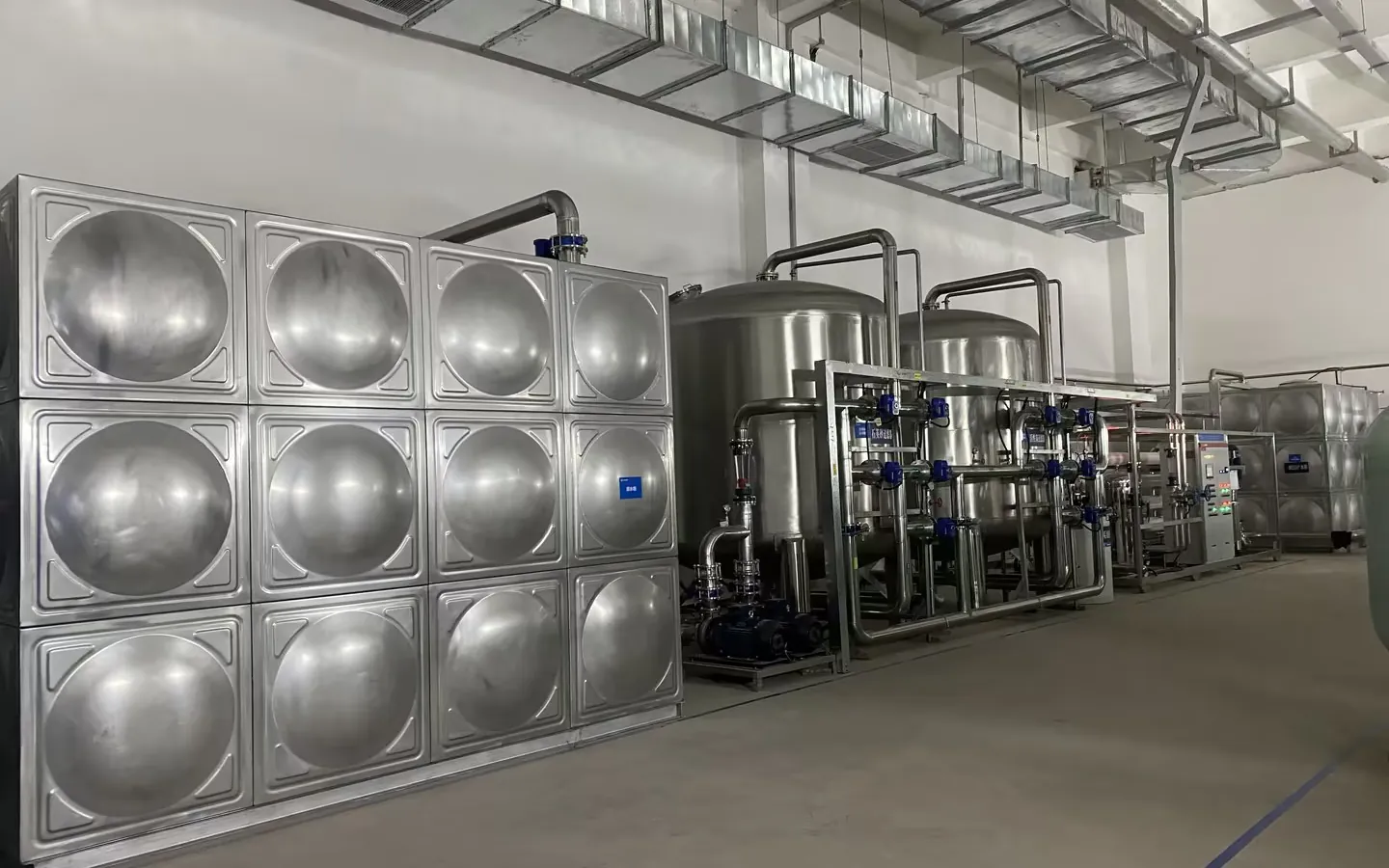
The treatment plan begins before the RO skid. Source protection, a protected raw-water tank, screening, clarification, or another preliminary barrier may be required where the incoming water is variable. The plant should prevent contamination through tank vents, overflows, drains, temporary hoses, and cross-connections.
2. Filtration and membrane protection
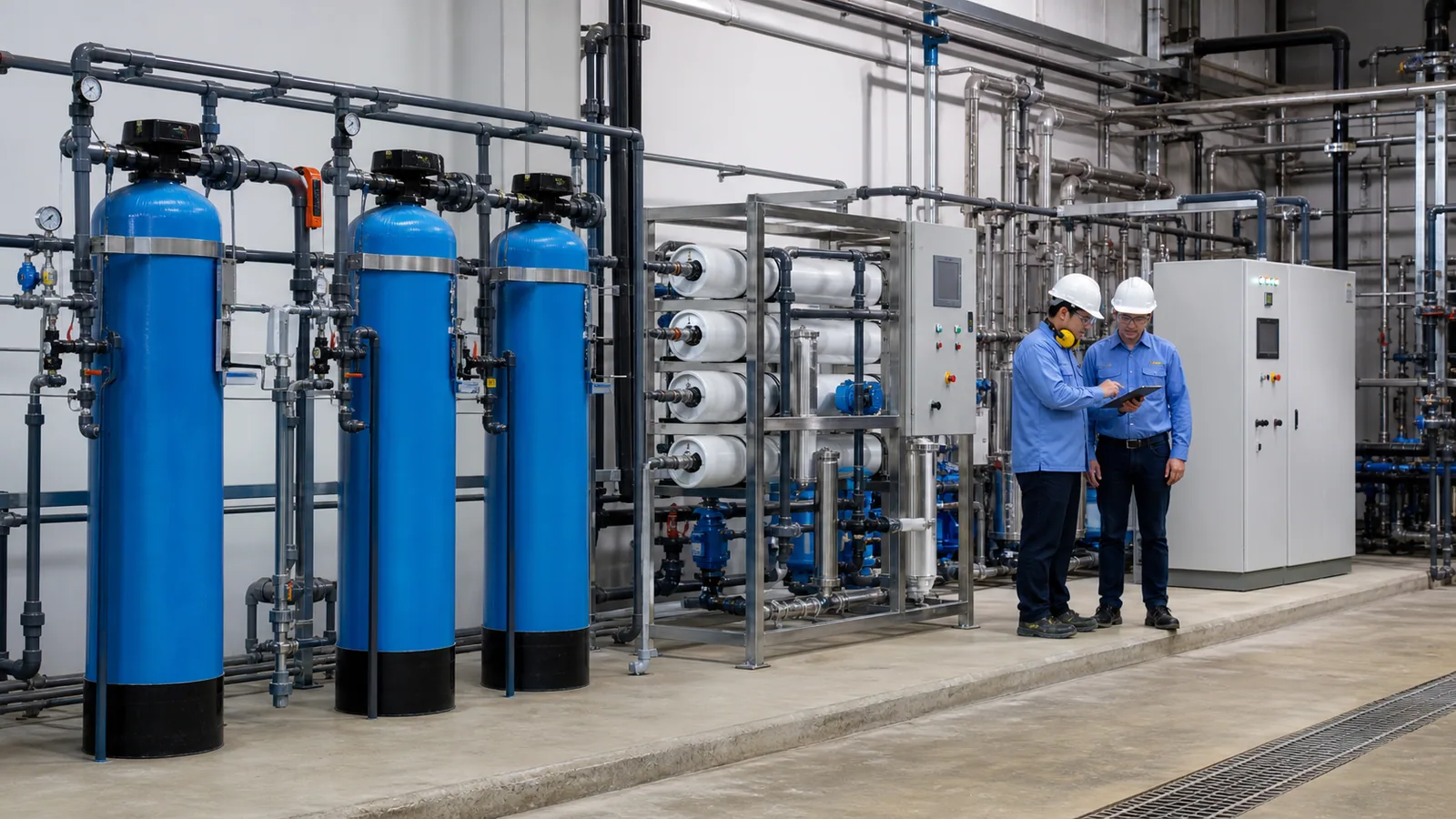
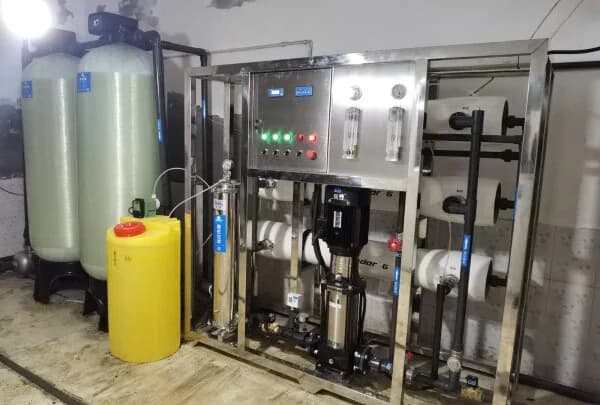
Pretreatment may include multimedia filtration or ultrafiltration, activated carbon, softening, antiscalant dosing, pH adjustment, and cartridge filtration. Each stage should have a stated purpose.
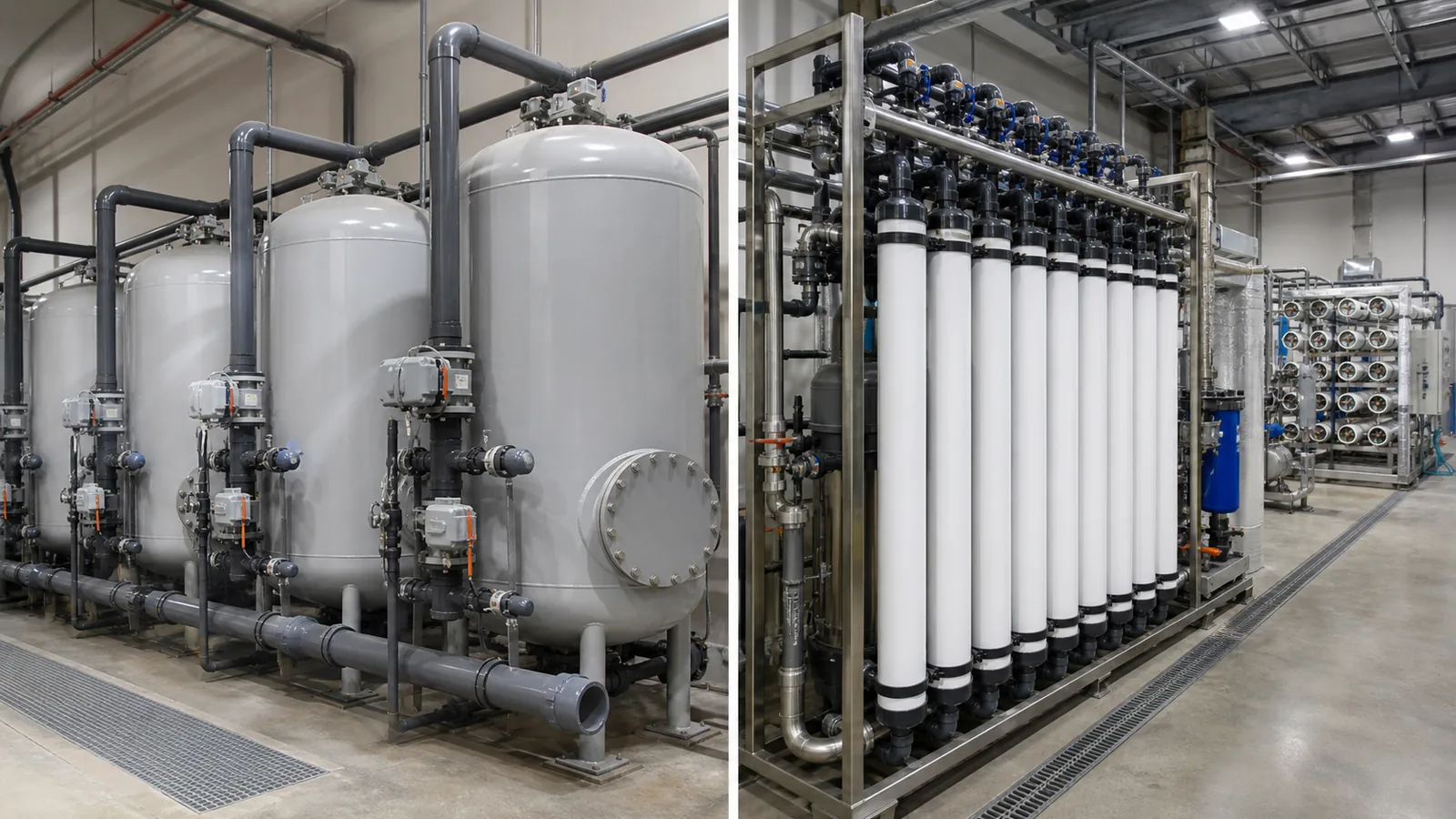
Multimedia filtration can reduce suspended solids when the source is suitable. Ultrafiltration provides a more defined particulate barrier but adds cleaning, backwash, chemical, and reject requirements. Activated carbon can remove chlorine and some organics, but it also needs microbiological control. Select softening or antiscalant from the scaling calculation and recovery target.
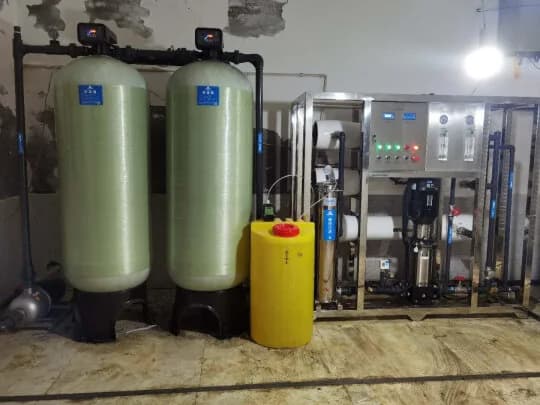
The supplier should explain why each component is included, how it is monitored, how it is cleaned, and what happens when its performance moves outside the operating limit.
3. Reverse osmosis
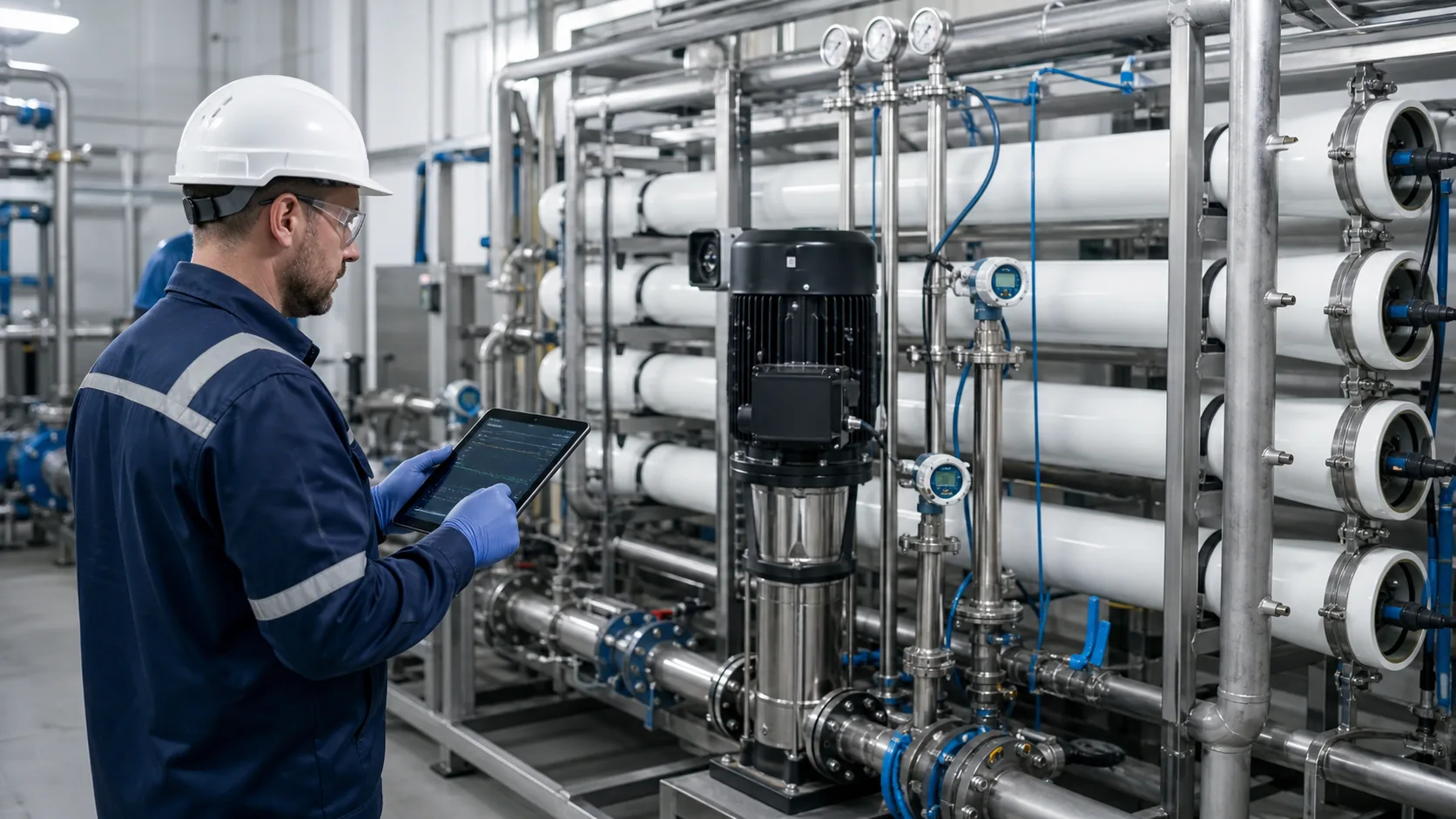
The U.S. EPA describes RO and nanofiltration as technologies capable of removing a broad range of contaminants. RO can be an effective main desalting step when the source contains excessive dissolved salts or other constituents within the membrane’s treatment capability.
RO is not required for every food factory. If an approved municipal supply already meets the intended-use requirements and the process does not need further mineral reduction, filtration and a validated hygienic control strategy may be sufficient. Conversely, a difficult groundwater source may need specific pretreatment or another barrier before RO.
For an RO proposal, request:
- membrane model and design basis;
- feed-water limits and temperature range;
- design flux, recovery, staging, and concentrate flow;
- scaling and fouling assumptions;
- normal pressure and power requirement;
- normalized permeate flow and quality expectations;
- flushing, preservation, cleaning, and sanitization provisions;
- instrumentation, alarms, and low-quality diversion logic;
- the destination and management of RO concentrate.
RO can also change finished-water chemistry. EPA notes that membrane treatment can lower pH and may require post-treatment for corrosion control. Where water is consumed or enters a product, the owner should evaluate stability, taste, mineral balance, and compatibility with tanks, piping, and the food formulation rather than pursuing the lowest possible conductivity without a reason.
4. Disinfection and final microbial control
RO membranes are not a complete microbial management program. UV, chlorination, ozone, heat, final filtration, or another control may be used depending on the source, distribution system, intended use, local requirements, and validation plan.
Each option has trade-offs. A disinfectant residual can protect distribution but may affect taste, product chemistry, materials, or downstream membranes. UV adds no residual and therefore cannot protect an unhygienic tank or stagnant branch after the reactor. Final filters require integrity and replacement controls. The correct approach combines barriers with a cleanable system and monitoring; it is not selected from a universal equipment checklist.
Hygienic Storage and Distribution Are Part of the System
Water that meets a specification at the RO outlet can deteriorate in storage and distribution. The product-water tank and piping therefore belong inside the hazard analysis and acceptance discussion.
Review the tank’s material, internal finish, cover, vent protection, overflow, level control, drainability, access for inspection, and cleaning or sanitization method. Confirm whether a tank is genuinely needed and size it from the demand profile. Excessive storage may increase residence time and microbial risk.
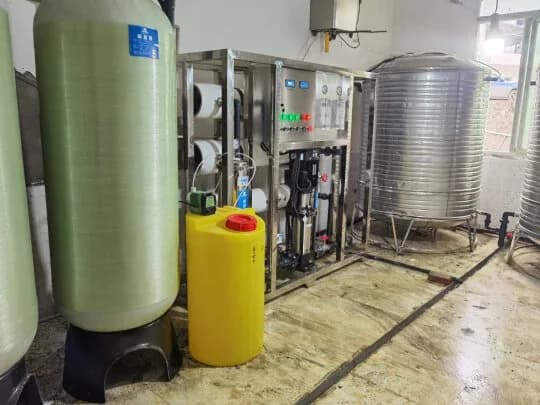
The distribution design should address compatible materials, recirculation where required, simultaneous-user pressure and flow, stagnant branches, backflow prevention, separation from non-potable systems, representative sampling, drainage, sanitization, and off-spec diversion after shutdown.
21 CFR 117.37 specifically addresses safe water supply and plumbing practices, including avoiding backflow and cross-connections. Even where U.S. rules do not apply, these are useful design questions for a food-processing facility.
Monitoring Does Not Replace Verification
Online instruments help operators see process condition, but a conductivity display alone cannot prove that water is potable. Microorganisms and many specific contaminants are not defined by conductivity.
A practical monitoring plan may include source and product flow, pressure, differential pressure, temperature, conductivity, pH, disinfectant residual or oxidation-reduction potential where applicable, UV intensity, tank level, and alarms. Select only instruments tied to a control decision.
For each critical instrument, define range, accuracy, calibration, alarm limit, response, and data recording. The laboratory plan should then verify the chemical and microbiological parameters required by the applicable standard and the facility’s risk assessment. Sampling points, flushing method, container, transport time, and laboratory method can materially change the result.
The buyer should ask the food-safety team to integrate the water system into the facility’s hazard analysis, sanitation program, corrective-action procedure, and periodic review. WHO’s water safety plan approach is useful because it treats safe water as a managed system rather than a one-time test certificate.
Capacity, Recovery, and Reject-Water Planning
Size the plant from a time-based demand profile. Storage can buffer peak use, but it must be balanced against hygiene, cleaning, space, and production-continuity requirements. Confirm the net product flow after flushing and internal consumption rather than comparing only nominal membrane capacity.
Ask each supplier for a complete water balance covering:
- usable product water;
- filter backwash;
- RO concentrate;
- flushing and sanitization water;
- sampling and drain losses;
- any recovery stream proposed for another approved use.
There is no universally correct RO recovery. It depends on feed chemistry, temperature, pretreatment, membrane staging, concentrate limits, and operating philosophy. A high recovery claim can increase scaling risk and cleaning frequency. The destination of concentrate must be compatible with local discharge, wastewater-treatment, or approved reuse conditions.
Factory Testing, Shipment Inspection, and Installation Preparation
Factory testing can confirm the equipment supplied, but it should not be presented as a final drinking-water certificate for the customer’s site.
A factory acceptance test may check equipment identity and configuration, materials and components, controls and interlocks, pump and valve operation, appropriate pressure or circulation tests, membrane documentation and preservation, drawings, manuals, spare parts, and the packing list.
The test water at the factory may differ from the customer’s source water. Final water quality also depends on the installed tank, distribution piping, sanitation, operating load, sampling, and laboratory method. These conditions belong in site commissioning and performance acceptance.
Shipment inspection should verify capped connections, protected instruments, membrane preservation, identified loose items, and suitable lifting and packing. Installation preparation should confirm access, clearance, foundations, power, water and drain interfaces, chemical handling, sampling, and commissioning utilities.
Define Site Commissioning and Acceptance Before Purchase
A clear acceptance plan separates four stages:
- Mechanical completion: verify installation, wiring, piping, labels, calibration status, drainage, and safety items.
- Wet commissioning: test flows, pressures, levels, alarms, interlocks, flushing, and automatic sequences.
- Cleaning, sanitization, and stabilization: prepare the tank and distribution system, then operate until agreed conditions are stable.
- Performance and quality verification: test capacity and water quality at the contractual sampling point under the agreed feed-water and operating envelope.
The protocol should state source-water limits, temperature, net flow, test duration, recovery definition, sampling points, laboratory method, acceptance criteria, retest rules, and responsibility for utilities and operators.
If the supplier’s contract ends at the RO skid outlet, do not describe that test as proof of quality at a remote production tap. If the supplier is responsible for the tank and loop, include representative points of use and the loop return in the agreed verification plan.
Ten Questions to Ask Every Supplier
Use the same questions when comparing bids:
- Which water uses and applicable quality requirements form the design basis?
- Which source-water values are confirmed, and which are assumptions?
- Why is each pretreatment stage necessary?
- Is RO required for this duty, and what does it remove under the stated conditions?
- What product-water quality is expected, and at which sampling point?
- How are disinfection, tank hygiene, shutdowns, and restart managed?
- What is included in storage, distribution, instrumentation, and laboratory sampling?
- How are backwash, concentrate, flushing water, and chemicals managed?
- What can be demonstrated during factory testing, and what requires site testing?
- What civil works, utilities, installation, commissioning, consumables, and compliance activities remain the buyer’s responsibility?
A lower quoted price may represent a different water-quality boundary, tank and distribution scope, recovery, redundancy, monitoring level, or commissioning responsibility. Compare the complete delivery and acceptance scope before comparing equipment price.
FAQ
Is RO water automatically safe to drink?
No. RO can remove many dissolved contaminants, but potability depends on the complete water system and verification against the applicable requirements. Source hazards, pretreatment, membrane condition, disinfection, storage, distribution, sampling, and laboratory results must all be considered.
Does every food-processing plant need reverse osmosis?
No. The decision depends on source-water quality and the intended use. An approved supply may need only targeted conditioning and hygienic control, while another source may require filtration, softening, RO, disinfection, or additional barriers. Select treatment from the risk and quality gap, not from an industry label.
What water-quality standard should be written into the RFQ?
Use the legal and regulatory requirements for the installation country plus any product-specific limits defined by the food manufacturer. State the sampling point and analytical method. WHO and Codex provide useful frameworks, but they do not replace local compliance review.
Is UV required after RO?
Not in every system. UV may be one microbial-control barrier, but it provides no residual protection after the reactor. Its need and location should be decided together with tank hygiene, distribution design, shutdown pattern, sanitization, and verification requirements.
How often should potable process water be tested?
There is no universal schedule for every plant. Frequency should follow applicable regulations, source risk, intended use, process controls, facility history, and the water-safety or food-safety plan. Online monitoring and laboratory verification serve different purposes.
What information is needed for a reliable quotation?
Provide the intended uses, source-water report and expected variation, applicable quality criteria, average and peak flow, batch pattern, operating hours, point-of-use pressure, storage and distribution scope, disinfection strategy, utilities, footprint, reject-water route, automation interface, documentation, destination, and acceptance method.
Conclusion
A potable process-water system for food manufacturing is not defined by an RO skid or a low conductivity number. It is defined by intended use, source risk, applicable requirements, treatment barriers, hygienic storage and distribution, monitoring, operating procedures, and verification at the agreed point of use.
For procurement, begin with a water-use map and representative source analysis. Ask suppliers to explain every treatment stage, disclose assumptions, show the complete water balance, and separate factory equipment checks from site water-quality acceptance. This creates a specification that can be compared fairly and operated responsibly after commissioning.
Related Buyer Resources
- Food & Beverage Water Treatment Solutions
- Ultrafiltration vs Multimedia Filter for RO Pretreatment
- RO Membrane Cleaning vs Replacement
- Ultrapure Water Systems
- Browse Water Treatment Systems
References
- WHO — Guidelines for drinking-water quality: fourth edition incorporating the first, second and third addenda
- Codex Alimentarius — Guidelines for the Safe Use and Reuse of Water in Food Production and Processing (CXG 100-2023)
- Electronic Code of Federal Regulations — 21 CFR 117.37 Sanitary facilities and controls
- U.S. EPA — Overview of Drinking Water Treatment Technologies
- WHO — Water safety plan manual, second edition