Introduction
Battery manufacturing wastewater should not be designed around the word “battery” alone. The correct treatment route depends on the battery chemistry, the production stage, the chemicals used, the way water is collected, and the required destination for treated water. A plant producing lithium-ion cells, a cathode-material facility, and a lead-acid battery factory can all generate very different wastewater.
Why Battery Wastewater Requires a Stream-by-Stream Design
The U.S. EPA describes battery manufacturing as a group of processes involving electrodes, electrolytes, cell components and associated washing or ancillary operations. Its regulated pollutant lists vary by battery subcategory and include several metals, suspended solids, oil and grease, COD and pH. This is an important procurement lesson: the contaminant list is not universal, even within one industry.
For a new project, the first engineering question is therefore not “Which machine treats battery wastewater?” It is “Which process creates each wastewater stream, and what is in it?”
A useful source map may include:
- raw-material or precursor preparation areas;
- electrode or component washing;
- product and equipment rinsing;
- acidic or alkaline cleaning solutions;
- wet scrubber blowdown;
- cooling or utility water discharges;
- floor and maintenance wash water;
- laboratory wastewater;
- membrane concentrate or regeneration waste from existing water systems;
- off-spec batches and concentrated spent solutions.
Not every factory has every stream. The map must be based on the actual production process and chemical inventory.
Which Parameters Should a Buyer Test?
An RFQ should include original laboratory reports where available, not only a short list copied into an email. Sampling dates, source points and operating conditions matter because a result from normal production may not represent cleaning, changeover or an off-spec event.
Core hydraulic and physical information
Provide average daily flow, peak hourly flow, batch volumes, discharge duration, temperature, pH range, conductivity or TDS, TSS and visible oil or solids. State whether the plant operates continuously, by shift or by campaign.
Metals and process-specific ions
The relevant metals depend on chemistry and process. Nickel, cobalt, manganese, lithium, copper, aluminum, iron, zinc, lead, cadmium, chromium or other elements may be relevant in different facilities. Do not request a generic “heavy metals” number only; specify the individual analytes that correspond to the materials used on site.
Fluoride, phosphate, sulfate, chloride, ammonia or other ions may matter where the production chemistry indicates them. Their importance may relate to discharge, scaling, reuse, biological inhibition, corrosion or downstream concentration.
Organic load and treatability
COD, BOD, TOC, oil and grease, surfactants and identified solvents help define the organic load. A COD result does not show whether the organics are biodegradable, volatile, inhibitory or refractory. If solvent-related or concentrated organic streams exist, confirm whether they belong in the aqueous treatment plant at all. Recovery, controlled collection or specialist disposal may be more appropriate than dilution into wastewater.
Chemicals that alter metal removal
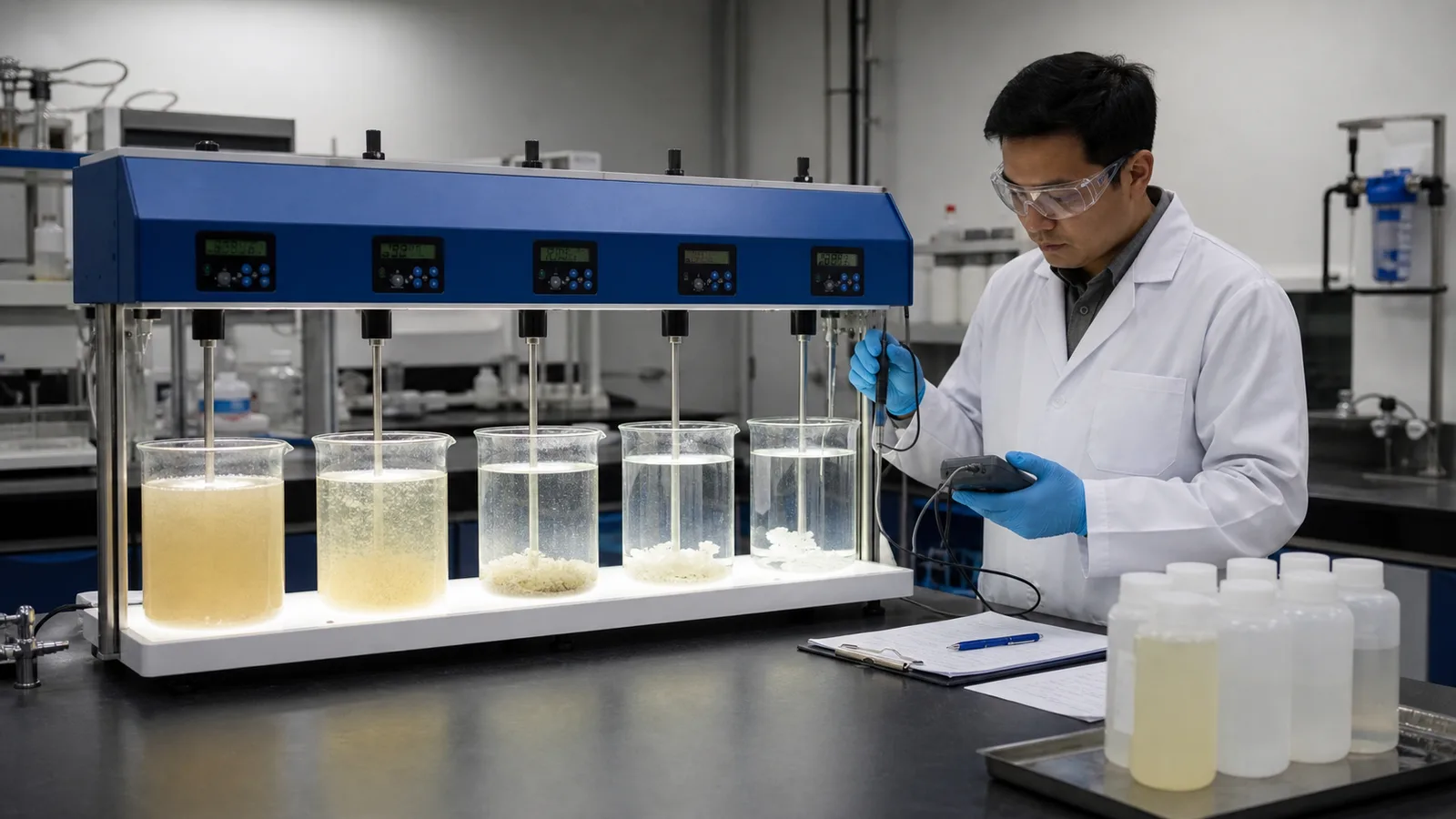
Chelating agents, complexing agents, dispersants and certain surfactants can keep metals soluble or change flocculation. Their presence may explain why a simple pH adjustment performs well in a theoretical calculation but poorly in a jar test.
A Practical Treatment-Route Decision Framework
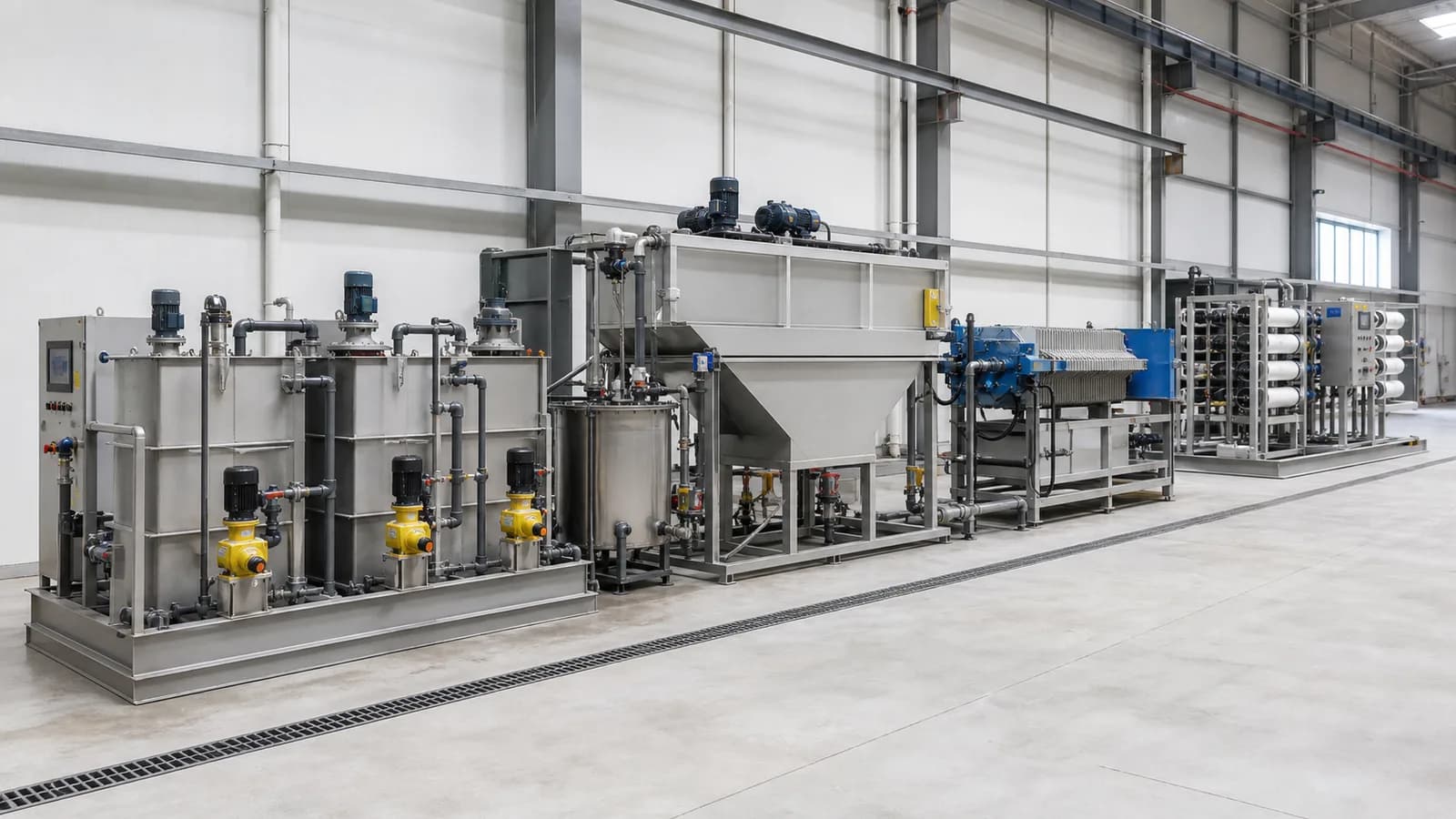
The stages below are process roles, not a fixed standard package. A defensible proposal should state which contaminant or operating risk each stage addresses.
1. Source segregation and controlled collection
Separate incompatible or disproportionately strong streams before they enter a common equalization tank. This can reduce chemical consumption, protect biological treatment and keep recovery options open.
At minimum, review whether the following should remain separate:
- strong acids and strong alkalis;
- concentrated metal-bearing liquids and dilute rinses;
- fluoride-bearing and non-fluoride streams;
- solvent-related or high-COD batches;
- oily wash water;
- relatively clean cooling or utility water;
- membrane concentrate and regeneration waste.
Segregation is not automatically the same as building a complete treatment line for every drain. The aim is to retain enough control to route each stream safely and economically.
2. Equalization, transfer and pH management
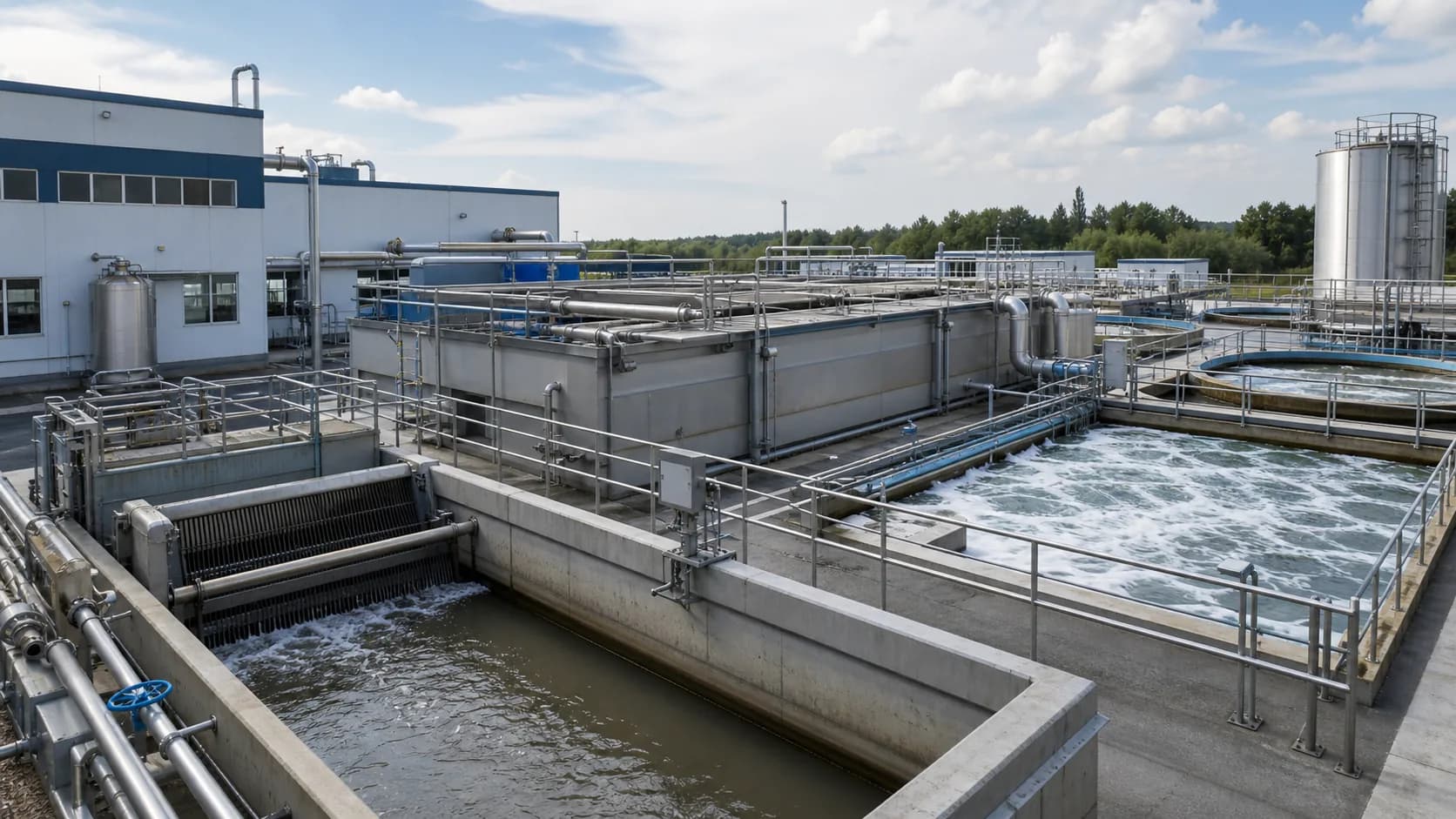
Equalization dampens flow and concentration peaks, but the tank must be sized around the real batch schedule. Mixing, ventilation, level control, compatible materials and emergency capacity should be reviewed. If reactions can occur during blending, the design needs an explicit chemical and safety assessment.
Neutralization prepares water for downstream precipitation or biological treatment. It is not, by itself, proof that dissolved metals or fluoride have been removed.
3. Metals precipitation and solids separation
Chemical precipitation commonly converts dissolved metals into removable solids. Reagent choice and operating pH depend on the metal species, complexing chemistry and target. Coagulation or flocculation may then improve separation by clarification, lamella settling, flotation, filtration or another solids-removal step.
EPA guidance for battery manufacturing identifies chemical precipitation, sedimentation and filtration among established treatment roles. However, a supplier should not promise a universal metals result from a generic pH setpoint. Jar testing across realistic water conditions is more useful.
The process must also include sludge thickening, dewatering, storage and a lawful disposal or recovery route. Treatment transfers metals from water into solids; it does not eliminate them.
4. Fluoride treatment where applicable
Where fluoride is confirmed, precipitation and solids separation may be evaluated. Performance depends on influent concentration, competing ions, reagent dose, pH, reaction time and the final limit. Low residual targets can require polishing beyond bulk precipitation.
Fluoride treatment also produces sludge and may add dissolved salts. Those consequences should be included in membrane and ZLD calculations.
5. Organic treatment: biological, oxidation or separation
Biological treatment may be appropriate for biodegradable aqueous organics after inhibitory metals, solvents, extreme pH and salinity are controlled. The decision should use BOD/COD relationships, respirometry or other treatability evidence rather than COD alone.
Advanced oxidation can be evaluated for selected refractory organics, toxicity reduction or polishing. It is not automatically an economical way to destroy all COD. Oxidant demand, scavengers, residual chemicals and reaction by-products should be tested.
Activated carbon, separation, recovery or off-site management may be more suitable for particular organics. The process should follow the identified compound and final target.
6. Membrane polishing and water reuse
Ultrafiltration, nanofiltration, reverse osmosis, ion exchange or other polishing can support reuse when the reuse specification requires them. Before RO, control suspended solids, precipitated metals, hardness, silica, organics, oil and biological activity as relevant.
RO creates permeate and concentrate. A high permeate recovery is not a complete answer if the concentrate has no permitted or practical destination. The proposal should show mass balance, expected concentration factors, antiscalant assumptions, cleaning strategy, off-spec water handling and the residual route.
Define the reuse point first. Water for equipment washing, cooling makeup, process rinsing or high-purity production has different requirements. “Reusable water” is not a single specification.
7. Concentration, evaporation and ZLD
Evaporation may be considered when discharge options are constrained or when concentrate volume must be reduced. It usually follows upstream removal of substances that cause severe scaling, corrosion, foaming or volatile carryover.
Zero liquid discharge means the liquid pathway and final solids management are both defined. It should not be presented as a label attached to an evaporator. The owner still needs an acceptable route for salt, sludge, cleaning waste and any mother liquor or off-spec residual.
How to Compare Supplier Proposals
Two proposals can contain similar equipment names yet have very different technical quality. Compare the assumptions behind them.
Require a water and contaminant mass balance
The proposal should show major inlet streams, treated-water flow, membrane concentrate, sludge, evaporation feed, distillate and final residuals. Ask where each contaminant is expected to go.
Check the design basis
Confirm average and peak flows, batch timing, design concentrations, temperature, recovery, operating hours and target water quality. If values are missing, they should be marked as assumptions, not silently treated as facts.
Review chemical and residual consumption
Ask for indicative chemical roles, expected sludge production methodology, membrane-cleaning waste, filter backwash and concentrate volumes. Exact consumption may require tests, but the proposal should disclose what drives it.
Verify materials of construction
Materials should reflect pH, chlorides, fluoride, temperature, oxidants, solvents and concentration. Stainless steel is not one universal corrosion solution. Review wetted parts, tank linings, seals, piping and instruments.
Define battery limits and site interfaces
Clarify who provides civil tanks, foundations, interconnecting piping, chemical storage, ventilation, power, compressed air, clean water, drainage, lifting and commissioning support. International projects often encounter delays at these interfaces rather than inside the treatment skid.
Treatability Testing and Pilot Work
Testing should answer a specific design question.
Jar tests can compare neutralization, precipitation, coagulation and settling. Filtration tests can assess solids behavior. Respirometry or biodegradability work can evaluate inhibition. Membrane trials can show flux, rejection, fouling and cleaning response. Evaporation testing can reveal scaling, foaming, boiling-point effects, condensate quality and material concerns.
Use representative samples from defined sources. A single blended sample collected after an unusual production day may produce misleading conclusions. For variable operations, test normal, high-load and cleaning conditions separately.
Factory Testing, Shipment Inspection and Installation Preparation
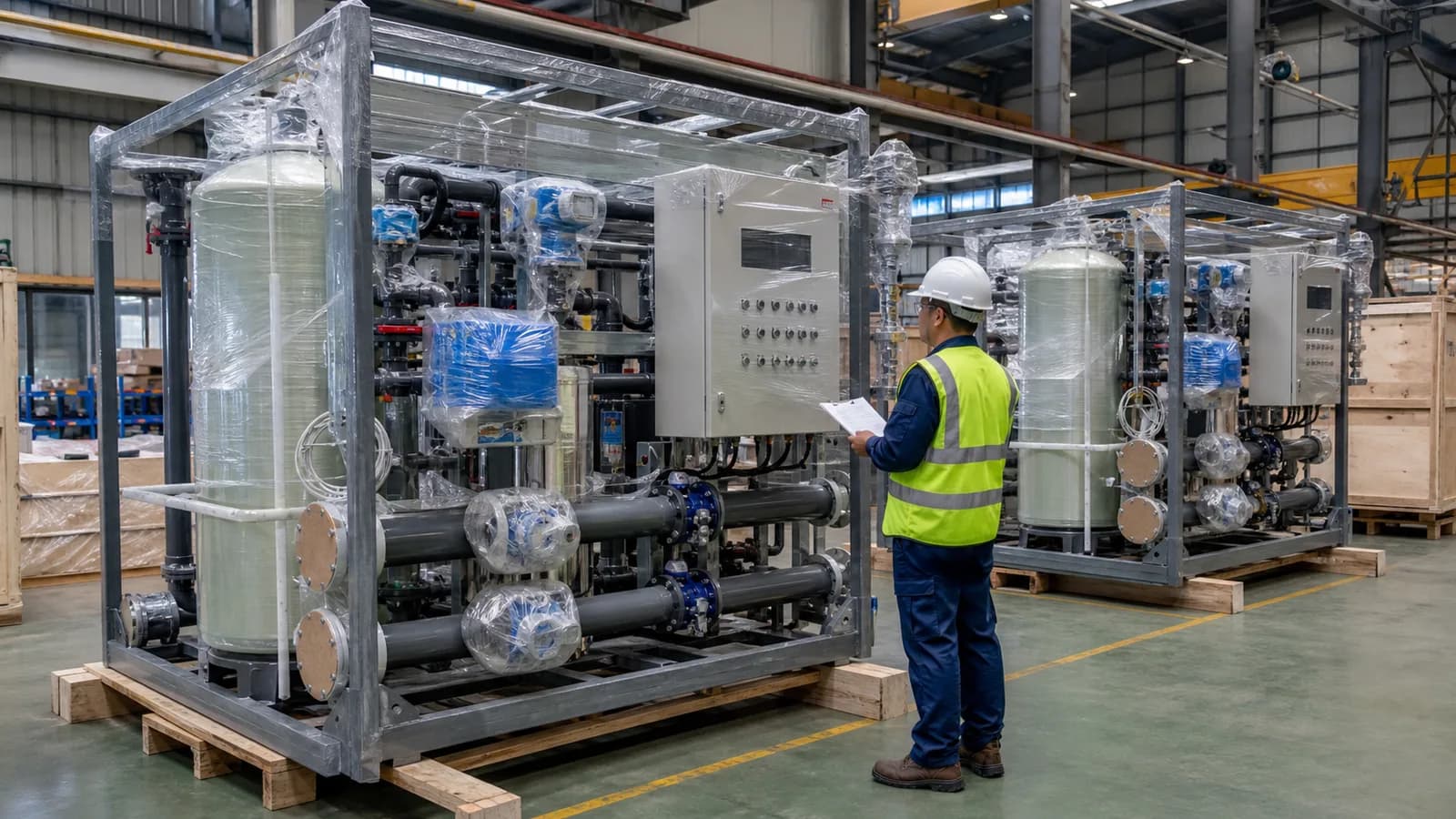
Factory testing should verify what can be verified before wastewater is available: equipment identity, dimensions, materials documentation, pump rotation, valve operation, instruments, controls, alarms, clean-water circulation where applicable, electrical checks and document completeness.
Clean-water factory testing does not prove battery wastewater treatment performance. Site performance depends on actual water, chemicals, operating conditions and biological acclimation where relevant.
Shipment inspection should check preservation, capped openings, loose parts, membrane storage requirements, chemical compatibility of temporary preservatives, lifting points, packing lists and export packaging.
Before installation, confirm foundations, access, drainage, ventilation, utility quality, power supply, chemical unloading, operator safety, sludge removal and the route for off-spec water. A compact skid still requires service clearance and removal paths.
Commissioning and Performance-Acceptance Planning
Commissioning should be divided into mechanical completion, wet commissioning, process start-up and performance testing. During mechanical completion, verify installation, electrical continuity, rotation, lubrication, piping cleanliness, instrument calibration and safety interlocks. Wet commissioning confirms flows, levels, dosing response, alarms and control sequences using clean water or an agreed safe fluid.
Process start-up begins only when representative wastewater, chemicals, residual containers, trained operators and laboratory support are available. If biological treatment is included, allow for biomass seeding and acclimation. Membrane performance should not be judged before upstream chemistry and solids control are stable.
Performance acceptance needs written boundary conditions. Define the feed-flow range, influent concentration envelope, temperature, operating hours, chemical quality, required operator actions and sampling method. State whether compliance is based on a daily composite, grab sample or another agreed protocol. The acceptance period should distinguish normal operation from cleaning, maintenance, off-spec production and emergency conditions.
Include residuals in acceptance. A system that reaches the water target while producing unmanageable sludge or concentrate has not solved the full project. Record sludge quantity and condition, filter-press behavior, membrane concentrate volume, chemical consumption and any wastewater recycled internally.
Finally, assign responsibility for feed outside the agreed envelope. The plant should have diversion or hold capacity for abnormal batches instead of forcing every event through a process designed for normal production.
Common Procurement Mistakes
- Combining all wastewater into one average before reviewing source streams.
- Selecting a process from one high metal result without checking speciation or complexing agents.
- Treating COD as if it were fully biodegradable.
- Adding RO without defining concentrate management.
- Calling evaporation “ZLD” without defining final residuals.
- Comparing suppliers on tank volume and pump power alone.
- Using clean-water factory testing as a process-performance guarantee.
- Omitting cleaning batches, off-spec production and future chemistry changes.
- Ignoring operator workload, analytical capability and chemical safety.
- Leaving site interfaces unresolved until the equipment arrives.
FAQ
What is the best process for lithium-ion battery wastewater?
There is no universal process. The route depends on production stage, chemistry, stream segregation, metals, fluoride, organics, salinity, flow variability and the discharge or reuse target. Chemical precipitation and solids separation may address metals; other stages are added only for confirmed contaminants and objectives.
Can all battery wastewater be collected in one equalization tank?
Not safely or economically by default. Concentrated, incompatible, solvent-related, fluoride-bearing, metal-bearing and relatively clean streams should be reviewed before mixing. Controlled blending may be appropriate only after compatibility and treatment consequences are understood.
Does pH adjustment remove dissolved metals?
pH control can support precipitation, but removal depends on metal species, complexing chemistry, reagent selection, reaction conditions and solids separation. A jar test is more reliable than a generic setpoint.
Is biological treatment necessary?
Only when biodegradable aqueous organics and the final target justify it. Metals, solvents, salinity or other inhibitors may require upstream control. Treatability testing should confirm the biological role.
Is reverse osmosis required for reuse?
Not for every reuse point. RO is useful when dissolved-solids reduction is required, but it creates concentrate. Define the reuse specification and residual route before selecting it.
What should be included in a battery wastewater RFQ?
Include process description, chemical inventory, source map, flow schedule, laboratory reports, discharge or reuse target, site utilities, available space, residual-disposal constraints, project location and delivery responsibilities.
Conclusion
Battery manufacturing wastewater treatment is a source-control and mass-balance problem before it is an equipment-selection problem. The most reliable projects keep difficult streams visible, test the chemistry that controls precipitation or biodegradation, define the treated-water destination and account for every sludge and concentrate stream.
A supplier proposal should explain the purpose of each stage, disclose assumptions and separate factory-verifiable equipment checks from site process performance. That approach gives buyers a stronger basis for comparing technical scope, operating risk and total project responsibility.
CTA
Planning a battery manufacturing wastewater project? Send Baihuipu your production process, wastewater source list, representative analysis, average and peak flows, treatment target, utilities and project country. The technical discussion can then focus on the missing data and the process roles that require evaluation, without assuming a standard package.