Introduction
Brewery wastewater is usually biodegradable, but that does not make it simple. Beer losses, yeast, sugars, cleaning chemicals, bottle or keg washing, floor washdown and utility streams can create large variations in flow, pH, temperature and organic load. A treatment plant designed from one average composite sample may struggle when a concentrated product loss or clean-in-place discharge reaches the equalization tank.
This article gives brewery owners, engineering companies and procurement teams a structured way to prepare data, compare process routes and define testing, shipment and acceptance requirements.
Map the Brewery Before Selecting Equipment
The International Finance Corporation’s brewery EHS guidance treats pollution prevention and process control as part of wastewater management. The most cost-effective load is often the load that never enters the drain.
A source map should identify at least:
- brewhouse and wort-handling losses;
- fermentation and yeast streams;
- filtration and clarification residues;
- beer recovery or off-spec product;
- bottle, can and keg washing;
- clean-in-place acid, caustic and disinfectant discharges;
- floor and equipment washdown;
- packaging-area drains;
- cooling-water and boiler-system discharges;
- water-treatment backwash and membrane concentrate;
- laboratory, maintenance and sanitary wastewater.
Not every stream should be sent to one biological plant. Spent grain, yeast and concentrated product may have recovery or controlled-disposal options. Strong acid and caustic batches may need controlled collection and gradual neutralization. Clean cooling water may not require the same treatment as product-contact wastewater, subject to local requirements.
The wastewater map should show where each stream originates, its expected timing, volume, temperature and composition, and whether it is continuous, scheduled or accidental.
Why Flow and Organic Load Change So Quickly
Brewery production is batch-oriented. Cleaning often follows brewing, fermentation, transfer or packaging schedules. The wastewater treatment plant therefore sees a sequence of events rather than a steady influent.
The EPA’s brewery training material describes wastewater contributions from brewing ingredients, yeast, product residues and cleaning solutions. It also notes that rapid releases of acids or caustics can create large pH fluctuations. An EPA inspection of a brewery documented load spikes associated with scheduled washdown and sanitation activities. These sources reinforce a practical design rule: record when wastewater is generated, not only how much is generated per day.
Useful monitoring includes:
- flow logging at a suitable interval;
- pH and temperature trends;
- COD or TOC profiles across production and cleaning cycles;
- TSS and settleable solids;
- BOD for biodegradability and regulatory evaluation;
- total nitrogen and phosphorus;
- oil and grease where maintenance or kitchen streams contribute;
- conductivity, chloride and other salts relevant to cleaning chemicals or reuse;
- observations of color, foam, odor and visible solids.
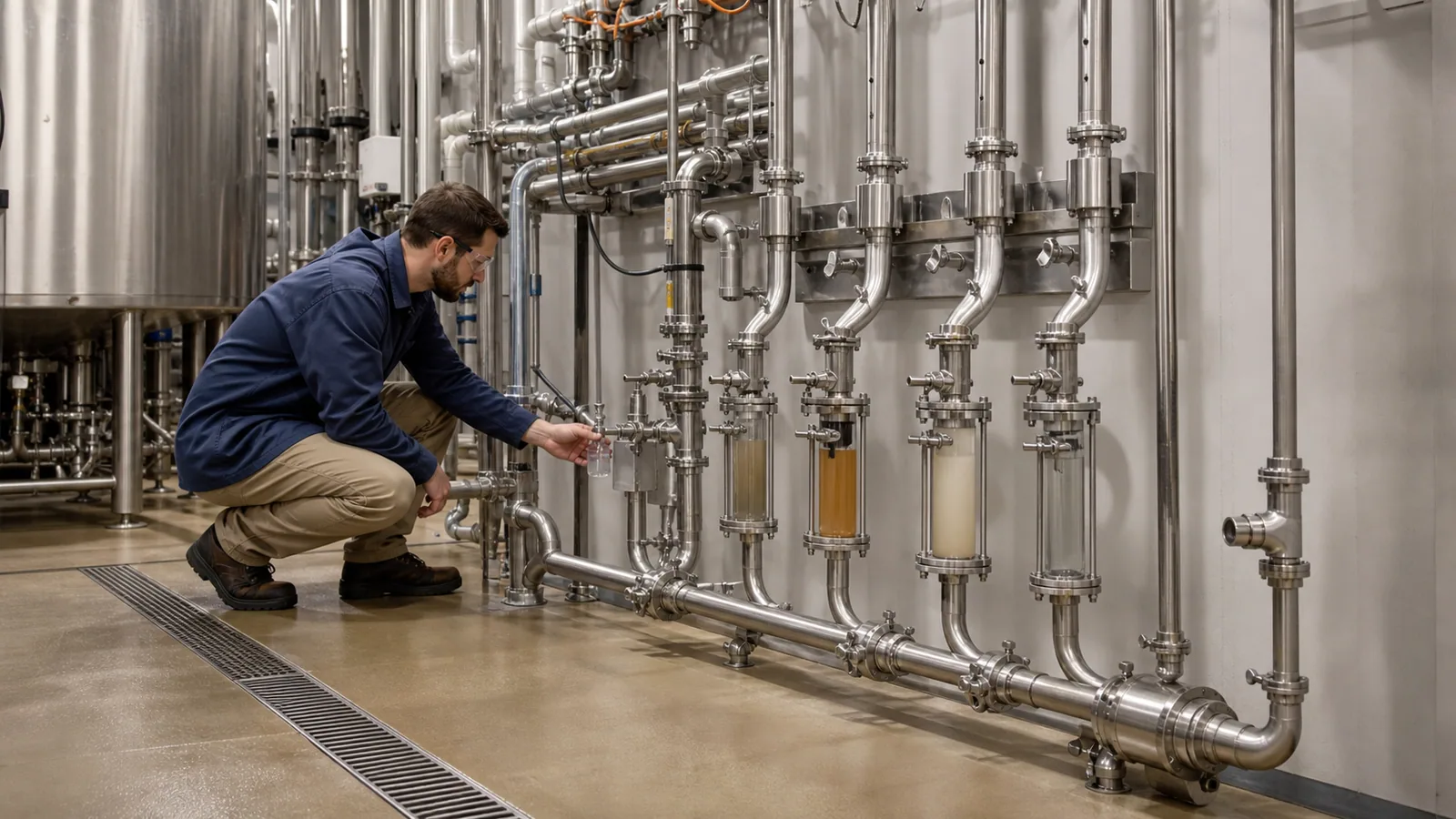
Sampling should capture normal brewing, packaging, CIP discharge, high-loss events and low-production periods. A composite sample can support average characterization, while targeted grab samples reveal side streams that should not be hidden by dilution.
Source Reduction and Pretreatment Come First
Keep product and solids out of the drain
Dry cleanup, collection trays, controlled transfers and recovery of usable by-products can reduce the organic and solids load. Screen size and configuration should match grain particles, labels, caps, glass risk and other site-specific material.
The buyer should ask how screenings will be removed, drained, stored and transported. A fine screen without a handling plan can become an odor and housekeeping problem.
Manage CIP discharges
Cleaning chemicals can cause pH, salinity and inhibitory shocks. Record recipe, concentration, volume and discharge time. Where practical, collect concentrated first discharges separately or meter them into equalization. Neutralization should use reliable mixing, pH measurement, chemical dosing and safeguards against overcorrection.
Provide effective equalization
Equalization reduces hydraulic and concentration peaks before biological treatment. It should be designed from the production schedule and load profile, not a generic retention time.
Review:
- working volume and freeboard;
- mixing and solids suspension;
- aeration or odor-control needs;
- foam management;
- corrosion-resistant materials;
- emergency or off-spec storage;
- transfer-pump turndown and redundancy;
- level, pH and temperature monitoring;
- access for cleaning.
Equalization does not remove COD. Its value is delivering a controlled feed to the next stage.
Clarification or dissolved air flotation
Screening, settling or DAF may remove suspended solids and floatable material before biology. DAF is most useful when contaminants can be conditioned into separable solids or are already associated with particles, fats or floatable matter. A large fraction of brewery COD can be dissolved, so primary physical separation alone should not be assumed to meet an organic discharge target.
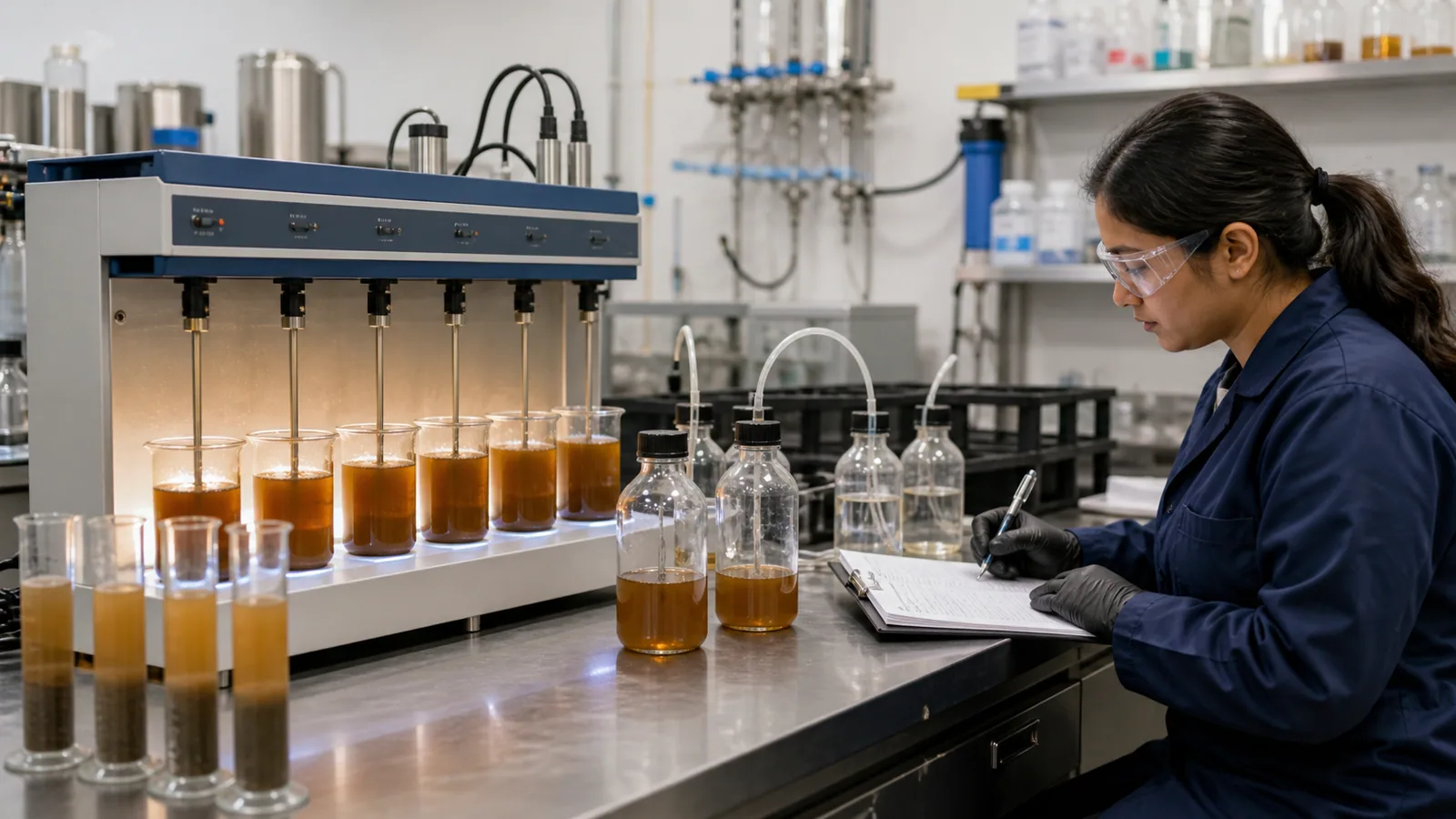
Bench coagulation or flotation testing can show chemical demand, floc behavior, solids capture and sludge volume for the actual wastewater.
When Is Anaerobic Treatment Appropriate?
Anaerobic microorganisms convert biodegradable organic matter without oxygen, producing biogas and a smaller biological-solids yield than a comparable all-aerobic route. Brewery projects commonly evaluate UASB, EGSB, anaerobic contact, anaerobic membrane or other reactor configurations depending on the wastewater and project scale.
Anaerobic treatment deserves evaluation when:
- the organic load is sufficiently strong and reasonably consistent;
- wastewater temperature supports the selected biology or heating is feasible;
- pH and alkalinity can be controlled;
- cleaning chemicals and disinfectants can be managed;
- the plant can operate the reactor through startup and load changes;
- biogas collection, treatment, safety and use have a defined scope;
- downstream polishing is included.
Anaerobic treatment is not simply an energy-recovery device. Startup, biomass retention, acidification risk, nutrient balance, sulfide, odor, gas safety and effluent polishing all require engineering and operation.
A supplier should explain the design organic loading, hydraulic loading, expected variation, biomass strategy, gas-handling boundary, flare or utilization interface and response to low-production periods. Any biogas or energy estimate must state the wastewater COD basis, assumed removal, methane assumptions and usable-gas conditions. Without those inputs, a precise savings claim is not defensible.
When Is Aerobic Treatment Appropriate?
Aerobic treatment uses supplied oxygen to remove biodegradable organics and can support nitrification or other nutrient-removal objectives in the right configuration. Activated sludge, SBR, MBBR and aerobic MBR are among the options that may be considered.
Aerobic treatment may be used:
- as the main biological stage for moderate or smaller loads;
- after anaerobic treatment to polish residual COD and BOD;
- where biogas infrastructure is not practical;
- where nitrogen removal is required;
- where variable production can be managed with equalization and controls.
Aeration capacity should be based on mass load and oxygen demand, not tank volume alone. The proposal should also address nutrient balance. Brewery wastewater may contain abundant carbon but not always the nitrogen and phosphorus needed for stable biomass growth. Nutrient dosing should be based on actual analysis and process monitoring rather than an assumed fixed recipe.
Other important parameters include sludge age, temperature, dissolved oxygen, settling, return sludge, waste sludge, foaming and standby blower capacity.
What Does MBR Add?
An aerobic MBR combines biological treatment with membrane filtration for solids separation. It can reduce the footprint associated with conventional clarification and can produce low-turbidity effluent suitable for defined downstream polishing.
MBR is often evaluated when:
- the site has limited space;
- final suspended-solids control is strict;
- a reuse train will follow;
- the plant accepts membrane cleaning and replacement responsibilities;
- pretreatment can reliably protect the membrane system.
MBR does not remove all dissolved salts and does not automatically make water suitable for reuse. It also does not remove the need for source control, equalization or biological loading calculations. Buyers should request membrane design flux, operating conditions, air-scour demand, screening, cleaning strategy, spare modules and the response to peak flows.
Research has demonstrated brewery wastewater treatment using MBR and other membrane combinations, but results from a study cannot be copied into a commercial guarantee. The project must use its own wastewater and acceptance conditions.
Anaerobic, Aerobic or MBR: A Decision Table
| Project condition | Route to evaluate | Main questions |
|---|---|---|
| Stable, high biodegradable organic mass load | Anaerobic + aerobic polishing | Is the load strong and consistent enough? How will biogas and startup be managed? |
| Moderate load, smaller plant or limited gas-use case | Aerobic treatment | What are aeration energy, nutrient needs, sludge production and peak-load response? |
| Tight TSS/turbidity target or compact reuse-oriented layout | Aerobic MBR, with polishing as required | How are screening, fouling, cleaning, peak flow and replacement handled? |
| High solids or floatable material before biology | Screening, settling or DAF before biological treatment | How much load is particulate versus dissolved? What sludge will be produced? |
| Water reuse target | Biological treatment + application-specific polishing and disinfection | What exact reuse quality is required, and where will concentrate or reject go? |
The routes can be combined. A large brewery may use anaerobic treatment for bulk organic removal, aerobic treatment for polishing and membranes for solids separation or reuse preparation. A smaller brewery may prefer well-equalized aerobic treatment. The decision should be based on mass loading, site constraints and lifecycle operation.
How to Define a Water-Reuse Target
Reuse starts with the destination. Examples may include landscape irrigation, cleaning, cooling-tower makeup or other non-product-contact applications where locally permitted. Product-contact or potable applications require a different level of risk assessment and regulatory review.
For each proposed use, define:
- required flow and daily profile;
- conductivity, hardness, alkalinity and silica limits;
- COD, turbidity and microbial targets;
- residual disinfectant or UV requirements;
- storage time and distribution system;
- cross-connection and backflow protection;
- operator monitoring and diversion logic.
Biological effluent may require filtration, activated carbon, UF, NF, RO, disinfection or a combination. If RO is used, the concentrate must be included in the water balance. A high recovery target should be checked against salts, organics, scaling and concentrate disposal.
The phrase “zero discharge” should not be used unless every liquid and solid residual has a defined, lawful route and the mass balance supports the claim.
Treatability and Pilot Testing
Testing should answer specific design questions. A practical program may include:
- settling or screening characterization;
- jar or DAF tests for particulate removal;
- respirometry or biodegradability assessment;
- anaerobic activity or toxicity screening where relevant;
- nutrient-demand evaluation;
- membrane fouling or polishing tests for reuse;
- sludge production and dewatering observations.
Pilot testing becomes more valuable when wastewater varies greatly, reuse limits are strict, unfamiliar cleaning chemicals are present, or the commercial guarantee depends on uncertain biological or membrane behavior.
The test report should document samples, storage, temperature, methods, dosing, duration and limitations. A favorable test on one sample does not represent every production condition.
Mid-article CTA
Need a brewery wastewater RFQ reviewed? Send the production schedule, source map, flow and COD profile, CIP chemical list, discharge or reuse target and site conditions. Baihuipu can identify missing inputs and organize a process comparison without assuming a standard brewery package. Send Your Requirements
Factory Testing, Shipment and Installation
Factory testing
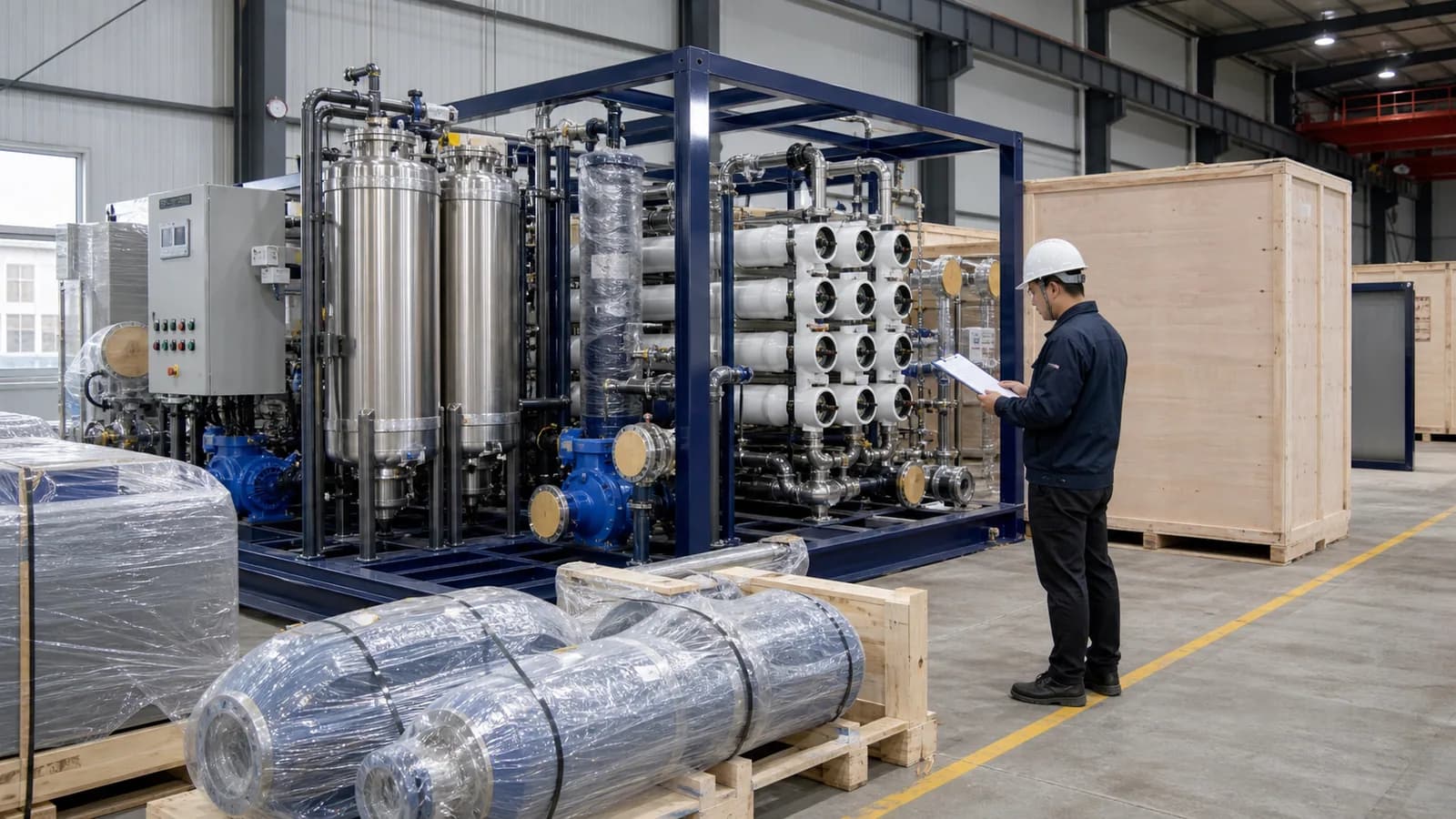
Factory testing for modular brewery wastewater equipment may verify:
- equipment and material conformity;
- tank and piping leak checks;
- pumps, blowers, mixers and valves;
- instruments, alarms and interlocks;
- control sequences and communication;
- membrane cleaning logic where applicable;
- gas-train component checks within the agreed safe procedure;
- drawings, manuals, tags and spare parts.
Factory testing with clean water does not prove biological COD removal, biogas production or reuse quality. Those outcomes require site wastewater, biomass development and performance testing under the defined load.
Shipment inspection
Before export packing, confirm protected instruments, capped connections, module drainage or preservation, restrained loose items, membrane storage conditions, media inventory and clear identification. Large tanks, gas equipment or external pipework may ship separately from the main skids; the packing list should reconcile every item with the installation drawings.
Installation preparation
Prepare civil tanks and foundations, drainage, ventilation, odor and gas-safety areas, pipe battery limits, lifting access, electrical supply, laboratory support, chemicals, seed biomass, sludge handling and the approved outlet route.
Commissioning should progress from mechanical completion and clean-water testing to controlled wastewater loading, biomass stabilization and performance verification. Brewing and cleaning schedules should be coordinated with the startup plan.
Buyer RFQ Checklist
- Beer types, production volume and operating calendar.
- Process-flow diagram and wastewater source map.
- Water use and wastewater flow profile.
- COD/BOD mass-load profile, not concentration alone.
- TSS, nutrients, pH, temperature and conductivity.
- CIP chemicals, recipes and discharge schedule.
- Solids, yeast and off-spec product handling.
- Discharge permit or numerical reuse target.
- Available footprint, utilities and climate.
- Sludge and concentrate disposal routes.
- Biogas use or flare boundary if anaerobic treatment is considered.
- Required redundancy, automation and operator staffing.
- Factory test, commissioning and acceptance requirements.
- Project country, delivery route and scope boundaries.
FAQ
Why does brewery wastewater have a high organic load?
Sugars, alcohol, yeast, wort, beer losses and other product residues contribute biodegradable organic matter. The load changes with production losses and cleaning schedules, so flow and COD profiling is important.
Is anaerobic treatment always the best option for a brewery?
No. It is most attractive when the organic mass load, temperature, consistency and operating scale support stable digestion and biogas management. Smaller or highly variable facilities may favor other routes after lifecycle comparison.
Does anaerobic treatment need an aerobic stage afterward?
Often, because anaerobic treatment is commonly used for bulk organic removal rather than final polishing. The required downstream stage depends on the discharge or reuse criteria.
Can DAF remove brewery COD?
DAF can remove suspended and floatable material and the COD associated with it. It is generally less effective for dissolved sugars, alcohol and other soluble organics, which usually require biological or other treatment.
When should a brewery consider MBR?
MBR is worth evaluating when footprint is limited, a low-turbidity effluent is required, or a reuse-polishing train will follow. Membrane screening, cleaning, energy and replacement must be included in the comparison.
Can treated brewery wastewater be reused?
Potentially, for a specifically defined use after the full treatment, polishing, disinfection and monitoring train meets local requirements. Reuse suitability cannot be determined from biological treatment alone.
What should a performance guarantee include?
It should specify the influent flow, organic load, pH, temperature and inhibitory-chemical envelope; required effluent values; sampling and test methods; stabilization period; operating responsibilities; and the treatment condition being guaranteed.
What can shipment photographs prove?
They can document equipment condition, packing, protected openings and loaded items. They cannot prove that the system has treated brewery wastewater or achieved a performance result.
Conclusion
Brewery wastewater treatment begins with production control and a time-based source map. Screening, equalization and pH management protect the biological stages. Anaerobic treatment, aerobic treatment and MBR each have a defensible role, but their suitability depends on organic mass load, variability, site operation and the final water destination.
Buyers should compare complete treatment trains rather than equipment names. A credible proposal explains where COD is removed, where solids and concentrate go, what biogas scope is included, how low-production periods are handled and which results can be demonstrated at the factory versus the operating brewery.
Final CTA
Planning a brewery effluent treatment or water-reuse project? Send the brewery process description, production and cleaning schedule, representative analysis, flow profile, treatment target, utilities and project location. Contact Baihuipu to request a technical discussion or industrial wastewater product information.