Introduction
There is no universally best sludge dewatering machine. A filter press, screw press, or decanter centrifuge can each be the right choice when its operating principle matches the sludge, required cake condition, daily dry-solids load, available utilities, labor model, and final disposal route.
The most reliable selection starts with representative sludge data—not the wastewater flow rate alone. Buyers should define the sludge source, feed solids concentration, expected dry-solids mass, organic and mineral content, variability, conditioning method, required operating hours, and where the dewatered cake and return liquor will go. A quotation based only on “cubic meters of sludge per day” can hide the factor that actually governs machine size: kilograms of dry solids to be processed.
This guide compares three common technologies from a buyer’s perspective. It does not promise a particular cake dryness or chemical consumption because those results must be established with representative samples, an agreed test method, and a complete mass balance.
The Direct Answer
- Choose a filter press when a batch process is acceptable and the project places a high value on a firm, handleable cake, especially for sludge that responds well to pressure filtration.
- Choose a screw press when continuous, low-speed operation, simpler automation, and moderate operator attention are important, provided the sludge can form and retain flocs through the machine.
- Choose a decanter centrifuge when continuous high-throughput processing, compact installation, and enclosed operation are priorities, and the site can support the energy, maintenance, noise control, and process optimization requirements.
These are screening rules, not purchase specifications. The final decision should follow sludge testing and review of the complete handling system.
Start with Dry Solids, Not Sludge Volume
Two sludge streams can have the same volume but very different solids loads. For example, a dilute biological sludge and a concentrated metal hydroxide sludge may require different conditioning, feed equipment, and machine area even when their daily liquid volume is identical.
Build the RFQ around these inputs:
- Sludge origin. State whether the sludge comes from biological treatment, coagulation and precipitation, dissolved air flotation, clarification, chemical treatment, or a mixed source.
- Feed solids concentration. Provide a measured range, not a single optimistic value. If the sludge is periodically diluted by wash water or cleaning, include that condition.
- Dry-solids load. Calculate the mass of dry solids per hour and per operating day. Also state the planned operating hours and whether the equipment must absorb peak production days.
- Physical behavior. Describe settling, thickening, fibrous content, grit, oil, stickiness, abrasiveness, and whether the sludge rapidly changes after storage.
- Chemical characteristics. Include pH, salinity, corrosive components, metals or other constituents relevant to materials selection and disposal.
- Conditioning history. Identify coagulants and polymers already used, their dose basis, preparation concentration, and whether overdosing has caused sticky cake or poor filtrate.
- Cake requirement. Explain why a particular cake condition is needed: transport, landfill acceptance, incineration, further drying, recovery of valuable material, or easier handling.
- Return-liquor destination. Filtrate or centrate normally returns somewhere. Its suspended solids, dissolved load, and chemical content can affect the headworks or a specific treatment stage.
If these data are incomplete, the proposal should clearly list assumptions and request sampling or testing rather than presenting an unsupported performance guarantee.
How the Three Technologies Work
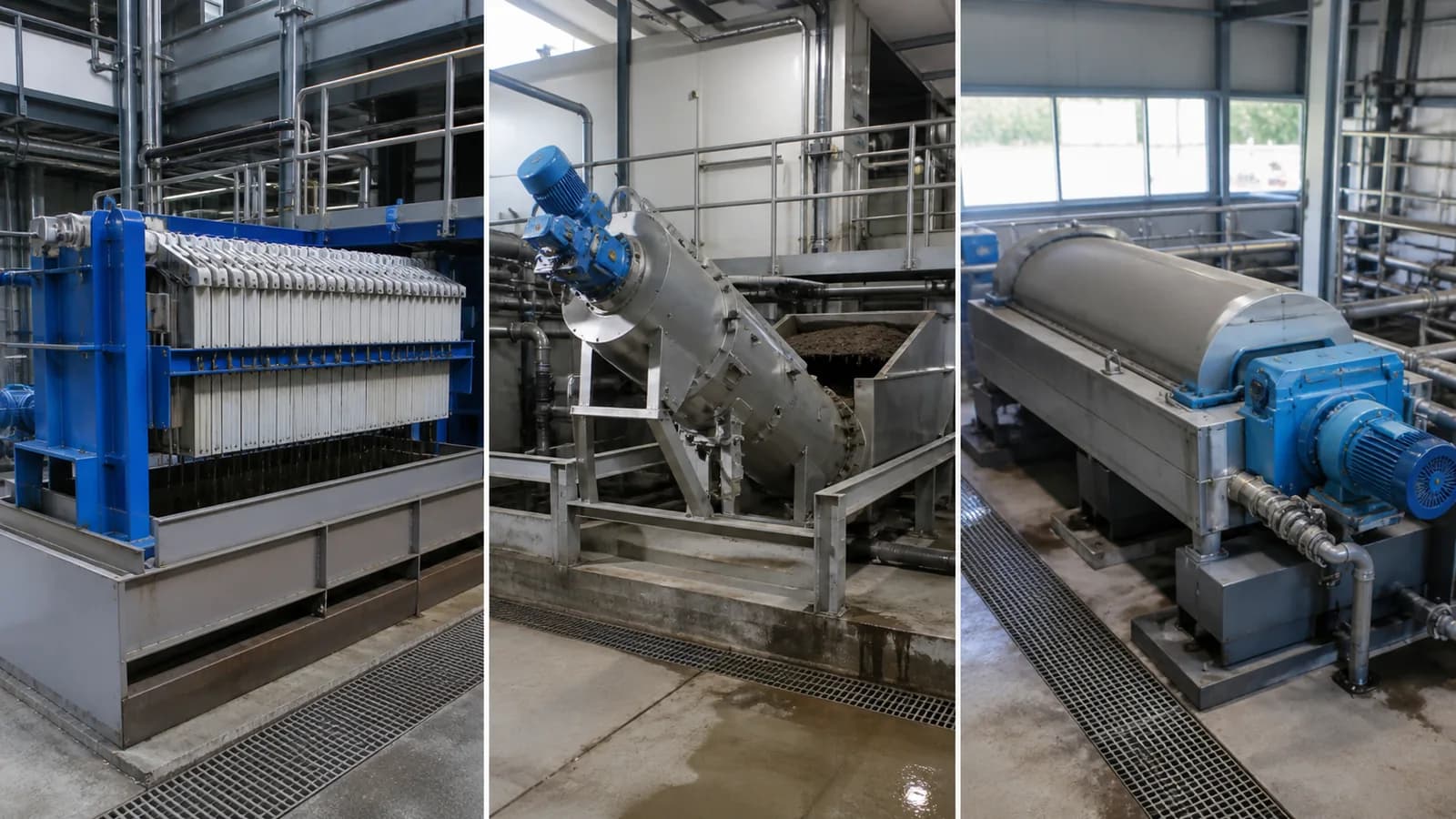
Recessed-Plate Filter Press
A filter press is a batch pressure-filtration device. Conditioned sludge is pumped into chambers formed between filter plates. Liquid passes through the filter cloth, while solids accumulate as a cake. The cycle normally includes filling, filtration, pressure holding where applicable, opening, cake discharge, and cloth or plate cleaning.
Its main advantage is the ability to apply pressure across a defined filtration area. Its trade-off is batch operation: cycle time, cake release, cloth condition, feed-pump control, and discharge labor all affect real throughput. A large chamber volume does not automatically mean high daily capacity if filling or cake removal is slow.
Screw Press
A screw press typically uses a slowly rotating screw to move conditioned sludge through a screen or ring structure while the available volume decreases. Free water drains in the early zone, and compression increases toward the discharge. The machine is generally continuous and operates at low rotational speed.
The technology depends strongly on floc quality. If the sludge is too dilute, oily, abrasive, or unable to form stable flocs, solids may escape with the filtrate or the required polymer dose may become impractical. Feed equalization and a controlled flocculation system are therefore part of the process, not accessories to be considered later.
Decanter Centrifuge
A decanter centrifuge separates solids and liquid in a rotating bowl. Centrifugal force accelerates settling, while a scroll conveys separated solids toward the discharge. It is continuous, enclosed, and capable of processing a substantial solids load in a relatively compact footprint.
The trade-offs are higher rotational energy, wear management, noise and vibration control, and the need to optimize bowl speed, differential speed, pond depth, feed rate, and polymer dosing. The US EPA describes centrifuge selection as site-specific and notes that plant size, downstream processing, final use or disposal, odor, and available space should all be considered.
Side-by-Side Buyer Comparison
| Decision factor | Filter press | Screw press | Decanter centrifuge |
|---|---|---|---|
| Operating mode | Batch | Continuous | Continuous |
| Separation mechanism | Pressure filtration through cloth | Drainage and progressive compression | Accelerated sedimentation by centrifugal force |
| Best screening fit | Projects prioritizing firm cake and accepting batch cycles | Projects prioritizing low-speed automated operation with floc-forming sludge | Projects prioritizing compact, enclosed, continuous high solids throughput |
| Sensitivity | Cloth blinding, cake release, cycle sequencing | Floc strength, screen condition, feed consistency | Polymer control, wear, speed settings, vibration |
| Operator tasks | Plate/cloth inspection, cake discharge, wash management | Polymer preparation, screen wash, solids observation | Process optimization, wear inspection, lubrication and vibration monitoring |
| Utility emphasis | Feed pressure, wash water, sometimes compressed air | Electrical power, wash water, polymer system | Electrical power, polymer system, wash/CIP provisions |
| Layout emphasis | Space for plate opening and cake discharge | Space for flocculation and discharge | Foundation, lifting access, noise/vibration isolation |
| Performance proof | Representative filtration test and cycle definition | Representative sludge trial with conditioning | Representative centrifuge trial or validated scale-up |
This table should be used for shortlisting. It is not a substitute for a test report or supplier duty-point confirmation.
Which Machine Fits Which Project Condition?
When a Filter Press Deserves the Shortlist
A filter press is often worth testing when transport or downstream handling requires a firm cake, the operation can accommodate batch cycles, and trained personnel can inspect cloths and manage cake release. It can also be appropriate when solids have good filtration characteristics and the plant has room for the press, feed skid, cake drop, and maintenance access.
Ask the supplier to define the complete cycle, not just chamber volume. The quotation should state the assumed feed concentration, filtration area, fill time, conditioning, cake discharge method, expected cycles per day, cloth-cleaning approach, and the basis of any cake claim.
When a Screw Press Deserves the Shortlist
A screw press is attractive where steady, continuous operation and a relatively simple mechanical layout matter. It may fit plants that prefer scheduled operator checks rather than repeated batch opening and where low rotational speed is operationally useful.
The decisive question is whether the sludge forms robust flocs and releases water through the drainage zone. A bench polymer test alone does not reproduce the shear and drainage conditions of a full machine. A representative equipment trial is preferable when sludge behavior is uncertain.
When a Decanter Centrifuge Deserves the Shortlist
A centrifuge should be considered when the project has a substantial continuous solids load, limited building area, or a preference for an enclosed machine. It can process changing loads, but that flexibility depends on controls and trained adjustment rather than being automatic in every situation.
Evaluate energy, wear parts, service access, lifting provisions, vibration monitoring, noise, and centrate quality together. A compact machine can still require significant surrounding space for safe maintenance and removal of the rotating assembly.
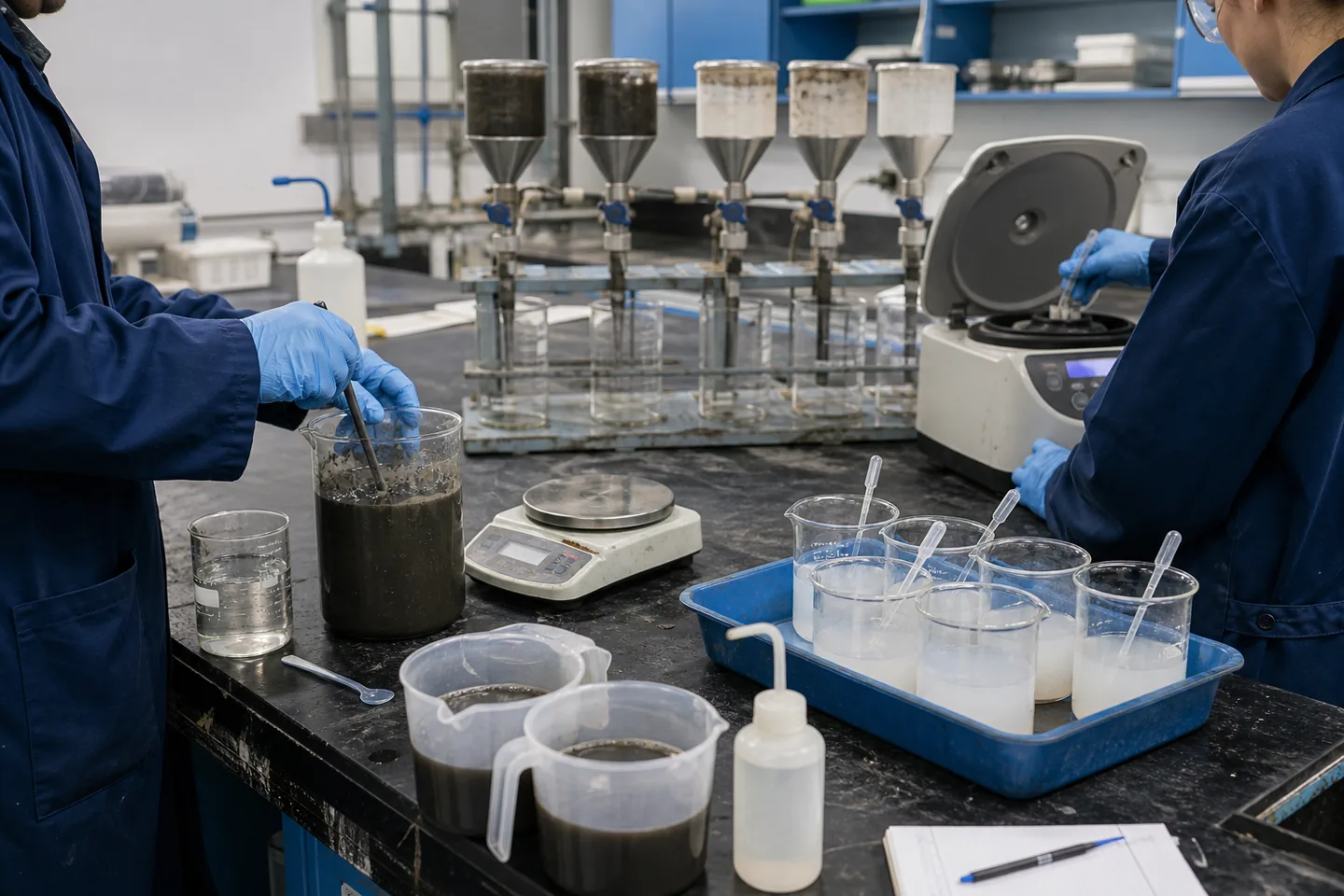
Test the Sludge Before Fixing the Specification
A defensible selection program uses a representative sample and a written test basis.
Step 1: Create a Sampling Plan
Take samples across normal production, cleaning, startup, and known peak conditions. Record where and when each sample was taken. If several sludge streams will be mixed, test both the individual streams and the proposed blend. A single bucket collected after unusual settling may not represent the machine feed.
Step 2: Characterize the Feed
At minimum, measure feed solids and note temperature, pH, density, visible oil, grit, fibers, and settling behavior. Add chemical analysis when it affects corrosion, disposal, or safe handling. Distinguish total sludge volume from dry-solids mass.
Step 3: Screen Conditioning
Compare polymers or other conditioning methods under controlled mixing. Record product identity, make-down concentration, active dose basis, mixing sequence, floc appearance, and filtrate or supernatant quality. Do not compare vendors using different dose units.
Step 4: Run Technology-Relevant Tests
Use filtration tests for a filter press, drainage/compression trials for a screw press, and centrifuge trials or appropriately validated scale-up for a decanter. Record throughput, feed concentration, cake solids, solids capture, return-liquor quality, polymer consumption, and operating stability. One exceptional result should not replace a repeatable operating window.
Step 5: Close the Mass Balance
For the agreed test period, reconcile feed liquid, feed dry solids, cake mass, cake dry solids, and return liquor. If the numbers do not reasonably close, investigate sampling and measurement before using the result as a design basis.
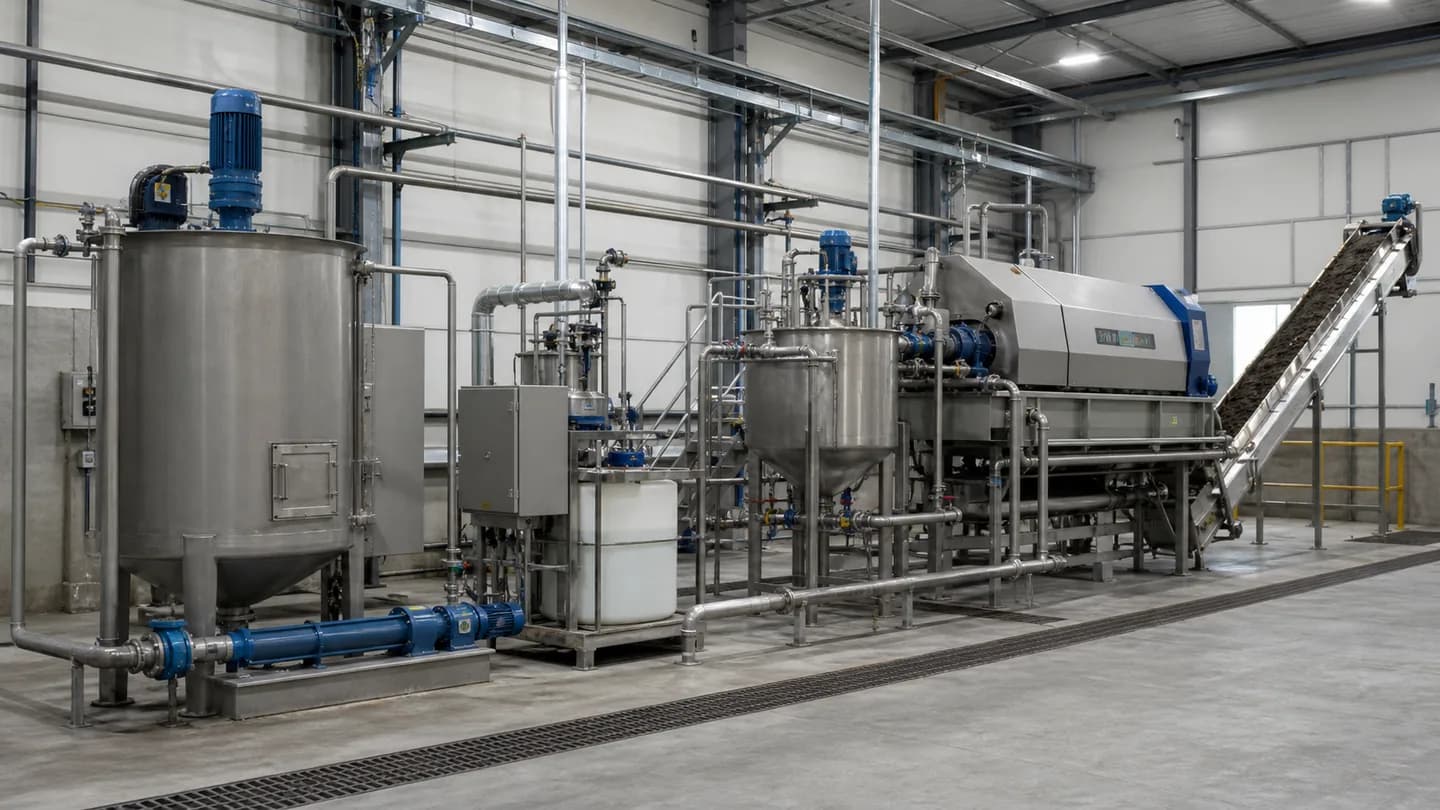
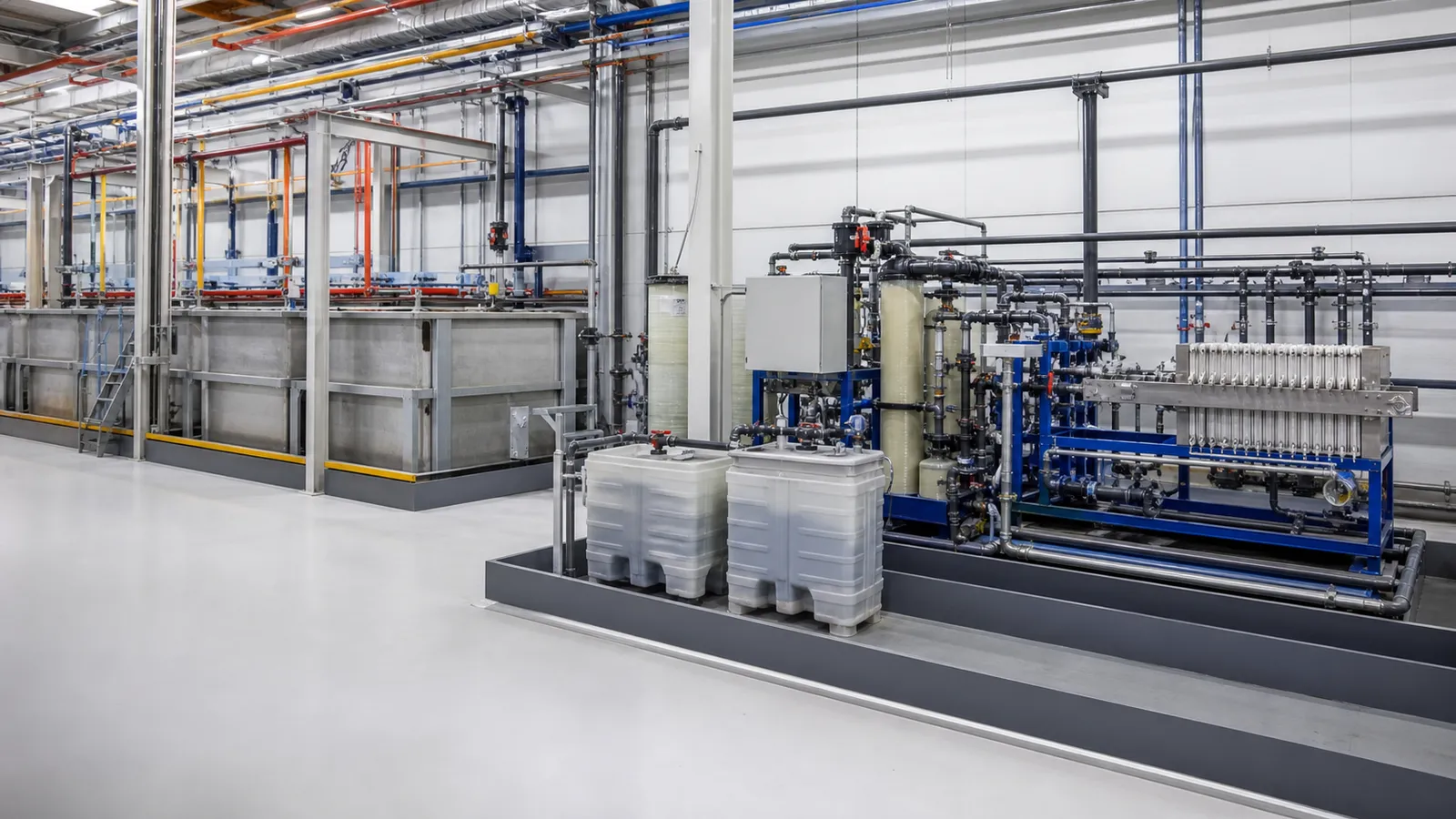
The Dewatering Machine Is Only One Part of the System
Many procurement problems arise from buying the separator without defining its upstream and downstream equipment. A complete scope may include:
- sludge storage and agitation;
- maceration, screening, or grit protection;
- controlled feed pumping;
- polymer preparation, aging, dilution, and dosing;
- flocculation tank or inline mixer;
- filtrate or centrate collection and return;
- cake hopper, conveyor, pump, or container interface;
- wash-water and drainage connections;
- odor collection or enclosure;
- access platform, lifting points, and maintenance clearance;
- instruments, interlocks, local controls, and plant communication;
- corrosion-compatible wetted materials.
The battery limits should state who supplies each item and how it connects to the plant. Otherwise, a low machine price can turn into a high installation-change cost.
Factory Testing, Shipment Inspection, and Installation Preparation
Factory testing should be tied to what can genuinely be verified before shipment. Mechanical rotation checks, motor direction, interlocks, emergency stops, valve operation, instrument signals, control sequences, leakage checks with water where appropriate, and documentation review can be included in a factory acceptance plan.
However, a clean-water factory test does not prove cake solids, polymer consumption, or capture efficiency on the buyer’s sludge. Those outcomes require representative process material and an agreed performance test. The distinction should be written into the acceptance criteria.
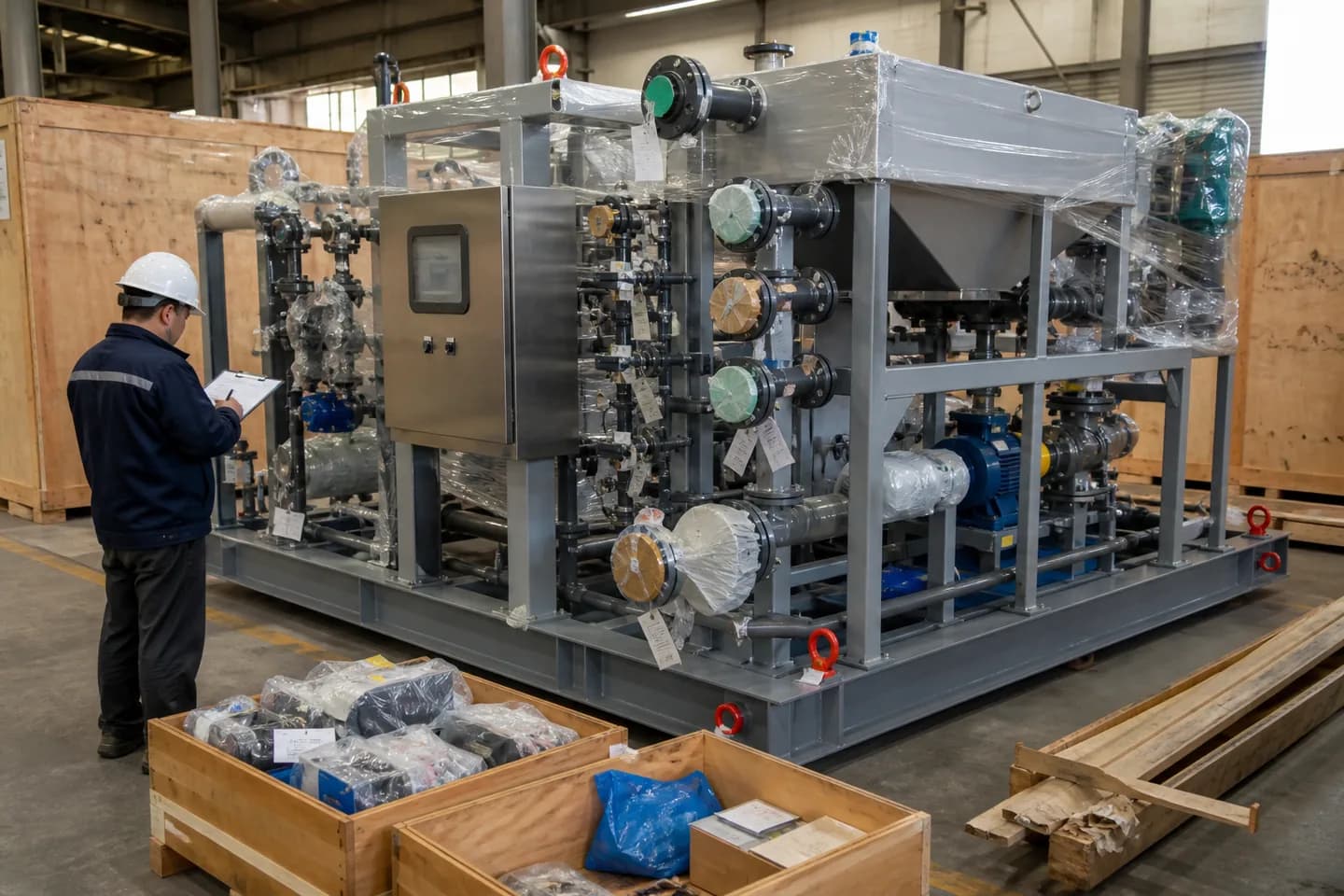
Shipment inspection should confirm the equipment identification, packing list, loose components, instruments, spare parts, preservation, connection labels, lifting points, and transport restraints. Photographing packed interfaces can help the receiving team identify items without presenting the images as operating-performance evidence.
Before delivery, confirm foundation loads, anchor locations, drainage, electrical supply, wash water, ventilation, safe access, cake removal route, and lifting clearance. Installation preparation is particularly important for filter-press plate opening and centrifuge maintenance access.
Questions to Put in the RFQ
- What sludge data and test results were used for selection?
- Is the rated duty expressed as wet sludge volume, dry-solids load, or both?
- What feed concentration and operating hours support the stated capacity?
- What polymer type, dose basis, and make-down system are assumed?
- Which cake and return-liquor values are guaranteed, estimated, or still subject to testing?
- What is included in the feed, conditioning, discharge, wash, controls, and access scope?
- Which components contact the sludge, filtrate, wash chemicals, and plant atmosphere?
- What routine operator tasks and planned maintenance are required?
- What wear parts and consumables should be stocked for commissioning?
- What can be tested at the factory, and what must be verified on site with actual sludge?
Mid-article CTA
Send Your Sludge Data Share the sludge source, feed solids range, daily dry-solids load, operating schedule, disposal route, and any available test results. Baihuipu can review the missing inputs needed before an equipment configuration is discussed. Send Your Requirements
Common Selection Mistakes
Comparing Only Motor Power or Purchase Price
The lowest installed motor power does not establish the lowest operating cost, and the lowest machine price does not include polymer, wash water, labor, return-load treatment, maintenance, or cake transport. Compare a defined operating basis and annual material balance.
Requesting a Cake Percentage Without Defining the Test
Cake solids vary with sludge composition, conditioning, feed concentration, sampling, and measurement. A credible value identifies the sludge, test method, operating condition, and whether it is a target, test result, or guarantee.
Ignoring Return Liquor
Poor filtrate or centrate can recycle solids and dissolved contaminants to the treatment plant. This may increase chemical consumption or disturb biological and membrane processes. Include the return stream in the hydraulic and pollutant-load balance.
Using Municipal Sludge Experience as a Universal Industrial Rule
Industrial sludge may contain metal hydroxides, oils, salts, abrasive minerals, fibers, or process chemicals that behave differently from municipal biosolids. Technology principles transfer; performance values do not automatically transfer.
FAQ
Which sludge dewatering machine produces the driest cake?
No technology can be declared the driest without defining the sludge and test conditions. A filter press is often shortlisted when firm cake is important, but screw-press and centrifuge results depend on sludge characteristics and conditioning. Compare verified trials on representative material.
Is a screw press always lower maintenance than a centrifuge?
It generally has a lower rotational speed and a simpler mechanical principle, but it still requires screen cleaning, polymer control, inspection, and protection from unsuitable solids. Maintenance should be compared through the supplier’s task list, intervals, wear parts, and site conditions.
Can the machine be sized from wastewater flow alone?
No. Wastewater flow helps estimate sludge generation, but machine selection requires the actual or calculated dry-solids load, feed concentration, operating schedule, and variability. The sludge-generation assumptions should be visible in the proposal.
How much polymer will be required?
Polymer demand depends on sludge type, existing chemicals, product selection, make-down, mixing, and the required result. Use controlled screening and equipment-relevant trials. State the dose on an active-polymer-per-dry-solids basis where possible.
Can factory testing guarantee site performance?
Factory testing can verify assembly, controls, interlocks, rotation, leakage, and agreed functional checks. It cannot prove process performance on site sludge unless representative sludge is used under an agreed method. Site commissioning and performance verification remain separate steps.
What information should be sent for a budgetary proposal?
Send sludge source, feed solids range, daily volume and operating hours, estimated dry-solids load, pH and relevant chemistry, disposal route, target cake condition, available utilities, space constraints, and sample/test availability. Mark estimates clearly.
Should the cake target be written into the purchase specification?
Yes, if it affects disposal or downstream processing, but the target should be connected to a defined feed envelope, conditioning basis, test method, and acceptance procedure. Otherwise, the number is difficult to verify fairly.
Conclusion
Filter presses, screw presses, and decanter centrifuges solve the same broad task through different separation mechanisms. The useful question is not “Which machine is best?” but “Which machine can process this sludge, at this dry-solids load, into a cake and return stream that fit the plant’s operating and disposal plan?”
A strong procurement process therefore begins with representative sludge data, narrows the technologies through practical constraints, verifies the shortlist through relevant testing, and purchases a complete handling system with clear battery limits. That approach creates a more defensible specification and reduces changes during installation and commissioning.
Final CTA
Request a Dewatering Configuration Review Send your sludge analysis, dry-solids load, operating hours, cake destination, site layout, and utility conditions. Baihuipu can identify the technical questions that should be resolved before quotation. Get a Quote