Introduction
An aluminum anodizing line is not one wastewater source. It is a sequence of cleaning, etching, desmutting, anodizing, coloring, sealing and rinsing operations. Each stage can add a different contaminant or chemical demand.
Spent alkaline etch can contain high dissolved aluminum and caustic. Acidic deoxidizing or anodizing rinses can contribute acidity, sulfate, phosphate or other bath constituents. Coloring and sealing may introduce dyes, nickel, acetate, fluoride or proprietary additives. Some facilities also perform chromate conversion or chromium-containing anodizing, which can introduce Cr(VI) and require dedicated reduction before conventional metals precipitation.
EPA technical material describes wastewater from anodizing as including spent process solutions, sealants and rinse water, with dissolved base metal accumulating in process baths. See the EPA machinery and metal-products development document and the Metal Finishing Effluent Guidelines.
This buyer’s guide explains how to translate the production line into a treatment basis without assuming that every anodizing factory needs the same tanks or can meet the same outlet with one neutralization stage.
Map the Anodizing Line Before Mapping the Wastewater Plant
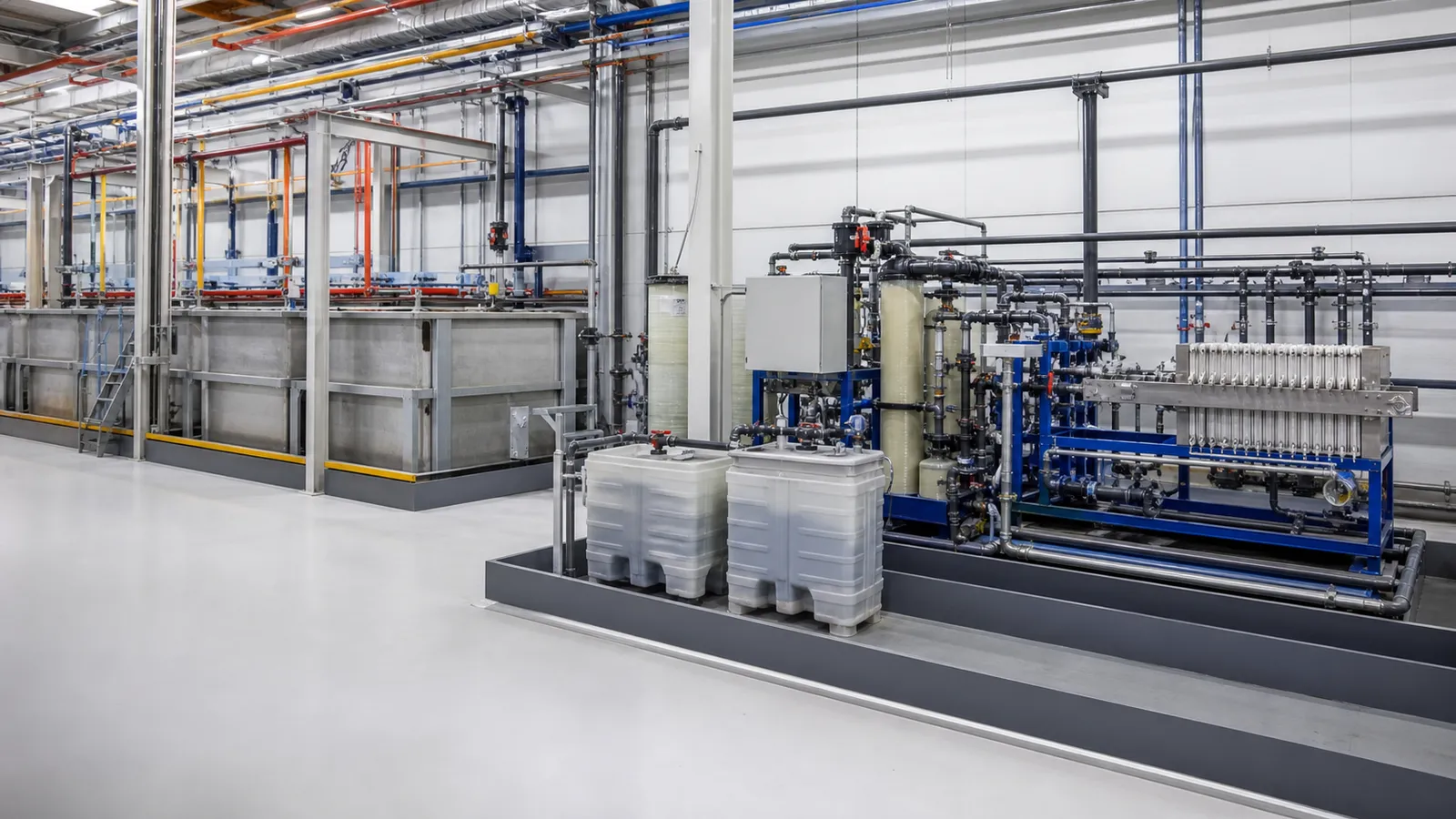
Walk the line with production, maintenance and EHS personnel. Record every bath, rinse, transfer point, drag-out station, floor drain, scrubber, laboratory drain and chemical-cleaning discharge.
A typical source map may include:
- alkaline cleaner and rinse;
- caustic etch and rinse;
- acid desmut or deoxidizer and rinse;
- sulfuric, phosphoric, boric or chromic anodizing bath and rinse;
- dye bath and rinse;
- hot-water, nickel-based or fluoride-containing sealing and rinse;
- chromate conversion coating where used;
- scrubber water, filter cleaning and floor washing;
- concentrated bath dumps and routine overflow rinses.
Do not assume all listed steps are present. The site’s current safety data sheets, bath make-up records and production recipe are the source of truth.
For each stream, document:
- normal and peak flow;
- batch volume and discharge duration;
- bath concentration and drag-out mechanism;
- pH and temperature;
- aluminum, nickel, chromium, fluoride and other relevant constituents;
- dyes, surfactants, oils and chelating additives;
- current destination and whether the stream can remain segregated.
The map often identifies immediate opportunities: reduce drag-out, repair rinse-control problems, use counter-current rinsing, recover selected bath components or keep a concentrated dump out of the continuous rinse-water system. These production measures can reduce treatment load, but any reuse or recovery change must be approved against product-quality requirements.
Why Stream Segregation Matters
Acid and alkaline streams can help equalization—but only when controlled
Acidic and alkaline water may partially neutralize each other, but uncontrolled mixing is not a treatment design. Reaction heat, precipitation, gas release and rapidly changing pH can create operational problems. Flow-paced transfer and a defined equalization strategy are more reliable than allowing random batch dumps into one pit.
Cr(VI) requires a dedicated reduction function
If chromic anodizing or chromate conversion is used and Cr(VI) reaches wastewater, the chromium-bearing stream should remain identifiable until reduction is complete. Cr(VI) is normally reduced to Cr(III), then the trivalent chromium is precipitated and separated. It should not be routed directly into common neutralization on the assumption that pH adjustment will remove it.
Fluoride can change aluminum behavior
Fluoride from etching or sealing can form complexes with aluminum and change precipitation behavior. Calcium-based fluoride treatment may also add a substantial solids load. The optimum sequence—aluminum removal, fluoride precipitation, combined treatment or staged treatment—should be established through representative testing.
Concentrated dumps should not define the continuous plant by accident
A spent bath released over one hour can impose a much larger instantaneous load than a day of rinse water. Separate batch holding, controlled metering or off-site management may be more practical than oversizing every downstream tank for an infrequent event.
Build a Representative Water-Quality Dataset
The analytical plan should follow the bath inventory. A starting package may include:
- pH, conductivity, TDS, suspended solids and turbidity;
- acidity and alkalinity where useful for chemical-demand estimation;
- total and dissolved aluminum;
- nickel, chromium species and other metals used on the line;
- fluoride, sulfate, phosphate, chloride and nitrate;
- COD or TOC, color, oil and surfactants where relevant;
- cyanide only if a process or adjacent line can introduce it;
- temperature and production condition;
- flow, batch schedule and expansion allowance.
Collect samples from named streams as well as the current combined wastewater. A single composite sample cannot show which operation causes a treatment upset.
Specify the outlet destination and applicable limits. Sewer discharge, industrial-park pretreatment, surface discharge and internal reuse can require different controls. If treated water will be reused, identify the exact point of use—such as early-stage rinse, final rinse, scrubber, cooling tower or floor washing—and define its complete quality requirement.
A Practical Treatment Route for Anodizing Wastewater
1. Collection and equalization
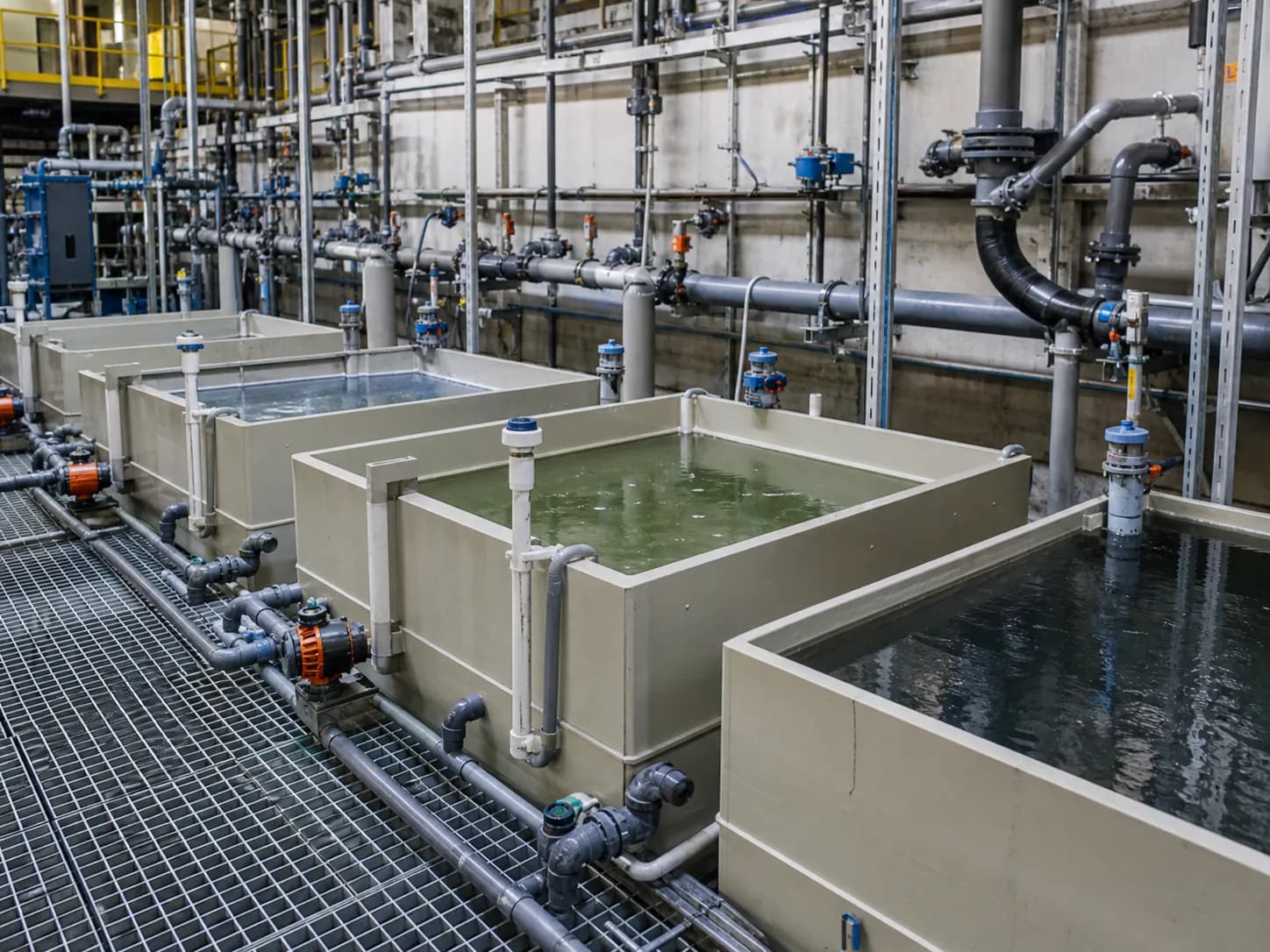
Provide dedicated collection for streams that require separate treatment or controlled release. Equalization tanks should be sized from the flow timeline, not daily volume alone. Mixing must keep solids and concentration reasonably uniform while allowing safe sampling and maintenance.
The control philosophy should include high-level alarms, abnormal-water holding and an approved transfer sequence. Tank material should be selected from actual pH, temperature, fluoride, chloride and chemical exposure.
2. Cr(VI) reduction where applicable
Where Cr(VI) is confirmed, use a dedicated controlled reduction stage before common-metals precipitation. Reagent, acidic reaction window, mixing, contact time and pH/ORP controls should follow testing and the selected chemistry. Laboratory Cr(VI) analysis verifies the result; ORP is an operating signal, not the compliance result.
If the site does not use chromium chemistry and testing confirms no chromium source, this stage may not be necessary. A modular design should follow evidence rather than include every possible unit operation.
3. Neutralization and aluminum precipitation
Aluminum is amphoteric: its solubility can increase again under excessively high-pH conditions. That makes a controlled pH window important. Mixed metals, fluoride complexes, chelants and high dissolved salts can shift the observed optimum.
Bench tests should compare pH and reagent sequence using actual water. Lime and sodium hydroxide can produce different sludge and operating behavior. Acid and alkaline streams may reduce net reagent demand if they are compatible and blended under controlled conditions, but the result must remain stable through production changes.
4. Fluoride treatment where required
Fluoride treatment may use a calcium source to form calcium fluoride, followed by flocculation and separation. The optimum position relative to aluminum precipitation is project-specific. Phosphate, sulfate, aluminum and pH can affect calcium demand and solids.
If the required residual is below the stable bulk-precipitation result, adsorption, ion exchange or membrane polishing may be evaluated on clarified water. Each creates a residual stream—spent media, regenerant or concentrate—that must be included in the scope.
5. Coagulation, flocculation and clarification
Neutralization creates precipitates, but the plant needs particles that can settle, float or filter. Jar testing should compare mixing, coagulant, polymer, floc strength, settling rate and carryover.
Lamella clarification can reduce footprint when floc settles well. Dissolved-air flotation may be useful when solids are light or when oil and surfactants change separation, but it should be tested. Filtration can control fine carryover after clarification; it cannot remove dissolved aluminum, chromium or fluoride that failed to react.
6. Sludge thickening and dewatering
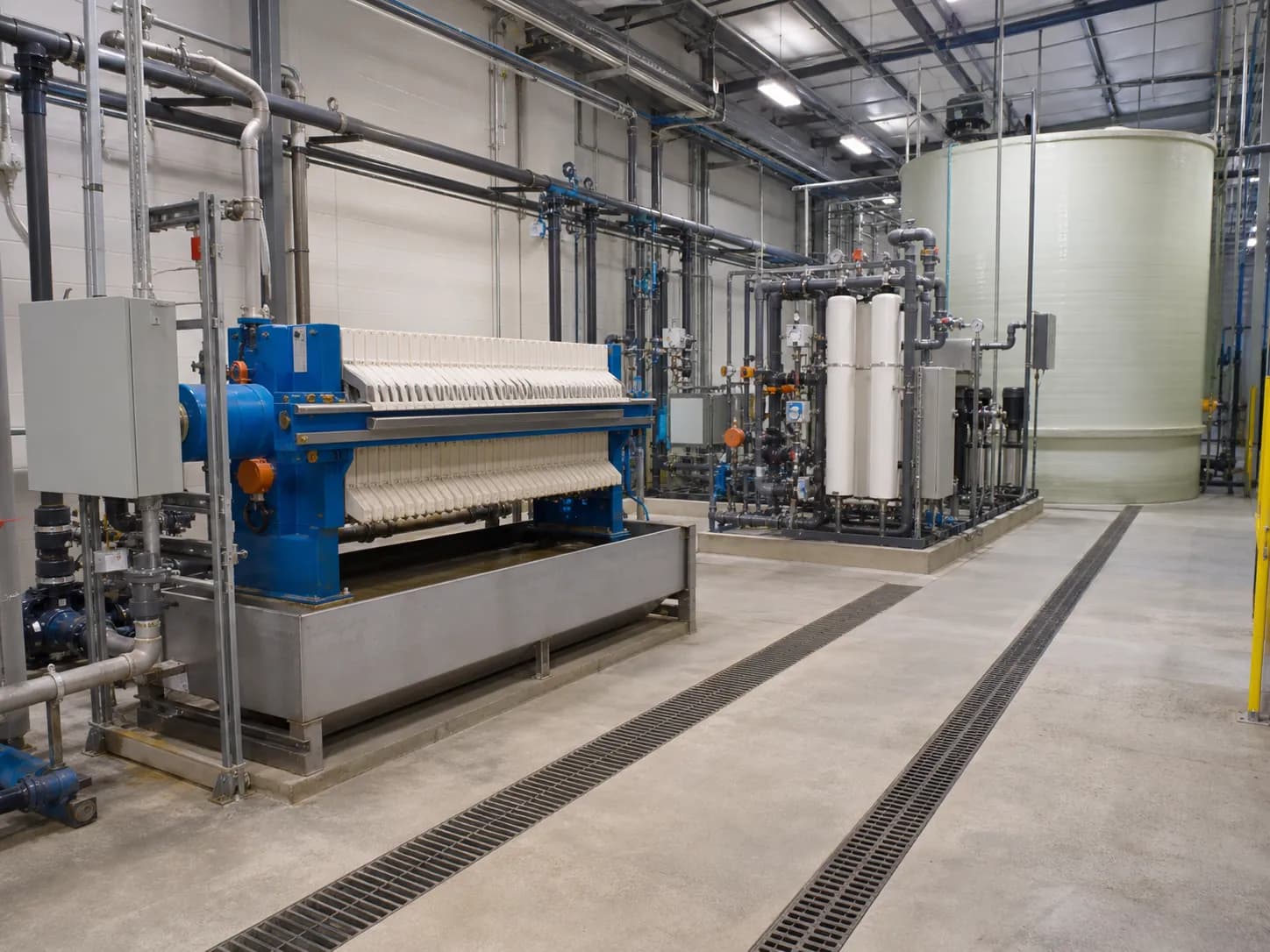
Aluminum hydroxide can create voluminous sludge. Calcium-fluoride and chromium-bearing solids add to the mass and may change dewatering behavior. The system should define sludge collection, thickening, filter press or other dewatering, filtrate return, cake storage and the customer’s legal disposal responsibility.
Measure sludge volume during testing. Include reagent-derived solids, not only influent suspended solids. Filter-press plate area and cycle time should follow tested sludge behavior and operating hours.
7. Organic and color control when required
Dyes, surfactants, sealants and cleaners can contribute color or COD. Coagulation may remove some fraction, but biological treatment, activated carbon, oxidation or another stage may be required when the actual outlet target demands it.
Do not add advanced oxidation solely because the wastewater is colored. Determine whether the concern is visible color, COD, a specific compound or reuse compatibility, then test an appropriate method.
When Is Anodizing Wastewater Reuse Practical?
Reuse begins with the receiving process, not with an RO equipment catalog. Early rinses may tolerate more dissolved salts than final rinses, while high-quality final rinse can affect staining, adhesion, corrosion and appearance.
A reuse assessment should identify:
- water quality required at each rinse or utility point;
- contaminants that can accumulate through recycle;
- conductivity, hardness, sulfate, chloride, silica, aluminum and organics;
- membrane or ion-exchange pretreatment needs;
- target recovery and reject route;
- storage, distribution and microbial control;
- product-quality monitoring and diversion procedure.
Treated wastewater may be suitable for a lower-grade utility even when it is not suitable for final rinse. A cascade can sometimes match the highest water quality to the most sensitive point and reuse lower-quality water upstream.
RO can reduce dissolved salts, but aluminum, fluoride, hardness, sulfate, silica, residual polymer and organics can foul or scale membranes. The concentrate still requires treatment or disposal. Recovery should be modeled from the clarified-water analysis and verified where uncertainty is material.
Treatability Testing Program
A practical test program can include:
- separate and combined stream samples;
- acid/alkali neutralization demand;
- Cr(VI) reduction where applicable;
- aluminum precipitation across a pH range;
- fluoride reagent and sequence comparison;
- coagulant and polymer selection;
- settling, flotation or filtration behavior;
- residual total and dissolved metals;
- fluoride, color or COD where relevant;
- sludge volume, thickening and filterability;
- polishing-media or membrane testing for reuse.
Record the sample source, production date, reagent identity, dose, mixing, reaction time, settling time and analytical method. Repeat critical tests on more than one production condition. A design based on one quiet-shift grab sample may not cover a bath dump or high-drag-out day.
What to Include in the RFQ
Process information
- complete anodizing-line flow diagram;
- bath and rinse chemistry with safety data sheets;
- current and future production schedule;
- stream flow, batch volume and release timing;
- representative laboratory reports;
- discharge and/or reuse requirements;
- abnormal-water and spill-management boundary.
Equipment and site information
- available footprint and ceiling height;
- indoor or outdoor installation environment;
- foundations, drainage and access;
- electricity, water, air and ventilation;
- chemical delivery and storage constraints;
- sludge storage and removal route;
- automation, remote interface and data recording;
- destination-country electrical and labeling requirements.
Commercial and acceptance information
- equipment supply boundary;
- civil, installation and commissioning responsibility;
- factory testing and shipment-inspection scope;
- operator training and documentation;
- spare parts and consumables;
- performance test conditions and analytical method;
- exclusions for feed outside the agreed envelope.
Factory Testing and Installation Preparation
Factory testing should verify equipment identity, dimensions, tanks, mixers, pumps, dosing systems, instruments, control sequences, alarms and clean-water functions within the written scope. Factory testing cannot prove final effluent quality without representative process water.
Shipment inspection should confirm protected instruments, capped connections, corrosion protection, loose-part records and packing suitable for the route. Photograph labels and package contents before dispatch.
Before arrival, verify:
- foundation levels and anchor locations;
- trench, drain and bund completion;
- maintenance and filter-press cake-removal clearance;
- power, cable and earth provisions;
- ventilation and chemical-storage readiness;
- raw-water, wastewater and discharge connections;
- lifting path and maximum module dimensions;
- availability of chemicals and representative wastewater for commissioning.
Performance Acceptance
Acceptance should be tied to a defined influent and operating envelope. State average and peak flow, named streams, concentration ranges, batch exclusions, chemical quality, operating hours, stabilization period, sample points and laboratory methods.
If several pollutants are critical, acceptance should list each one. Low aluminum does not prove low fluoride, Cr(VI), nickel, COD or TDS. If reuse is included, verify the point-of-use requirement and product-quality safeguards as well as the treatment-plant outlet.
Common Procurement Mistakes
- Calling all water “anodizing rinse”: each bath contributes different chemistry.
- Combining Cr(VI) before reduction: chromium needs a dedicated verified step where present.
- Driving pH too high for aluminum: amphoteric behavior can increase dissolved aluminum again.
- Ignoring fluoride complexes: aluminum and fluoride can change each other’s treatment.
- Designing from daily flow only: batch dumps and peak rinse flow determine tank and dosing duty.
- Assuming clear water is reusable: dissolved salts and product-quality risks remain.
- Adding RO without a concentrate plan: reuse shifts contaminants into reject.
- Leaving sludge out of scope: anodizing treatment can generate substantial hydroxide and fluoride solids.
- Using one laboratory sample as a guarantee: production variability must be represented.
FAQ
What contaminants are common in anodizing wastewater?
They can include acidity or alkalinity, dissolved aluminum, sulfate, phosphate, fluoride, nickel, chromium, dyes, surfactants and suspended solids. The actual list follows the site’s baths and additives.
Can acidic and alkaline anodizing wastewater be mixed?
They may be compatible for controlled equalization, but uncontrolled mixing can create heat, rapid precipitation and unstable pH. Testing and a defined transfer sequence are required.
Why can aluminum increase again at high pH?
Aluminum is amphoteric, so its dissolved behavior can increase outside a suitable precipitation window. The optimum pH must be tested with the actual mixed wastewater.
Does every anodizing plant need chromium reduction?
No. It is needed when Cr(VI) is present from chromic anodizing, conversion coating or another source. The process inventory and analysis should confirm the need.
How is fluoride removed from anodizing wastewater?
Calcium-based precipitation followed by flocculation and solids separation is commonly evaluated for bulk removal. Lower targets may require tested polishing.
Can treated anodizing wastewater be reused for rinsing?
Possibly, but the specific rinse and product-quality limits must be defined. Conductivity, sulfate, chloride, hardness, metals, fluoride and organics can govern suitability.
Conclusion
Anodizing wastewater treatment is a source-management problem before it is an equipment problem. The line can generate acid, alkali, aluminum, fluoride, chromium, nickel, dyes and variable batch loads. Keeping those sources identifiable allows the treatment sequence to match their actual chemistry.
A defensible project normally combines production mapping, representative analysis, staged treatability testing, controlled chemical treatment, reliable solids separation and a written sludge boundary. Reuse should be evaluated as a separate water-quality and concentrate-management decision.
For procurement, the strongest RFQ is not the longest equipment list. It is the clearest connection between production streams, test results, site interfaces and acceptance conditions.
Request an Anodizing Wastewater Review
Send your anodizing process steps, bath list, wastewater analyses, flow and batch schedule, discharge or reuse target, site layout and destination country. Baihuipu can review the inputs needed for treatment testing and a project-specific equipment proposal.
Related resources: