Introduction
“How many cubic metres per day?” is usually one of the first questions in an industrial wastewater inquiry. It is important, but it is not enough to define a treatment system.
Two factories can report the same daily wastewater volume and still require very different equipment. One may discharge evenly over a 24-hour production schedule. Another may release most of its wastewater during two cleaning cycles, with a separate high-strength batch at the end of a shift. A system designed only around the daily total can be oversized in one part of the process and underprepared in another.
For an overseas buyer, the practical goal is not to calculate a final design alone. It is to prepare a clear design basis that lets engineering teams compare proposals on the same assumptions. This guide explains the information that matters before requesting an industrial wastewater treatment system quotation.
Start With a Flow Profile, Not a Single Number
Flow is a time pattern. A useful project brief separates at least four descriptions:
- Total daily or weekly volume: the overall quantity generated during a defined period.
- Average operating flow: the expected flow while the relevant production line is running.
- Peak flow: the highest short-duration flow that may reach collection or treatment equipment.
- Batch discharge: a discrete release from cleaning, regeneration, tank emptying, process changeover, or another event.
These values should be connected to a production schedule. If wastewater is generated only during one shift, its treatment and storage requirements differ from a similar daily volume generated continuously. If a batch arrives within minutes, a collection or equalization step may be more important than a larger downstream treatment unit.
The most useful records are time-stamped flow readings, production logs, tank-emptying records, and a simple description of when each wastewater stream is generated. When measured data is not yet available, the inquiry should clearly identify assumptions and open questions rather than presenting estimates as confirmed facts.
Why Average Flow Does Not Define Peak Conditions
Average flow is helpful for understanding overall throughput, chemical consumption planning, and operating pattern. It does not show the largest hydraulic event that the collection system, pumps, equalization tank, and downstream process must handle.
Peak flow may occur when several actions coincide:
- rinse operations begin at the same time;
- a cleaning-in-place cycle is discharged;
- a storage vessel is emptied;
- rainfall or non-process water enters the collection route;
- different departments release wastewater into a common sump.
The first engineering question is therefore not simply “What is the maximum?” It is “How often does that maximum happen, how long does it last, and what is in the water at that moment?” A brief hydraulic spike with ordinary wash water is not the same design problem as a short, concentrated chemical discharge.
Batch Discharge Must Be Treated as Its Own Event
Batch wastewater is common in surface treatment, chemical processing, cleaning operations, regeneration steps, and intermittent manufacturing lines. It can carry a different pH, temperature, salt load, contaminant concentration, or oil content from the normal process stream.
For a preliminary design basis, describe every known batch with:
- the source process;
- approximate volume per event;
- expected frequency;
- discharge duration;
- available analysis or safety information;
- whether it can be held, segregated, neutralized, or released gradually.
This information helps determine whether the batch should be treated separately, buffered in equalization, blended under controlled conditions, or kept out of a common treatment line. The final decision must follow the confirmed chemistry, safety review, treatment target, and site layout.
Operating Hours Change the Required Treatment Window
The same volume per day produces different design conditions in a continuous factory and a single-shift factory. A treatment system may have time to process collected water between shifts, or it may need to operate in parallel with production. Maintenance windows, standby requirements, and operator availability also affect the practical operating window.
Include these questions in the project brief:
- How many days per week does the line run?
- Is discharge continuous, shift-based, or campaign-based?
- Are there planned shutdowns or seasonal changes?
- Must treatment run while production is active?
- Is temporary storage available when the system is offline?
- Does the project require redundancy for any critical process step?
These are operational questions, not just equipment questions. They also make supplier quotations easier to compare because each supplier can state the operating assumptions behind the proposed flow rate.
Water Quality and Flow Variability Must Be Reviewed Together
A flow profile is not complete without a water-quality profile. The treatment challenge can change when different streams are mixed or when a high-concentration event occurs at low volume.
For each stream, identify available data such as pH, conductivity, suspended solids, COD, oil, metals, salts, temperature, and any process chemicals relevant to the treatment route. The exact analytical list depends on the industry and target, so it should be defined with the project engineer rather than copied from a generic checklist.
Pay particular attention to variability:
- Does the composition change by product, shift, or cleaning cycle?
- Are critical streams currently mixed with lower-strength wastewater?
- Is the available sample representative of normal and worst-case operation?
- Is there a planned expansion that may change flow or chemistry?
A representative analysis supports preliminary selection. It does not remove the need to confirm design assumptions before committing to final equipment scope or performance obligations.
Build a Practical Design-Basis Table
Before contacting suppliers, consolidate the information in one controlled document. A practical table can include the following fields:
| Item | Information to define | Why it matters |
|---|---|---|
| Wastewater source | Process, department, or equipment producing the stream | Identifies whether segregation is needed |
| Flow pattern | Daily total, average flow, peak flow, and batch events | Defines hydraulic loading and storage needs |
| Operating schedule | Shifts, run hours, shutdowns, and seasonal changes | Defines the available treatment window |
| Water analysis | Available results, sampling date, and known variability | Guides process-route review |
| Treatment objective | Discharge, reuse point, concentration, or another defined target | Prevents selection from starting with equipment alone |
| Residuals | Sludge, concentrate, spent chemicals, or other outputs | Keeps downstream responsibility visible |
| Site interfaces | Space, power, water, drainage, ventilation, lifting, and access | Defines installation assumptions |
| Delivery scope | Destination, packing needs, documentation, FAT, and commissioning expectations | Makes supplier scope comparable |
The purpose of this table is not to replace engineering. It is to make the engineering conversation more accurate from the first inquiry.
Equalization Is a Design Function, Not a Default Tank
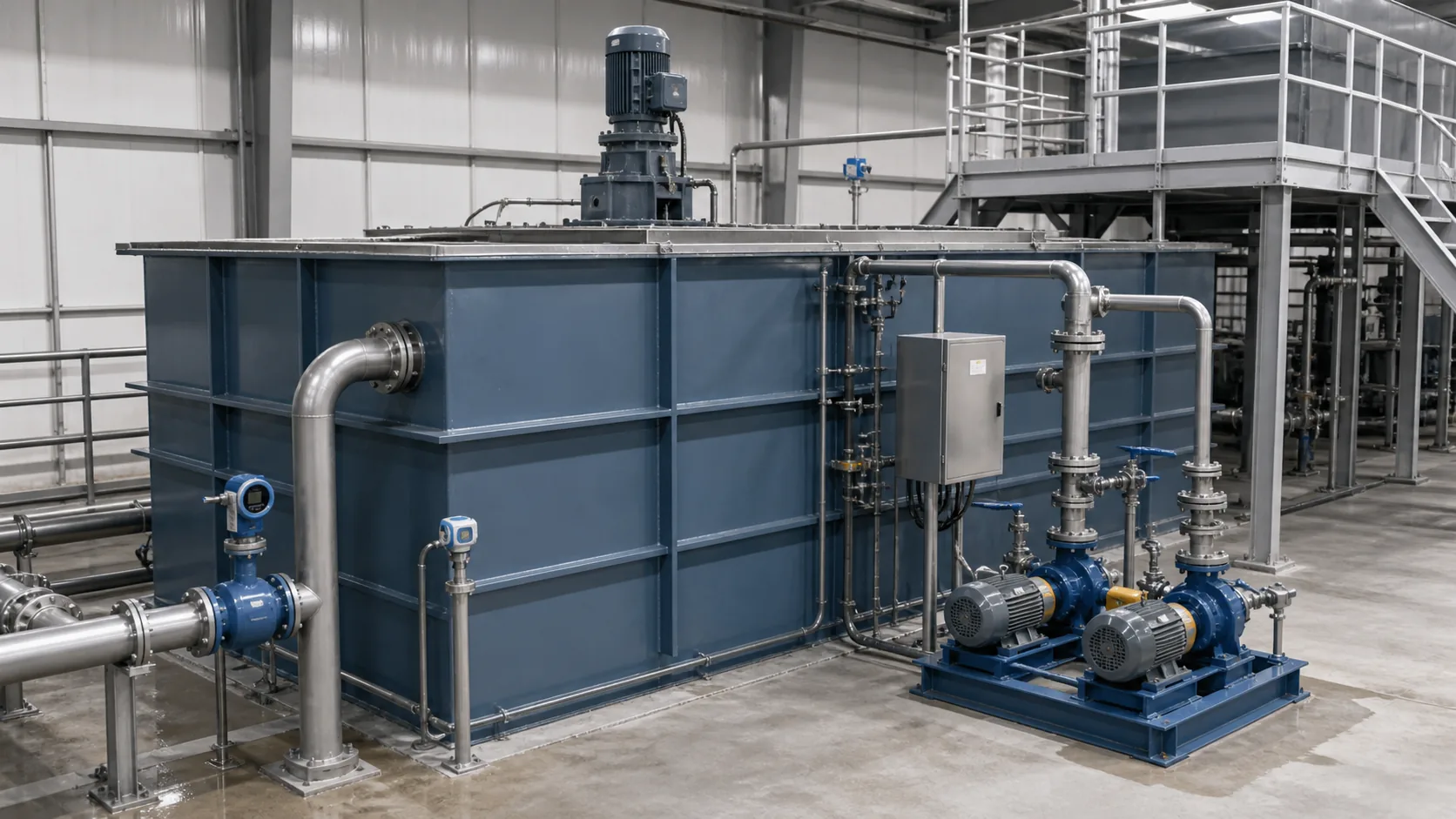
Equalization is often discussed as a tank placed before treatment. In practice, it is a function: reducing the impact of hydraulic and quality fluctuations so that later process stages can operate within a defined range.
Whether equalization is appropriate, and how it should be configured, depends on the discharge pattern, compatibility of streams, mixing and aeration needs, retention time, safety requirements, and available footprint. It should not be assumed that every stream is safe or useful to blend.
For buyers, the key question is: Which variations should be absorbed before treatment, and which streams should remain separate? The answer affects more than tank volume. It can change the collection layout, pumping arrangement, instrumentation, chemical dosing approach, and control philosophy.
Common Sizing Mistakes to Avoid
Using only the daily total
This hides peak events, batch discharges, and the available operating hours. A daily total is a starting point, not a complete design basis.
Treating one sample as the entire wastewater story
One sample may not represent every shift, product, cleaning cycle, or concentrated side stream. Record what the sample represents and what remains unknown.
Mixing streams before understanding compatibility
Combining streams can simplify piping but may create safety, treatment, or residuals-management problems. Stream segregation should be reviewed before a final layout is fixed.
Leaving site interfaces until shipment
Flow sizing and process selection must eventually connect to available power, drainage, installation access, foundations, lifting, and maintenance space. These interfaces should be visible in the inquiry stage.
Questions to Ask When Reviewing a Supplier Proposal
When proposals arrive, check whether each supplier has stated the same design basis. Useful questions include:
- Which average, peak, and batch flow assumptions were used?
- Which water-quality data were treated as confirmed, and which were assumptions?
- Are critical streams segregated, blended, or buffered? Why?
- What treatment objective does the proposal address?
- What residuals remain outside the stated equipment scope?
- Which site utilities and installation interfaces are assumed?
- What factory testing, documents, shipment inspection, and commissioning support are included?
This makes the discussion more meaningful than comparing only the equipment headline or total price. It also gives both sides an early opportunity to resolve gaps before fabrication and delivery planning begin.
Frequently Asked Questions
Can a wastewater treatment system be sized from daily flow alone?
No. Daily flow is useful, but the design basis also needs the operating window, peak flow, batch releases, water-quality variability, treatment target, and available site conditions.
What should I do if I do not have flow measurements yet?
Share production records, tank volumes, discharge timing, operating hours, and any available estimates. Mark them as estimates. A supplier can then identify the most important measurements or samples needed before finalizing the scope.
Is peak flow always the same as batch discharge?
No. Peak flow describes a hydraulic maximum over a period. A batch discharge is a distinct event that may have a different composition, temperature, or concentration from the normal stream.
Can a supplier guarantee treatment performance from one water sample?
One sample can help with preliminary planning, but it may not represent every operating condition. Final performance commitments should be tied to an agreed design basis, defined sampling assumptions, and project scope.
Does system sizing include installation and commissioning?
Sizing is one part of the project definition. Installation, utilities, site interfaces, factory testing, shipment inspection, and commissioning support should be clarified as separate scope items in the proposal.
Conclusion
Industrial wastewater treatment system sizing starts with a realistic picture of how water is generated, not just how much is generated. By separating average flow, peak flow, batch events, operating hours, and water-quality variability, a buyer gives the engineering team the information needed to develop a more comparable and practical treatment proposal.
For a project discussion, prepare the flow profile, available analysis, treatment objective, operating schedule, site constraints, and intended delivery scope. Where data is incomplete, list the uncertainties openly. That is usually more useful than presenting a single number with false precision.