A wastewater evaporator may be advertised by its evaporation capacity, construction material, and energy source. Those details are necessary, but they do not establish whether the equipment can operate reliably on a particular industrial wastewater.
The liquid changes as water is removed. Material that appears manageable at the inlet may become concentrated, viscous, difficult to transfer, or prone to deposits. The recovered condensate may also require further treatment before it is suitable for the intended reuse.
For buyers considering mechanical vapor recompression, or MVR, the most valuable early question is therefore not only “Which model should we buy?” It is “What evidence defines the safe and practical operating range for our feed?”
This guide explains how to prepare a useful feed-testing program and connect the findings to equipment selection, quotation review, and performance acceptance.
Quick Answer: What Should Be Tested Before Buying an MVR Evaporator?
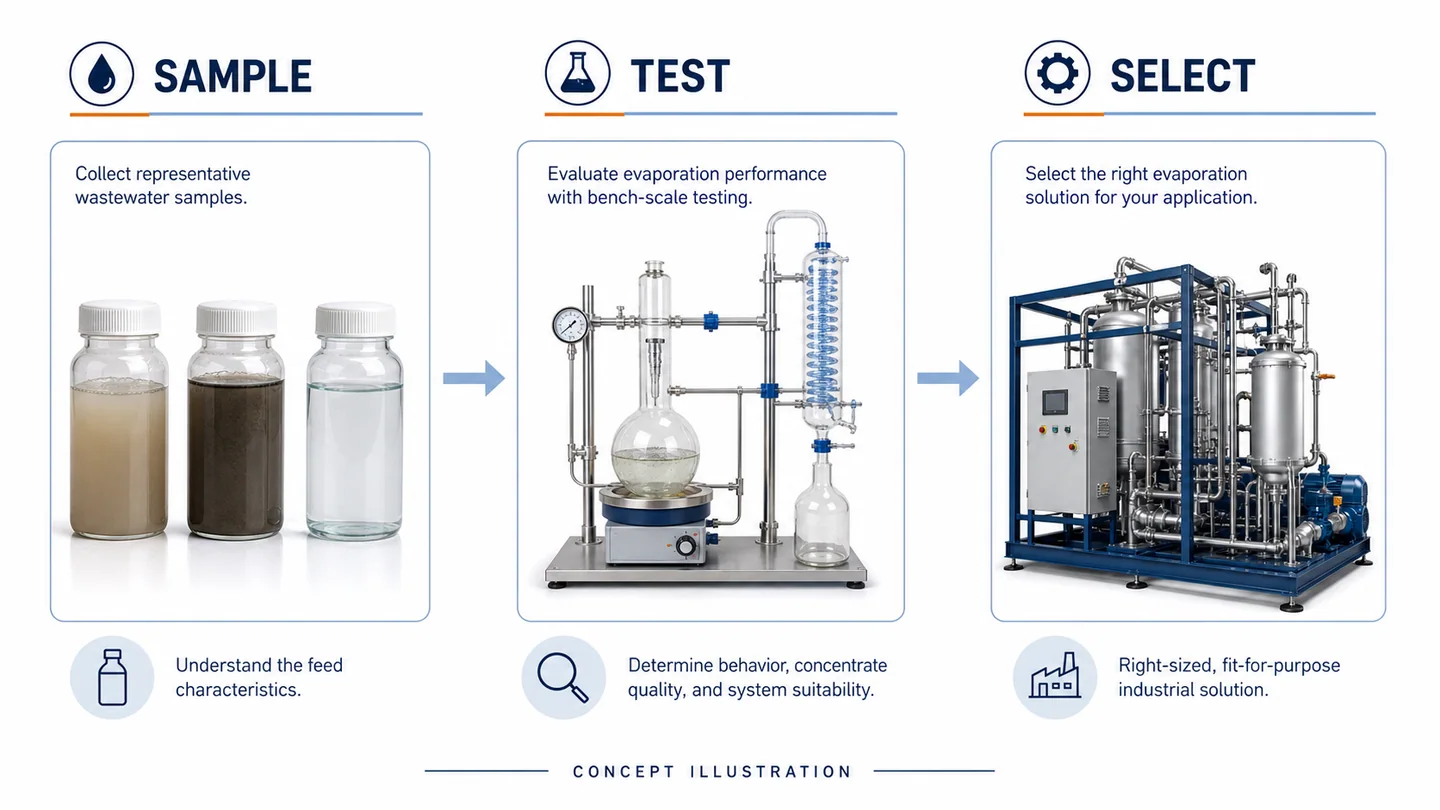
A useful test program should characterize the incoming wastewater and evaluate how it behaves as concentration increases.
The required information may include composition, solids, density, viscosity, boiling behavior, deposits, foaming, condensate quality, and the properties of the final concentrate.
Testing should also define the proposed concentration endpoint and identify conditions that prevent stable operation.
The result is not simply a photograph of clear condensate. It should be a documented basis for process selection, material review, mass balance, cleaning provisions, and acceptance conditions.
The depth of testing should match the uncertainty and consequences of a wrong purchasing decision.
1. Define What the Evaporation System Must Achieve
Wastewater evaporation can serve different objectives:
- Reduce liquid waste volume.
- Recover water for a defined reuse.
- Concentrate a process stream.
- Prepare material for another separation step.
- Support a wider waste-minimization strategy.
These are not interchangeable duties.
A buyer seeking lower off-site disposal volume may accept a different condensate treatment arrangement from a factory intending to reuse that water in a sensitive process.
Similarly, producing a pumpable concentrate is different from deliberately producing crystals or a dry residue.
Write down:
- The feed stream included in the project.
- Required feed-processing rate.
- Expected operating schedule.
- Intended concentrate condition.
- Required condensate quality.
- Available routes for remaining waste.
- Utility and site constraints.
Avoid using “zero liquid discharge” as a substitute for this definition. The complete site balance must account for remaining liquid streams, cleaning solutions, and other outputs before such a claim is justified.
2. Separate Waste Streams Before Taking a Representative Sample
A composite sample is useful only if it represents the proposed evaporator feed.
First establish which streams will be combined and which will remain separate. Production rinses, spent baths, cleaning waste, and membrane concentrate may have different characteristics.
Do not combine unfamiliar chemical streams simply to simplify sampling. Compatibility and safe handling should be reviewed by qualified personnel using the available chemical information.
For each sample, record:
- Collection location.
- Production activity.
- Date and time.
- Relevant upstream treatment.
- Whether it represents a batch or mixed tank.
- Recent chemical additions.
- Known abnormal events.
- Storage and transport conditions.
Ask the testing laboratory or equipment specialist how much sample is needed and how it should be preserved. Different measurements may require different containers or handling.
Where composition varies substantially, a single average sample may conceal the condition that controls equipment selection. A better plan may include normal feed and a defined credible high-load condition, supported by historical analysis.
The objective is traceability: every result should be connected to an identified feed situation.
3. Build an Analytical Package Around the Actual Process
“High TDS wastewater” is too broad to serve as a complete evaporator specification.
Useful analysis may include major dissolved constituents, suspended solids, relevant organic contamination, pH, density, and specific substances associated with the production process.
The exact list should be selected for the application rather than copied from an unrelated industry.
For example, the testing team may need to understand whether the feed includes:
- Constituents likely to form deposits.
- Dissolved material that may crystallize.
- Volatile compounds relevant to condensate quality.
- Components affecting material compatibility.
- Fine solids affecting circulation or separation.
- Organic compounds that change during heating.
Do not assume that conductivity identifies the chemical composition. Two streams with similar conductivity can behave differently during concentration.
GEA describes viscosity, boiling point elevation, thermal conductivity, and solids concentration among the properties evaluated in its evaporation test facilities. This illustrates why an evaporator assessment extends beyond a standard inlet water analysis.GEA evaporation test center
For procurement, ask the supplier which missing measurements materially affect its design and which assumptions remain in the quotation.
4. Distinguish Feed Capacity from Evaporation Capacity
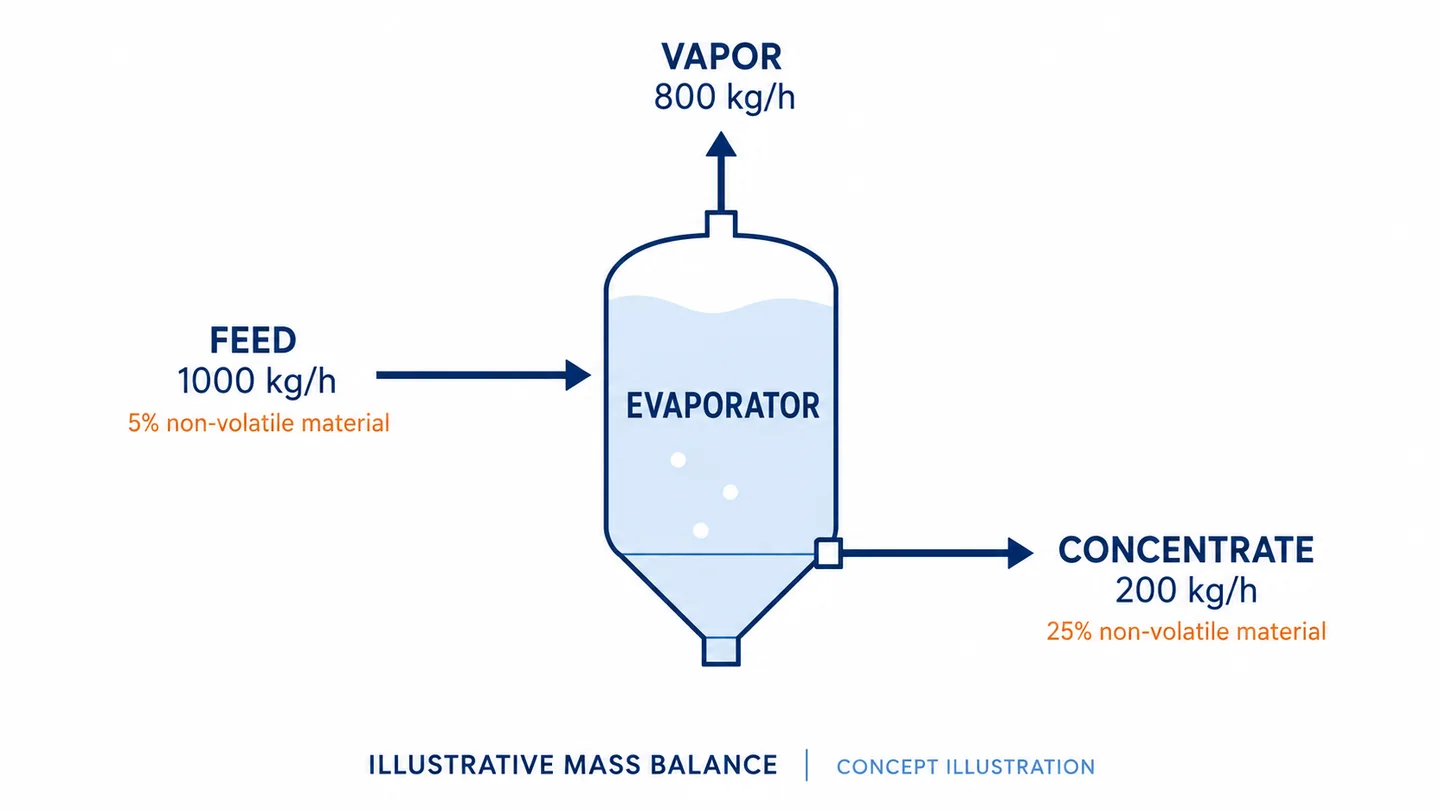
Use a simple mass balance
Consider an illustrative feed:
- Feed rate: 1,000 kg/h.
- Non-volatile dissolved material: 5% by mass.
- Proposed concentrate: 25% non-volatile material by mass.
Assume that all of that non-volatile material remains in the concentrate, with no other losses or additions.
Incoming non-volatile material is:
1,000 × 0.05 = 50 kg/h
Required concentrate flow is:
50 ÷ 0.25 = 200 kg/h
Calculated vapor production is:
1,000 − 200 = 800 kg/h
This example describes an idealized balance. It is not a Baihuipu project result and does not establish that the wastewater can actually reach 25% concentration.
Why the distinction matters
An evaporator rated for 1,000 kg/h of water evaporation is not the same as a system rated for 1,000 kg/h of feed processing.
Ask the supplier to identify:
- Incoming feed rate.
- Evaporated water rate.
- Concentrate rate.
- Relevant losses and additional streams.
- Basis of each density conversion.
- Conditions supporting the proposed endpoint.
For real wastewater, the balance may need to include suspended solids, volatile material, cleaning streams, and deliberate additions. A more complete balance should replace the simple example before a performance guarantee is agreed.
5. Test Toward the Proposed Concentration Endpoint
A test stopped shortly after boiling begins may show that evaporation is possible, but it does not demonstrate the proposed final duty.
Request observations and samples at meaningful concentration stages.
The test record should explain:
- How concentration is calculated or measured.
- How the liquid changes during the test.
- Whether deposits appear.
- Whether transfer remains practical.
- What limits continued concentration.
- Whether the endpoint can be reproduced.
The endpoint should be described as an operating condition, not only a percentage printed in a brochure.
Also discuss shutdown and restart. A concentrate that transfers while hot may behave differently after cooling. The proposed storage and transfer arrangements should therefore be reviewed against the conditions they will actually experience.
If the test identifies a lower practical endpoint than originally assumed, update the mass balance and waste-volume estimate before comparing equipment prices.
A less aggressive but well-supported duty may be more useful than a higher concentration target that cannot be maintained reliably.
6. Investigate Foaming and Condensate Quality Together
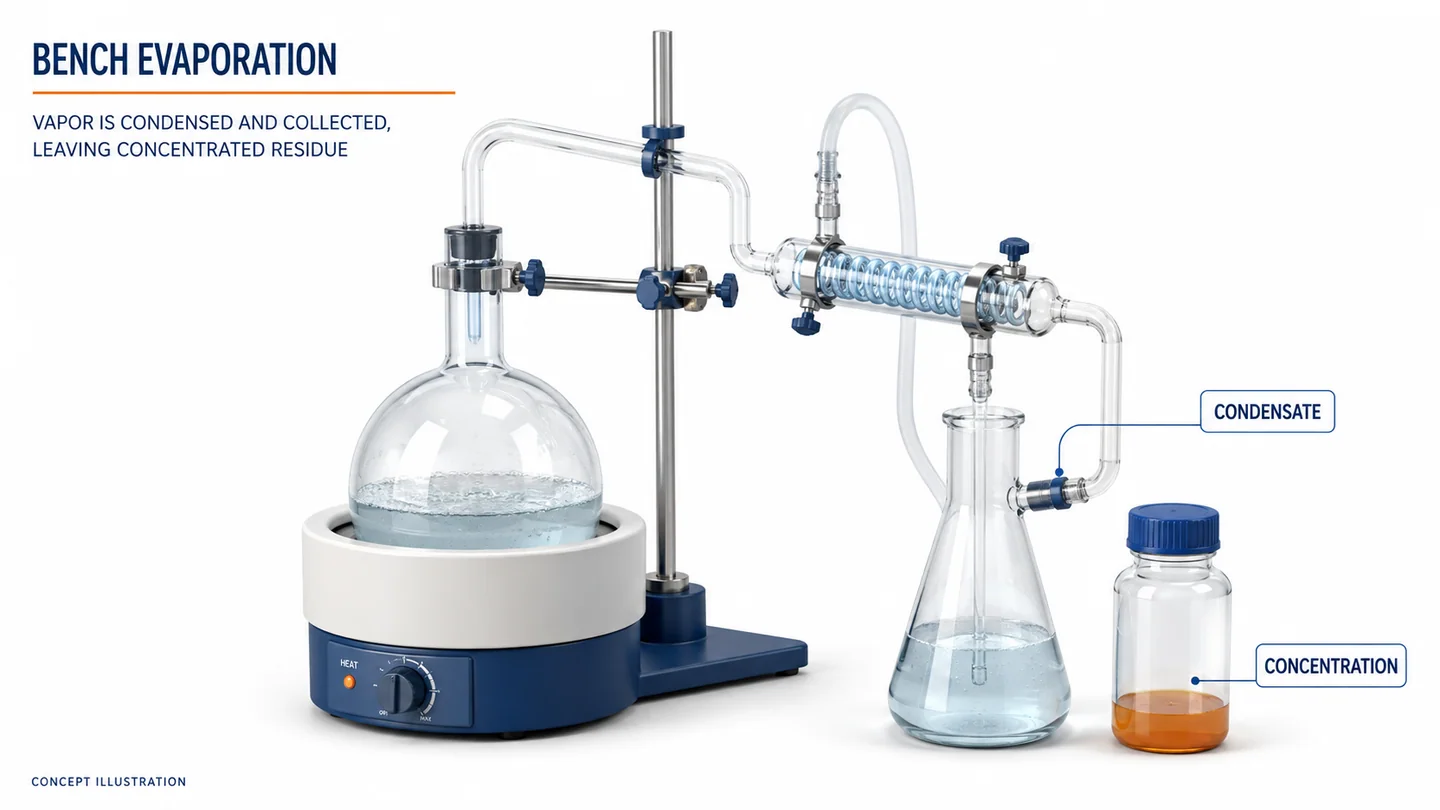
Foam can complicate the separation between the liquid being concentrated and the vapor stream.
The relevant test question is not merely whether foam appears, but how it behaves under the proposed conditions and what effect it has on the process outputs.
Ask the test plan to address:
- Conditions associated with foaming.
- Observable liquid carryover.
- Condensate sampling.
- Response to operating adjustments.
- Any proposed additive and its consequences.
- Cleaning and inspection implications.
Veolia identifies condensate quality, boiling-point rise, foaming, fouling, and physical properties among the subjects of evaporation laboratory work. Its described pilot work also examines operating behavior that cannot be established from composition alone.Veolia laboratory services
Condensate should be tested against the intended reuse requirement. Low salt content or clear appearance does not prove that every relevant organic or volatile contaminant has been removed.
If polishing is needed, include it in the process scope and cost comparison rather than treating it as an unexpected addition after commissioning.
7. Turn Deposit Observations into a Cleaning Strategy
A test report should do more than state that “some scaling occurred.”
The buyer needs to understand where deposits formed, under what conditions, and what the observation means for the proposed equipment.
Questions for the technical review include:
- Were deposits observed on heated surfaces or elsewhere?
- Did the condition change with concentration?
- Could the material be removed using the proposed procedure?
- What parts need inspection access?
- Which cleaning streams require collection?
- What downtime has been included in the operating plan?
Do not treat a short clean test as proof of a long uninterrupted operating campaign. The strength of the conclusion depends on test duration, conditions, and how closely the equipment represents the proposed duty.
The cleaning procedure should also be compatible with the selected equipment and known feed. It should be developed by qualified personnel rather than improvised from generic chemical recommendations.
Before ordering, ask which cleaning provisions are included physically: connections, circulation equipment, drainage, access, and control functions.
8. Understand Why MVR Selection Needs More Than a Power Figure
MVR recovers useful heat by compressing vapor for reuse within the evaporation process. Whether it is suitable for a particular wastewater depends on the complete thermal and process design.
For purchasing purposes, ask the supplier to explain how the tested feed properties influence:
- Proposed operating conditions.
- Heat-transfer arrangement.
- Vapor-handling scope.
- Circulation requirements.
- Start-up utilities.
- Expected operating range.
- Cleaning and maintenance provisions.
Boiling point elevation is especially relevant to the thermal design: a solution may boil at a different temperature from pure water at the same pressure. The importance of that difference depends on the application.
GEA’s evaporation technology material identifies boiling behavior, viscosity, solubility, foaming, fouling, and precipitation among the considerations affecting evaporator selection.GEA evaporation technology
Do not select the package from an isolated “kWh per tonne” claim without knowing the feed, endpoint, utilities included, and operating conditions.
For the broader comparison between evaporation arrangements, see MVR, MEE, and wastewater evaporator selection.
9. Match the Testing Level to the Remaining Risk
Not every project requires the same test program.
A well-characterized stream with relevant operating evidence may need a different level of verification from a highly variable or unfamiliar wastewater.
Separate the questions that can be answered by:
- Laboratory analysis.
- Bench concentration tests.
- Material-compatibility review.
- Pilot operation.
- Site performance testing.
A pilot should have a written purpose. “Run the wastewater” is not sufficient.
Define which uncertainty it is intended to reduce—for example, a practical concentration endpoint, condensate treatment requirement, or behavior over an extended operating period.
Pilot testing can examine process behavior under a controlled protocol, but the conclusions must remain within the tested conditions. Veolia describes pilot work as a means of evaluating treatment options and operating parameters before full-scale decisions.Veolia pilot testing
Where a question remains unresolved, keep it visible in the proposal. An explicit limitation is more useful than an unsupported full-scale promise.
10. Convert Results into a Purchasable Design Basis
The test report and quotation should connect to each other.
Prepare a design-basis table identifying:
| Item | Required definition |
|---|---|
| Feed | Included streams and composition range |
| Capacity | Feed processing and evaporation rate |
| Endpoint | Concentrate condition and limitations |
| Condensate | Quality requirements and polishing scope |
| Operating schedule | Production, cleaning, shutdown periods |
| Utilities | Start-up and normal-operation requirements |
| Materials | Selected scope and review basis |
| Waste streams | Concentrate, cleaning liquid, other outputs |
| Controls | Included measurements and protective actions |
| Acceptance | Conditions, measurements, responsibilities |
Label assumptions separately from measured results.
For example, if the final concentrate density is assumed rather than measured, do not present the resulting tank-volume estimate as a verified project fact.
Ask suppliers to price the same duty and identify deviations. Otherwise, one package may appear cheaper because it assumes a lower endpoint, excludes condensate polishing, or leaves waste transfer outside its scope.
11. Review Factory Testing, Shipment Inspection, and Site Acceptance
Factory testing should verify the agreed equipment and functional scope. Depending on the package, this may include assembly checks, instrument functions, control sequences, alarms, and specified tests of individual systems.
Those checks are different from proving performance on the actual wastewater.
Shipment inspection should cover identification, packing, protected connections, loose components, and the documents required for installation preparation.
At site, performance acceptance should define:
- Representative feed conditions.
- Stable operating period.
- Feed and product measurements.
- Concentrate sampling.
- Condensate sampling.
- Utility measurement boundaries.
- Handling of interruptions.
- Conditions requiring retesting.
If energy consumption is part of acceptance, define which equipment is metered and whether start-up or cleaning periods are included.
If a long operating campaign is important, make it a separate, clearly stated verification objective. A brief commissioning run should not be silently converted into evidence of long-term availability.
Frequently Asked Questions
Is a wastewater analysis enough to select an evaporator?
It is an essential starting point, but it may not show how the wastewater behaves during concentration. Additional testing can be necessary to investigate the endpoint, deposits, foaming, condensate quality, or transfer behavior.
Does clear condensate mean the water can be reused?
No. Reuse depends on the receiving application and measured quality. Relevant volatile or other contaminants may require analysis and additional treatment even when the condensate looks clear.
Can a beaker test prove full-scale MVR performance?
A bench test can reduce important uncertainties, but it does not automatically reproduce full-scale heat transfer, circulation, vapor separation, controls, or operating duration. Its limitations should be stated.
Should I specify the highest possible concentration?
Specify a useful and supportable endpoint. Higher concentration is not automatically better if it creates transfer problems, excessive cleaning, unstable operation, or an unsuitable final waste.
Is MVR always the lowest-cost choice?
No universal conclusion is appropriate. Compare the complete duty, utilities, feed behavior, operating schedule, maintenance, and downstream requirements. A generic efficiency claim is not a substitute for a project-specific assessment.
What should I send with an evaporator RFQ?
Provide feed analysis, stream origins, quantity, variability, current treatment, desired endpoint, condensate reuse requirements, available utilities, operating hours, and previous tests. Identify known hazardous ingredients and handling constraints.
Conclusion: Purchase a Verified Operating Range
The purpose of wastewater evaporator feed testing is to connect an actual waste stream to a defensible equipment duty.
A strong purchasing package combines traceable samples, relevant concentration testing, a transparent mass balance, practical waste handling, and clearly bounded acceptance requirements.
The most useful result is not an unsupported maximum concentration or energy promise. It is an operating range that the buyer and supplier understand in the same way.
Explore Baihuipu’s wastewater evaporators to discuss the application and supply scope.