Introduction
Wastewater evaporator selection is often simplified to “Is MVR better than MEE?” The first question is whether the feed can be concentrated reliably. High-chloride brine, silica-rich RO concentrate, metal-bearing wastewater, foaming organic streams, and crystallizing slurry behave differently, and the same feed can change between startup, normal production, cleaning, and final concentration.
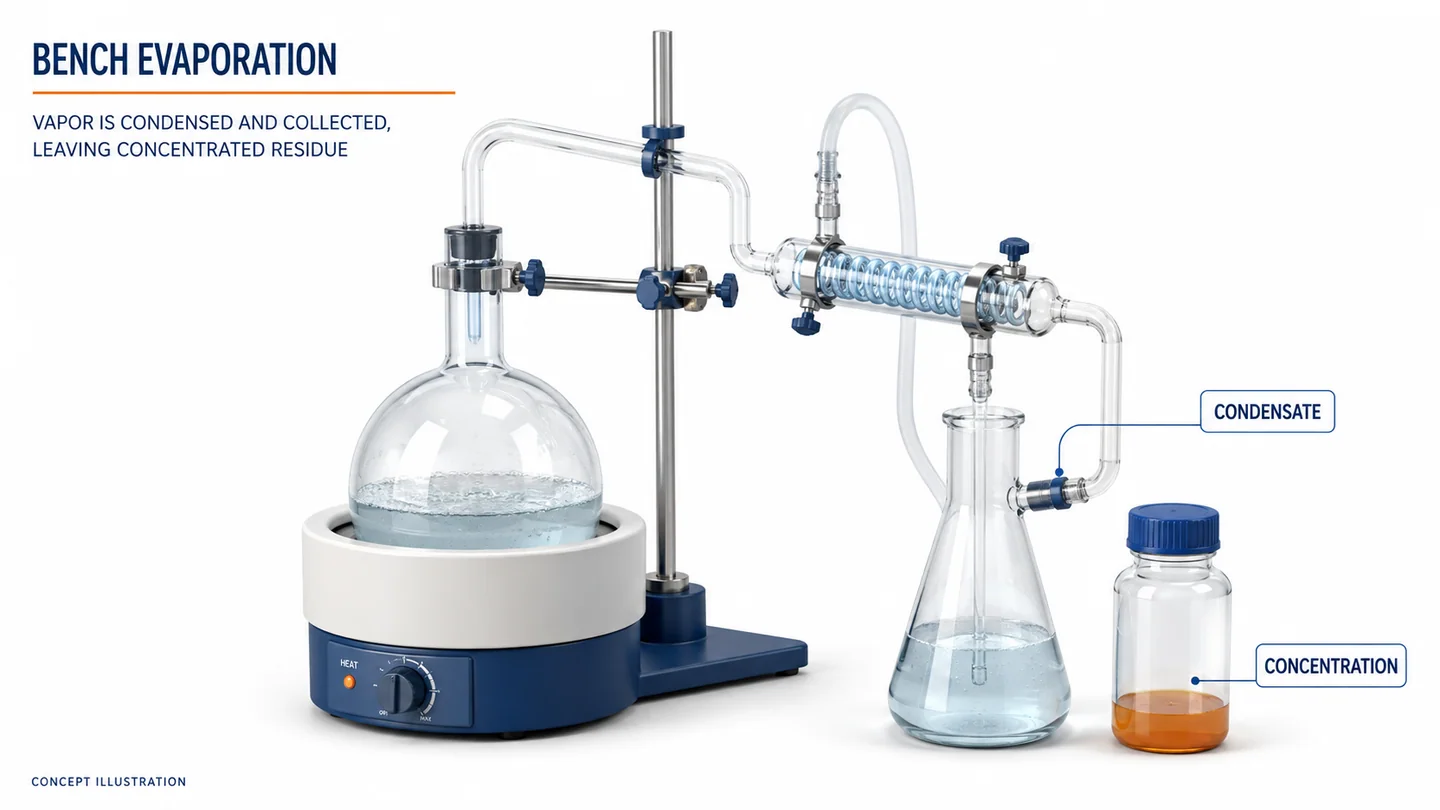
After feed behavior is understood, compare energy sources and heat recovery. MVR primarily uses electricity to compress and reuse vapor. MEE reuses vapor from one effect in another and normally relies on steam or another thermal source. TVR uses motive steam to recompress part of the vapor.
Flow configuration is another decision. Falling-film equipment can offer short residence time and efficient heat transfer for suitable clean, low-viscosity feeds. Forced circulation can provide higher velocity and better control for scaling, high-solids, viscous, or crystallizing duties, although it increases pumping and mechanical requirements. An MVR system may use falling-film or forced-circulation equipment; an MEE system may also use either arrangement.
This guide provides a practical route from wastewater data to a defensible evaporator RFQ. It also explains where an evaporator fits in brine concentration and zero liquid discharge, what should be checked at the factory, and which proposal assumptions deserve the closest review.
First define the project objective
“Evaporate wastewater” is not a complete process objective. Define what the project must deliver.
Possible objectives include:
- reduce wastewater volume before off-site disposal;
- concentrate reverse-osmosis reject;
- recover condensate for reuse;
- reach a specified concentrate density or solids content;
- produce a pumpable slurry;
- feed a crystallizer or dryer;
- achieve minimum liquid discharge;
- support a complete zero-liquid-discharge route.
The final concentrate or solids destination matters as much as the distillate. If the project only needs volume reduction, operating close to the crystallization limit may add unnecessary complexity. If the project requires dry or dewaterable solids, the scope may need a crystallizer, centrifuge, filter press, dryer, or another solids-handling step after the brine concentrator.
Does an evaporator alone achieve zero liquid discharge?
Not necessarily. An evaporator can recover condensate and produce a concentrated liquid or slurry. A complete ZLD route must address all remaining liquid streams and provide an acceptable final solids or residuals pathway.
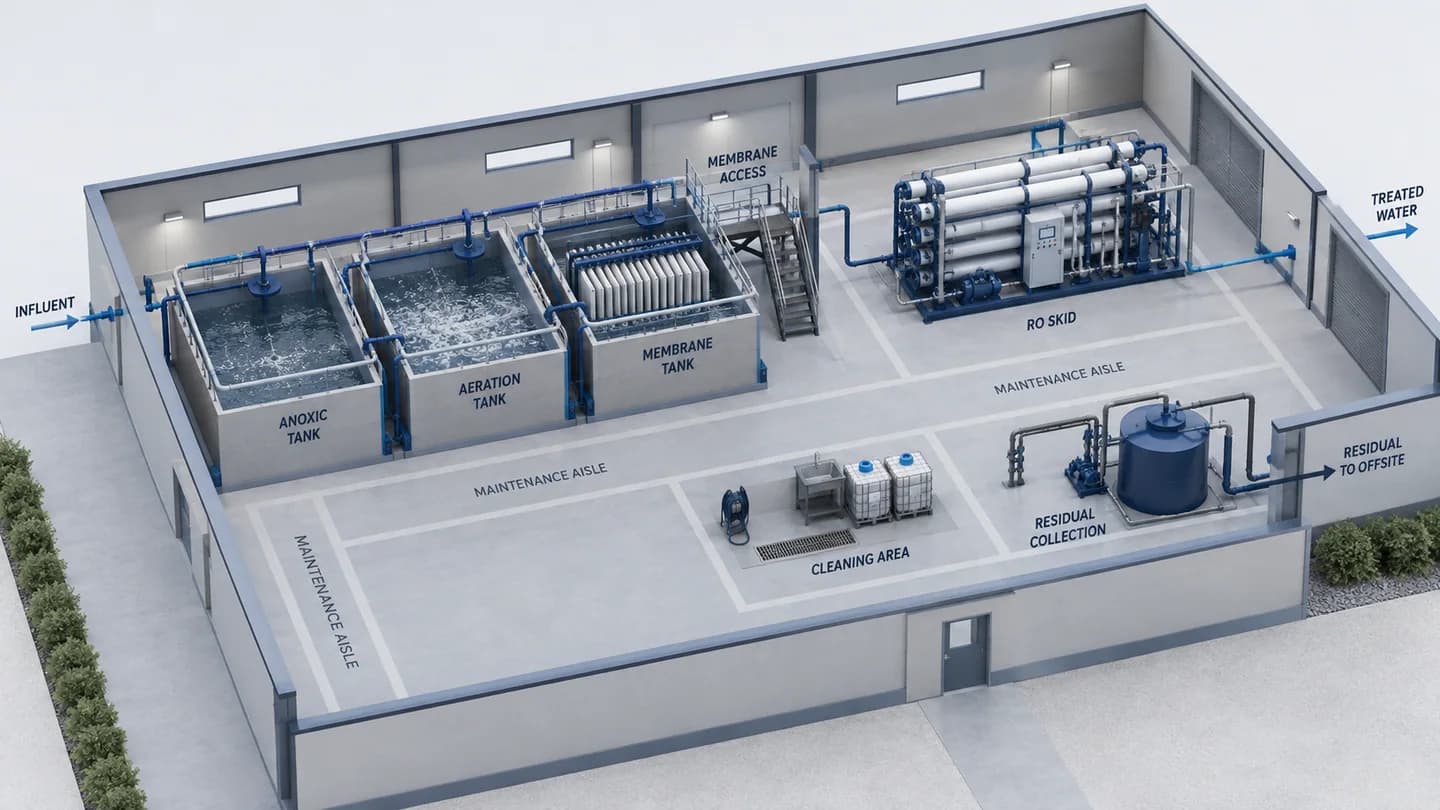
The US Bureau of Reclamation describes a conventional thermal ZLD route as brine concentration followed by crystallization. Actual industrial projects may combine pretreatment, membranes, evaporation, crystallization, solids dewatering, condensate polishing, and reuse. The selected boundary should state whether the proposal covers only an evaporator or the complete liquid and solids balance.
Avoid describing a volume-reduction system as ZLD unless the remaining concentrate, cleaning waste, seal water, scrubber liquid, and other side streams are included in the stated design boundary.
The 10 data sets required for evaporator selection
1. Feed flow and evaporation load
Feed flow is not the same as evaporation capacity. The project should calculate how much water must be removed to reach the target concentration.
For a simple steady-state illustration with non-volatile dissolved solids and no precipitation:
Feed solids = Concentrate solids
If the feed flow is 10,000 kg/h at 5% dissolved solids and the target concentrate is 20% solids, the solids flow is 500 kg/h. The concentrate flow would be approximately 2,500 kg/h, so the theoretical water removal would be approximately 7,500 kg/h before allowing for other streams and real operating conditions.
This is only a mass-balance illustration. Real wastewater may precipitate salts, contain suspended solids, release gases, produce volatile organics, or require blowdown and cleaning streams. The supplier should show the mass balance and state the feed, product, concentrate, and side-stream assumptions.
2. Ionic composition and concentration range
TDS alone does not describe a brine. Ion composition determines solubility, scaling sequence, corrosion risk, boiling-point elevation, and possible precipitates.
Useful data include major cations and anions, silica, metals, ammonium, alkalinity, pH, total and suspended solids, temperature, conductivity, and minimum-to-maximum variation.
Provide individual ions where possible rather than only “salinity.” An ion balance and repeated samples help identify inconsistent laboratory data.
3. Organic load, volatility, and foaming
COD can indicate organic load but does not identify compounds. Some organics transfer into vapor and condensate; others foam, polymerize, degrade, increase viscosity, or form deposits. Describe production chemicals, solvents, surfactants, oils, cleaning agents, and unusual odors. Review volatile transfer and condensate polishing if the water will be reused or discharged.
Laboratory evaporation or vapor-liquid testing may be appropriate when organic behavior is uncertain. A design that assumes every contaminant remains in the concentrate can produce an unexpected condensate-quality problem.
4. Scaling and precipitation behavior
As water is removed, dissolved species approach saturation. Calcium carbonate, calcium sulfate, silica, metal hydroxides, and other salts may precipitate depending on chemistry and temperature.
Review which species reach saturation first, whether precipitation is prevented or intentionally seeded, allowable wall temperature, heat-exchanger velocity, residence time, cleaning method, and the route by which solids leave the system.
Pretreatment may include pH adjustment, softening, clarification, filtration, ion exchange, membrane separation, or selective removal of a scaling species. Pretreatment should be justified by the complete process balance: removing one ion can reduce evaporator risk but create sludge, chemical consumption, and additional wastewater.
5. Boiling-point elevation
Dissolved salts and other solutes can raise the boiling temperature of a solution relative to pure water at the same pressure. This boiling-point elevation reduces the effective temperature difference available for heat transfer.
It is particularly important for MVR because the vapor compressor must provide enough temperature lift to overcome boiling-point elevation plus heat-transfer and system losses. A project that looks attractive at low concentration may require different compression or staging near the final concentration.
Do not assume that conductivity can be converted directly into a reliable boiling-point elevation for a complex mixed brine. Laboratory data, thermodynamic modelling, or a justified conservative basis may be needed.
6. Viscosity, suspended solids, and crystallization
Viscosity generally increases as a stream becomes concentrated, reducing heat transfer and affecting pump duty. Suspended solids can settle, erode components, block distributors, or deposit on surfaces. Intentional crystallization requires controlled supersaturation, circulation, crystal growth, separation, and mother-liquor management.
Provide any existing rheology, settling, or filtration data. If the final product is expected to be a slurry, specify the target solids fraction, crystal-handling method, and downstream dewatering equipment.
7. Corrosion and materials compatibility
Chloride, fluoride, acidity, oxidants, temperature, and concentration can create demanding corrosion conditions. Material selection may differ between feed, vapor, condensate, concentrated brine, and cleaning circuits.
The supplier should identify key wetted materials, lining or coating systems, gasket and seal materials, and corrosion assumptions. “Stainless steel construction” is not a complete description. Premium material should be used where justified, while unnecessary alloy specification can make a project uneconomical.
8. Utility availability and price
Compare electricity, steam, waste heat, cooling water, compressed air, and clean-water availability at the actual site.
For each utility, provide:
- pressure, temperature, quality, and available capacity;
- operating reliability;
- local unit cost;
- seasonal or contractual constraints;
- recovery or integration opportunities.
MVR may reduce fresh-steam demand but requires electrical power and a suitable compressor operating range. MEE may fit a site with economical steam or waste heat. TVR may be attractive when motive steam is available at the required condition. The lowest theoretical energy consumption does not automatically produce the lowest lifecycle cost if maintenance, turndown, fouling, or utility reliability is poor.
9. Operating pattern and turndown
Define whether the system operates continuously, by campaign, or intermittently. Frequent startup and shutdown can affect thermal stress, cleaning, vacuum stability, crystallization, and operator workload.
Provide minimum and maximum feed rates, feed storage, production schedule, and required availability. The supplier should state stable turndown and the low-load strategy. Equalization or modular trains may be better than forcing one large unit to follow highly variable feed.
10. Condensate and residuals requirements
Condensate is not automatically reusable water. Its quality depends on entrainment control, volatile contaminants, separator performance, operating conditions, and possible leakage.
Define:
- condensate destination;
- required conductivity, COD, TOC, ammonia, or other parameters;
- online monitoring and diversion logic;
- polishing treatment, if required;
- concentrate or slurry destination;
- solids classification and disposal route;
- treatment of cleaning and off-spec streams.
The water balance should include all liquid streams, not only the main feed and condensate.
MVR vs MEE vs TVR: how the heat is reused
Mechanical vapor recompression (MVR)
MVR compresses generated vapor so that it can return as a heating medium. It is often considered where electricity is reliable, fresh steam is limited, and the feed behavior allows a practical compressor temperature lift.
Review boiling-point elevation, compressor type and operating envelope, startup heat, anti-surge and low-load strategy, entrainment protection, vibration, service access, and power quality.
MVR is not automatically the best route for every high-salinity stream. High boiling-point elevation, severe fouling, wide turndown, or unstable feed may require staging, hybrid operation, or a different heat-recovery arrangement.
Multiple-effect evaporation (MEE)
MEE sends vapor from one effect to heat the next effect at a lower pressure and temperature. It can reduce fresh-steam consumption compared with a single effect and may fit sites with established steam systems or useful waste heat.
Review effect count, temperature range, steam and condensate conditions, vacuum design, fouling allowance, liquid distribution, cleaning access, building height, and footprint.
More effects do not provide unlimited benefit. Each effect adds equipment, controls, heat-transfer area, pressure balance, and maintenance requirements.
Thermal vapor recompression (TVR)
TVR uses motive steam in a thermocompressor to recompress part of the vapor. It may suit a stable duty with appropriate steam pressure. The proposal should state steam consumption, operating range, discharge pressure, and behavior as feed or concentration changes.
Falling film vs forced circulation: how the liquid moves
Falling-film evaporators
In a falling-film unit, liquid is distributed as a thin film over heat-transfer surfaces. The configuration can provide good heat transfer and short residence time when distribution is stable and the feed is suitable.
It is generally more comfortable with relatively clean, low-viscosity, non-crystallizing liquids. Poor distribution, low flow, scaling, or solids can create dry areas and deposits. Feed distribution and minimum wetting are therefore critical.
Forced-circulation evaporators
Forced circulation uses a pump to maintain liquid velocity through the heat exchanger and separates vapor in another vessel or zone. It is often considered for higher-solids, scaling, viscous, or crystallizing duties where surface wetting and solids suspension require stronger circulation.
Tradeoffs include pump energy, erosion, larger equipment, seals, and slurry management. The design should state circulation rate, velocity basis, materials, solids allowance, and cleaning access.
These are not competing categories
An important procurement point is that “MVR vs forced circulation” is not a technically complete comparison. MVR describes vapor-energy recovery. Forced circulation describes the liquid-side configuration. A forced-circulation evaporator can use MVR, steam in a single or multiple effect, or another heat source. The proposal should describe both axes.
A practical selection matrix
| Project condition | Route to evaluate first | Important caution |
|---|---|---|
| Clean, low-viscosity, heat-sensitive feed | Falling film with suitable heat-recovery arrangement | Confirm minimum wetting, distribution, and fouling behavior |
| High solids or scaling tendency | Forced circulation | Check pump energy, erosion, solids separation, and cleaning |
| Reliable electricity, limited steam | MVR | Confirm boiling-point elevation, compressor lift, and turndown |
| Economical steam or usable waste heat | MEE or TVR/MEE hybrid | Confirm steam balance, vacuum, condensate return, and effect count |
| Final crystallization required | Forced-circulation crystallizer or defined finishing step | Brine concentration alone is not the complete solids route |
| Variable feed or batch production | Equalization, modular trains, or flexible hybrid route | Confirm stable minimum load and startup/shutdown losses |
| Volatile organics or ammonia | Evaporation plus vapor/condensate management | Do not assume condensate automatically meets reuse limits |
| High chloride, fluoride, or aggressive chemistry | Corrosion-focused material and process review | Material must be selected for final concentration and temperature |
This table is a screening tool, not a final design rule. Pilot or laboratory work may be justified where solubility, foaming, scaling, or volatile transfer is uncertain.
Pretreatment can determine evaporator reliability
Evaporator reliability may depend on upstream equalization, pH control, oil and solids removal, hardness or silica management, metal precipitation, biological treatment, or membrane concentration.
Evaluate pretreatment by total lifecycle impact: softening creates sludge, antiscalant can affect crystallization, and membrane preconcentration adds pressure, fouling, and cleaning requirements. Use a complete mass balance; optimizing one unit in isolation can increase cost elsewhere.
Factory testing and shipment inspection
Evaporator factory acceptance should follow an agreed inspection and test plan. Depending on assembly and available utilities, it may verify materials and components, fabrication records, vessel tests, pump alignment, vacuum functions, panels, PLC alarms and interlocks, instruments, compressor protection, clean-water circulation, documentation, preservation, and packing.
A clean-water FAT cannot reproduce boiling-point elevation, scaling, foaming, corrosion, crystallization, or condensate chemistry. Final process acceptance needs an agreed feed envelope, site utilities, methods, stabilization period, and responsibility matrix.
Before shipment, protect heat-transfer surfaces, instruments, compressor connections, vacuum components, seals, and open flanges. Identify loose items and lifting points. Confirm whether refrigerant, oil, chemicals, or preservation media are shipped, drained, or supplied locally.
What to request in a wastewater evaporator proposal
Ask suppliers to provide or clearly state:
- feed design envelope, excluded contaminants, and process assumptions;
- mass and heat balances at normal and maximum conditions;
- evaporation capacity, concentrate target, and complete liquid/solids boundary;
- heat-recovery and liquid-circulation configurations;
- utility loads, boiling-point elevation, fouling, and turndown assumptions;
- pretreatment, materials, condensate quality, and cleaning strategy;
- controls, alarms, startup, shutdown, and off-spec handling;
- FAT, commissioning, and performance-test method;
- exclusions, spares, and service scope.
A responsible supplier should distinguish calculated performance, laboratory evidence, assumptions, and guaranteed conditions.
Frequently asked questions
Is MVR always more energy efficient than MEE?
MVR often reduces fresh-steam demand by reusing compressed vapor, but the correct comparison depends on electrical and steam cost, compressor lift, boiling-point elevation, feed behavior, turndown, fouling, startup, and maintenance. Compare lifecycle cost at the project’s design conditions rather than a generic energy statement.
When is forced circulation preferred?
Forced circulation is often evaluated for scaling, high-solids, viscous, or crystallizing duties where higher liquid velocity and solids suspension improve reliability. It adds circulation-pump power and mechanical complexity, so the design should be based on the actual slurry and heat-transfer duty.
Can an evaporator treat any high-TDS wastewater?
Thermal concentration can treat many streams beyond conventional membrane limits, but not without evaluation. Volatile organics, foaming, corrosion, scaling, heat-sensitive compounds, suspended solids, and hazardous constituents can require pretreatment, material changes, vapor treatment, or another route.
What analysis is needed for an evaporator RFQ?
Provide feed flow, temperature, pH, TDS, individual major ions, hardness, alkalinity, silica, metals, TSS, COD/TOC where relevant, known organics, oils, surfactants, ammonia, minimum/maximum variation, target concentrate, condensate requirement, and utilities. State the sample source and date.
Is condensate automatically suitable for reuse?
No. Entrainment and volatile components can affect condensate. Reuse suitability depends on the next use and its water-quality target. The system may need demisting, online diversion, aeration, carbon, biological treatment, membranes, or another polishing step.
What is the difference between brine concentration and ZLD?
Brine concentration removes water and reduces liquid volume. ZLD requires that the project’s defined wastewater boundary produces no routine liquid discharge, with remaining salts or residuals handled as solids or another approved non-liquid route. An evaporator may be one part of that system.
Conclusion
The right wastewater evaporator is selected from the feed and the site—not from a preference for one acronym.
Start with a representative chemical analysis, evaporation mass balance, concentration objective, expected scaling and volatile behavior, condensate target, operating pattern, and real utility costs. Then compare how vapor energy is reused and how liquid is circulated. MVR, MEE, TVR, falling film, and forced circulation are tools that can be combined around the duty.
The most credible proposal will state its assumptions, define the complete liquid and solids boundary, and separate factory functional checks from site process-performance validation.