When an industrial buyer asks whether MBR or RO is better for wastewater reuse, the question often combines two different treatment duties. A membrane bioreactor treats suitable biodegradable pollution and separates biomass. Reverse osmosis separates water from many dissolved constituents.
The equipment names both contain a membrane concept, but the processes are not interchangeable. Selecting one from the purchase price or the appearance of its effluent can leave an important water-quality requirement unaddressed.
A better purchasing question is: what contamination must be removed, what quality does the receiving application require, and which treatment train can reliably connect those two conditions?
This guide compares the roles of MBR and RO, explains when they may be combined, and provides a framework for reviewing proposals. It does not claim that Baihuipu has completed a particular MBR project or that either technology guarantees compliance without project-specific design and verification.
Quick Answer: What Is the Difference Between MBR and RO?
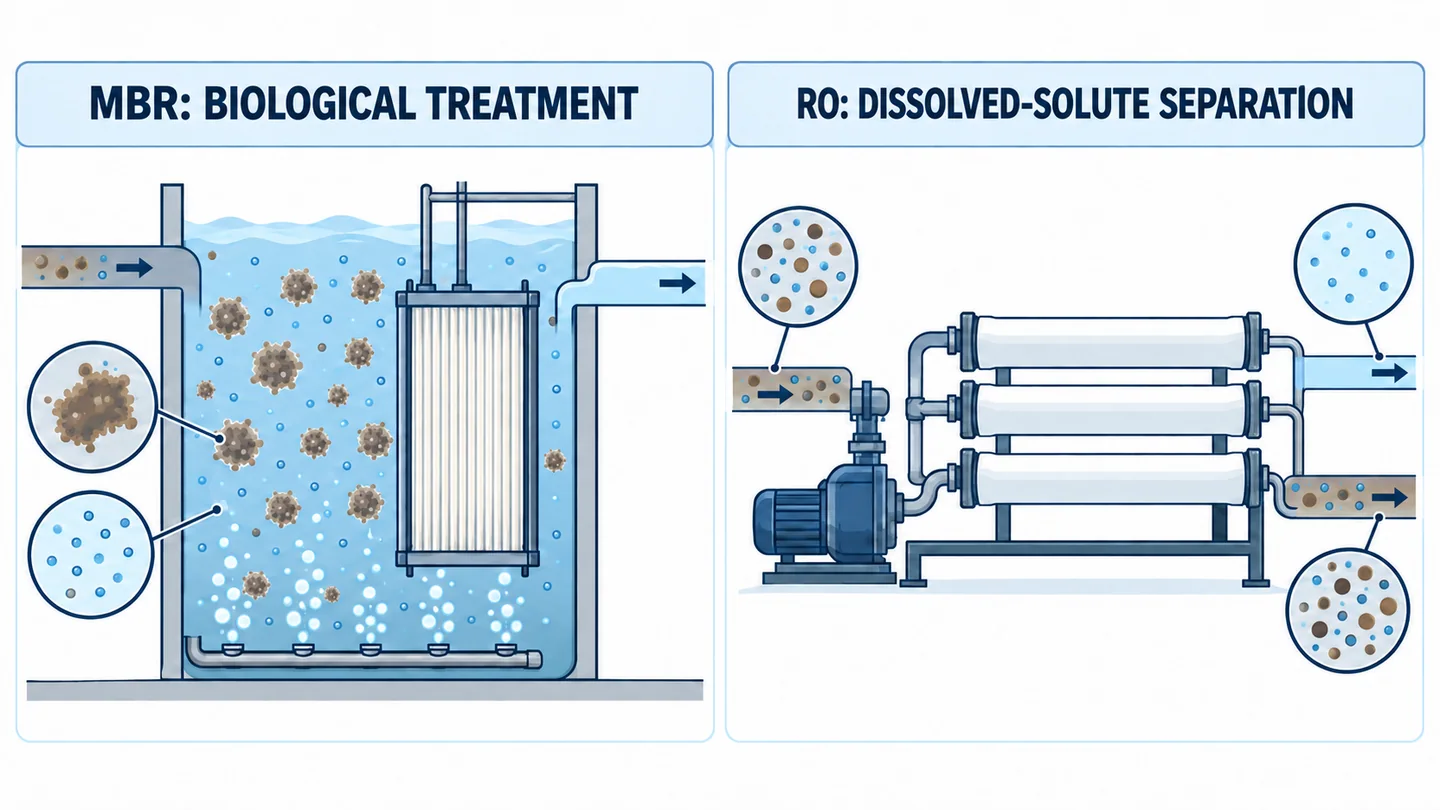
MBR combines biological treatment with membrane-based solids separation. It is used where the wastewater can support the required biological process and where reliable separation of biomass from treated water is valuable.
RO is a pressure-driven separation process used to reduce many dissolved salts and other constituents. It requires suitably pretreated feed and produces both permeate and concentrate.
For industrial reuse, MBR may provide the biological treatment and low-solids feed needed upstream of RO. RO may then be added when the receiving application requires lower dissolved-salt concentrations or other separations beyond the MBR's capability. Neither process should be selected before the source and use specifications are defined.
1. Compare Treatment Duties, Not Membrane Labels
| Decision factor | MBR | RO |
|---|---|---|
| Core duty | Biological treatment plus biomass separation | Separation of water from many dissolved constituents |
| Role of the membrane | Retain biomass and suspended material | Produce permeate while concentrating retained solutes |
| Dissolved salts | Conventional MBR is not a desalination process | Many salts can be substantially reduced, depending on design |
| Biodegradable organics | Treated by the biological process under suitable conditions | Separation is compound-dependent; RO is not biological destruction |
| Main residual streams | Waste sludge and maintenance-related wastes | Concentrate and cleaning-related wastes |
| Key operating concerns | Biology, oxygen supply, fouling, solids management | Scaling, fouling, pressure, recovery, membrane compatibility |
| Procurement question | Can this wastewater be biologically treated as required? | Can this feed be separated to the required product quality sustainably? |
The table describes conventional treatment roles, not every specialized membrane technology.
EPA's MBR fact sheet explains the combination of biological treatment and membrane solids separation, including membrane maintenance and energy considerations. Although the document primarily discusses municipal applications, its basic process distinction is useful; industrial suitability still requires assessment of the actual wastewater. EPA membrane bioreactor fact sheet
2. Define the Reuse Application Before the Treatment Train
“Reusable water” is not one specification. A utility wash application, a cooling system, a production rinse, and a high-purity process can impose very different constraints.
Ask the receiving process owner to identify limits for the parameters that affect operation. Depending on the application, these may include conductivity, hardness, silica, chloride, organics, suspended solids, microorganisms, temperature, and specific process contaminants.
Specify where the quality must be achieved. A result measured directly after treatment is not necessarily the same as quality at the point of use after storage and distribution.
Also define whether product contact, aerosol exposure, or worker contact occurs. Potable, food-contact, and other sensitive applications require their own validation and applicable requirements. A membrane process label does not establish that the finished water is safe for those uses.
Do not start with an unnecessarily strict specification merely because a supplier offers a high-purity package. Additional treatment should address a documented need, while any decision to omit treatment must remain consistent with the intended application.
3. Establish Whether the Wastewater Is Suitable for MBR
Biology is an essential part of the process
The membrane does not remove the need for a stable biological treatment environment. Evaluate organic loading, biodegradability, temperature, pH, nutrients, salinity, and potentially inhibitory substances.
A factory may produce a wastewater that changes substantially during cleaning, product changeovers, or campaign manufacturing. These variations should be included in the assessment rather than averaged away.
For difficult wastewater, request appropriate treatability work. A short membrane filtration demonstration does not show that the biological system can handle toxic shocks or a poorly biodegradable organic mixture.
DuPont describes MBR as combining biological oxidation with liquid-solid separation. That distinction matters for procurement: performance depends on the biological process as well as the membrane hardware. DuPont MBR technology overview
Pretreatment remains important
Screening, equalization, oil and grease control, and specific contaminant removal may be required ahead of an MBR. The appropriate arrangement depends on the source.
For example, a high-solids food-processing stream and a metal-bearing chemical stream should not receive identical pretreatment simply because both are described as industrial wastewater.
Ask which feed constituents the supplier excludes from its biological performance commitment. If the plant generates those constituents, the proposal must identify their management route rather than leaving an exclusion that makes the guarantee unusable.
4. Determine Whether MBR Effluent Actually Needs RO
RO should solve a defined residual water-quality problem.
If MBR effluent satisfies every verified requirement of a particular reuse application, adding RO may provide little practical benefit while introducing concentrate management, pressure pumping, cleaning, and additional maintenance.
If dissolved salts remain above the receiving application's limit, a conventional MBR will not solve that limitation merely by using a finer biomass-separation membrane. A desalination step may be necessary.
Evaluate specific contaminants rather than assuming every dissolved substance behaves identically in RO. Membrane selection, operating conditions, and the chemistry of individual compounds affect passage. Some applications may need additional treatment beyond RO.
Keep the decision tied to the most demanding justified requirement. A factory might use MBR effluent directly for one approved duty while treating only a portion through RO for a more demanding duty. Splitting flows can be more appropriate than polishing every cubic meter to the highest quality required anywhere on site.
5. Understand What Must Happen Between MBR and RO
Low suspended solids are useful, but they are not the complete RO feed specification.
Assess dissolved salts, scaling potential, residual organics, biological growth potential, chemical carryover, temperature, and membrane compatibility. Review any oxidants used around the MBR or distribution system against the selected RO membrane's limits.
Ask the designer to identify additional conditioning required between the units. This may include pH adjustment, scale control, protective filtration, or other measures justified by analysis. Do not add a standard list of equipment without explaining the purpose of each item.
The proposal should also define a response to off-spec MBR permeate. An alarm that merely informs an operator after poor-quality water has reached RO may not provide the protection expected by the buyer.
Agree on monitoring, diversion or shutdown logic, storage capacity, and restart criteria. Distinguish parameters that can be monitored continuously from those requiring periodic laboratory verification.
6. See How the Two Technologies Can Work Together
A possible treatment arrangement for a suitable wastewater is:
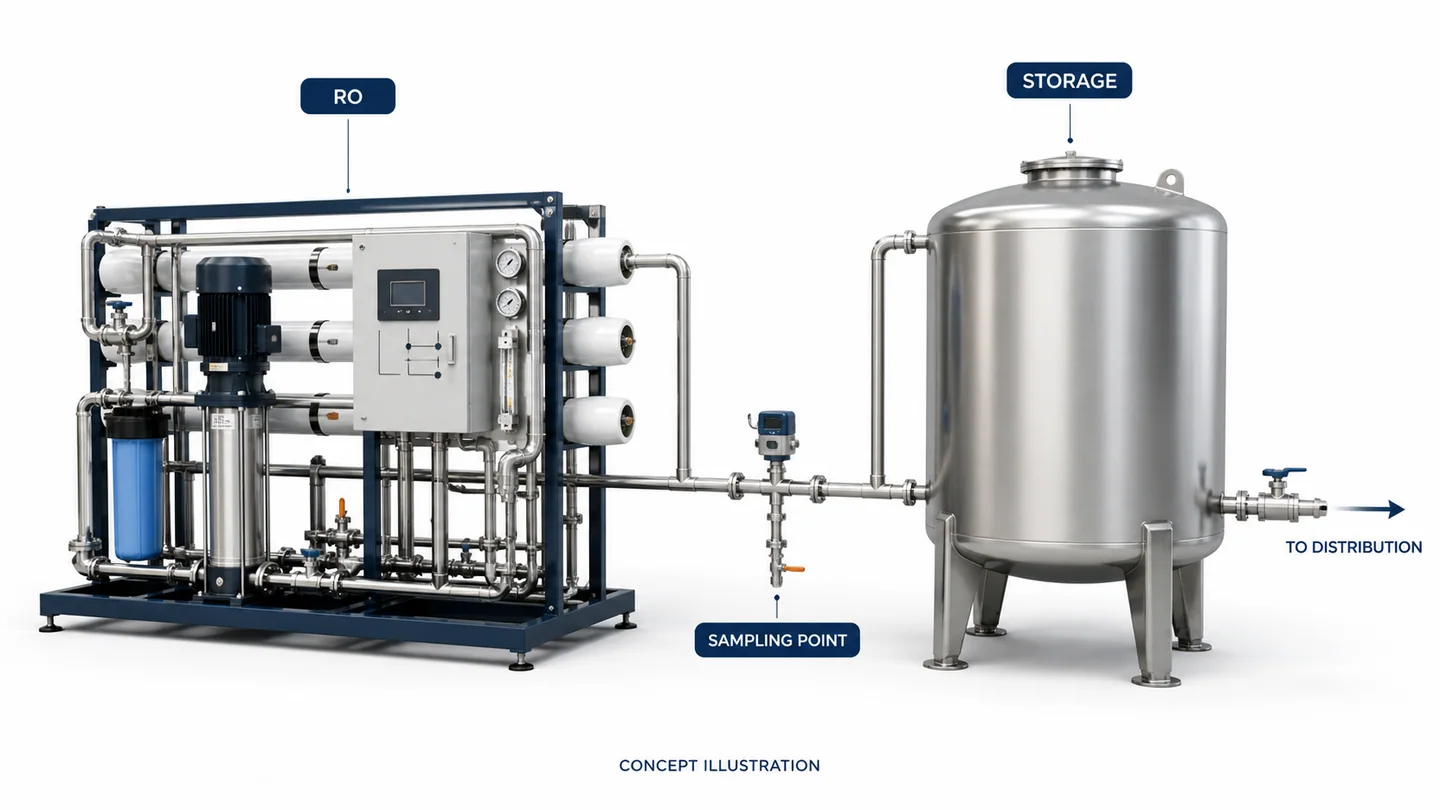
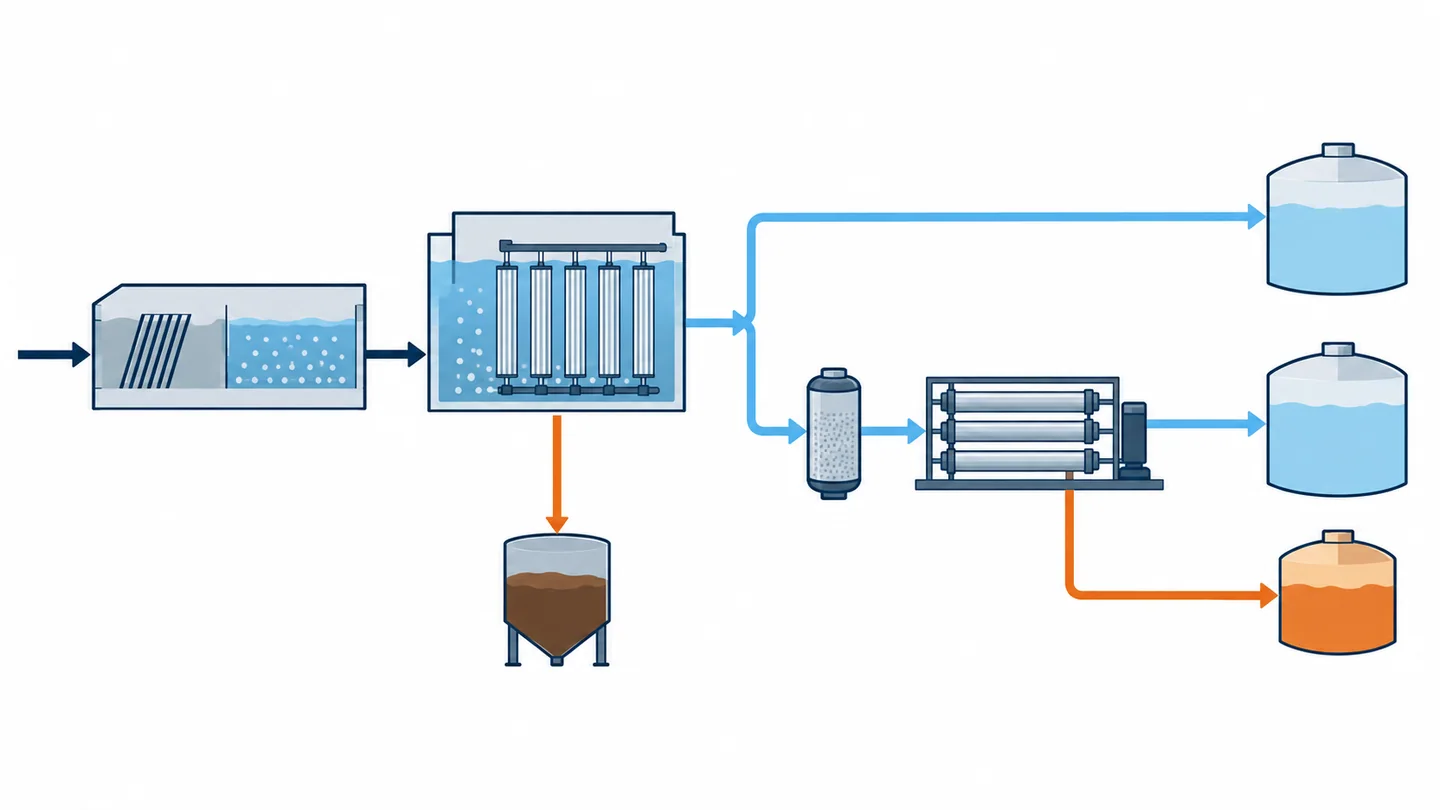
Source control → pretreatment and equalization → biological treatment with MBR separation → RO feed conditioning → RO → application-specific finishing and storage.
This is a conceptual route, not a universal specification. Some sites need additional treatment; others do not need either membrane process.
A published Veolia case at Bush Brothers describes a reclamation facility in which a portion of MBR permeate is sent to RO for utility reuse. It demonstrates complementary roles and split-flow planning. It is a third-party example, not a Baihuipu reference project, and its reported results should not be transferred to another wastewater. Veolia industrial MBR and RO reuse case
The practical lesson is to assign a purpose to each process. MBR addresses the suitable biological load and solids separation; RO addresses the additional separation needed by the selected receiving application.
7. Calculate Reuse from the Whole Plant
A membrane specification may report instantaneous production or recovery under defined conditions. The factory needs usable water over a shift, month, or year.
Consider an illustrative plant receiving 200 m³/day of wastewater. Assume 190 m³/day is available after upstream treatment and MBR operation, after accounting for the losses included in this example.
If all 190 m³/day enters an RO system operating at 75% recovery:
- RO permeate is 142.5 m³/day.
- RO concentrate is 47.5 m³/day.
- The upstream difference is 10 m³/day.
- Maximum calculated permeate production is 71.25% of the original wastewater flow.
These assumptions are not recommended design values. The upstream difference may include water leaving with sludge and other losses, depending on how the project boundary is defined.
If the receiving process can use only 120 m³/day, useful substitution is capped at 60% of the original 200 m³/day unless another approved demand exists. Producing more permeate than the factory can use is not equivalent to saving more purchased water.
Model downtime, cleaning, seasonal demand, off-spec diversion, and storage. A realistic annual water balance is more valuable than an attractive single-equipment recovery percentage.
8. Compare Operating Costs on Equivalent Boundaries
MBR and RO cost estimates often use different denominators. One supplier quotes cost per cubic meter of wastewater treated; another quotes cost per cubic meter of permeate produced.
Convert both to the same project basis before comparing alternatives. Useful bases include total annual cost and cost per cubic meter of compliant water actually delivered to the application.
For MBR, assess biological aeration, membrane scouring where applicable, pumping, cleaning, sludge management, membrane replacement, laboratory work, and operator attention.
For RO, assess feed and high-pressure pumping, conditioning chemicals, cartridge replacement where used, membrane cleaning, membrane replacement, concentrate handling, and monitoring.
For the combined plant, also include pretreatment, tanks, civil works, distribution, standby arrangements, and commissioning. Avoid counting shared equipment twice, but do not omit it simply because it sits outside the membrane vendor's skid.
Request expected operating ranges with stated assumptions. A universal energy figure or payback claim is not a substitute for a load profile, electricity tariff, residual-management cost, and actual receiving demand.
9. Specify Availability and Operator Requirements
A technically appropriate process can still be unsuitable for a site that cannot maintain it.
Ask how the plant behaves when a membrane train is isolated, a blower is unavailable, or a dosing system requires maintenance. Determine whether production can continue at reduced capacity and what water supply is available during the interruption.
Biological systems require appropriate management during low-load periods and shutdowns. Membrane systems require cleaning procedures, compatible chemicals, instruments, and replacement parts. These needs should be incorporated into staffing and service planning before procurement.
Compare the maintenance tasks with the site's actual capabilities. A factory with limited wastewater staff may need simpler operating routines, training, better access, or a different arrangement of redundancy.
Document response responsibilities. Remote advice can support troubleshooting, but it does not replace the local person who collects samples, isolates equipment safely, verifies valves, and follows the operating procedure.
10. Make Installation Preparation Part of Selection
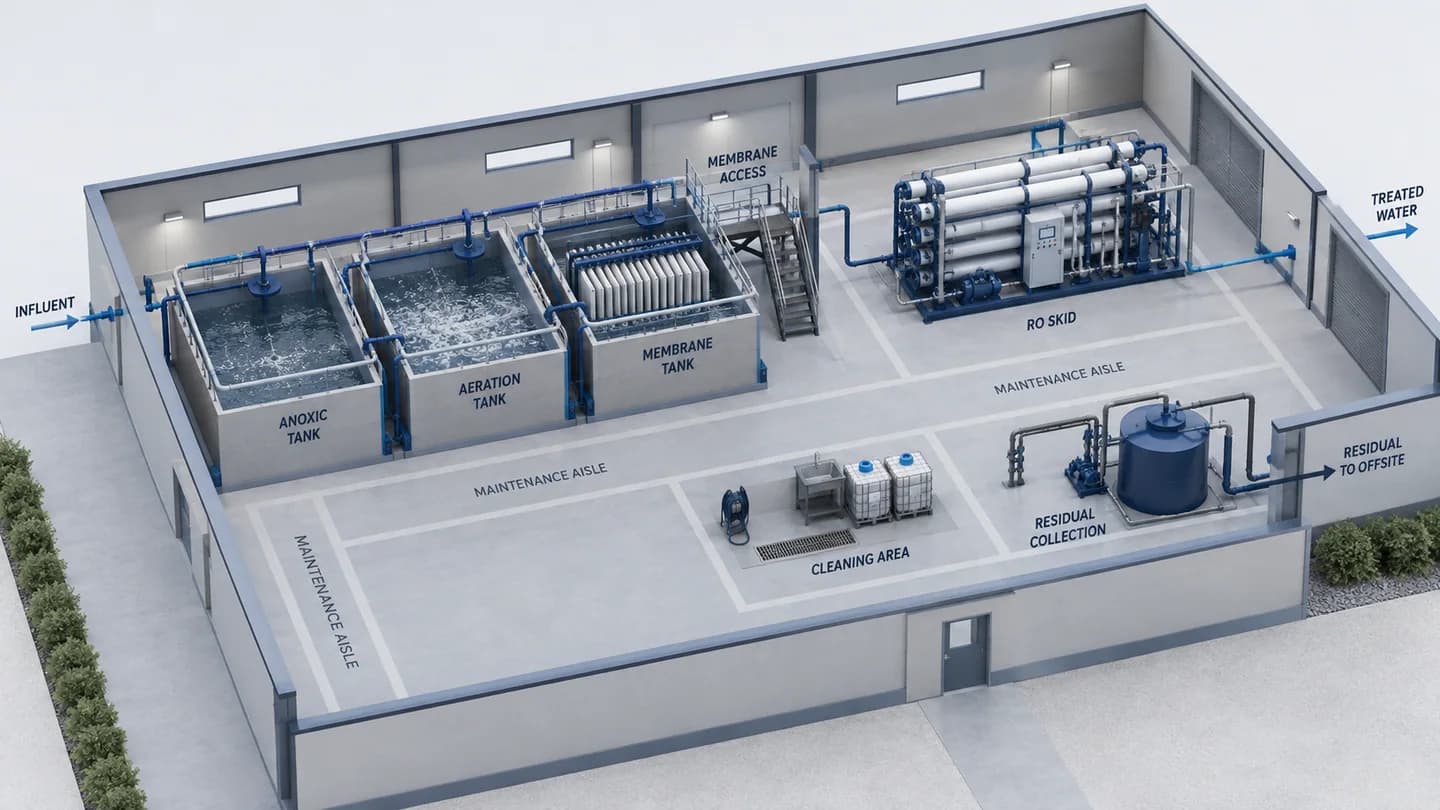
Footprint comparisons should include more than membrane skids. Allow space for pretreatment, biological tanks, access, cleaning equipment, lifting, sludge handling, chemical containment, and residual storage.
Check floor loading, tank foundations, drainage, electrical supply, ventilation, noise management, and access for membrane removal. Identify which works belong to the supplier and which belong to the buyer or installation contractor.
The same discipline applies to distribution. Label reuse networks clearly and address cross-connections, backup water, and off-spec diversion according to the applicable application requirements.
Ask for operating access drawings, not only an equipment arrangement that fits inside a rectangle. A layout that prevents safe maintenance is not made acceptable by having a compact advertised footprint.
11. Separate Factory Checks from Process Acceptance
Factory testing can establish that the supplied package matches the agreed component list and functional scope. It can check instruments, alarms, pumps, valves, control sequences, and selected clean-water functions.
Shipment inspection can confirm packing, protection, labels, accessories, spare parts, and documents. These are important quality checks, but they do not prove long-term biological treatment or membrane performance on the buyer's wastewater.
Site commissioning must then establish stable operation within an agreed feed envelope. For MBR, account for biological start-up and the conditions needed before performance testing begins. For RO, verify feed quality, normalized performance, product quality, and concentrate flow.
Write acceptance criteria for the complete reuse duty, including the sampling location and intended water use. Specify the test period, operating hours, availability assumptions, laboratory methods, and treatment of abnormal incoming batches.
Ask for a responsibility matrix
A combined project frequently crosses supplier boundaries. The biological designer, membrane supplier, controls contractor, and factory utility team may each own a different part of the result.
Record who approves feed conditions, calibrates instruments, supplies chemicals, manages sludge, and handles off-spec water. Assign responsibility for reviewing test data and authorizing any change in the operating envelope.
Before accepting a proposal, check what happens when upstream treatment meets its own guarantee but the resulting water does not satisfy downstream RO requirements. The interface specification should prevent that contradiction.
Do the same at the point of use. If the supplier guarantees water at a treatment tank while the factory requires quality after a long distribution loop, the unassigned gap can become the main cause of disagreement. Resolving it early is usually easier than adding equipment after installation.
FAQ
Does MBR remove TDS?
Conventional MBR is not designed as a desalination process. Its membrane separates biomass and suspended material, while biological reactions address suitable contaminants. If dissolved salts control the reuse specification, evaluate a separate desalination or selective treatment step.
Can RO replace biological wastewater treatment?
Not generally for untreated, high-organic industrial wastewater. RO is a separation process that requires suitable feed and creates concentrate. It should not be used as a shortcut around required biological or physicochemical pretreatment without a validated process basis.
Does every MBR plant need downstream RO?
No. Add RO when the intended use requires separations that MBR does not provide. If verified application requirements are already satisfied, RO may add cost and residual-management obligations without a necessary benefit.
Is MBR effluent automatically safe to reuse?
No. Reuse suitability depends on the source, intended application, treatment performance, storage, distribution, and applicable requirements. Clear water and low TSS are not complete evidence of chemical or microbiological suitability.
Which technology is cheaper?
The answer depends on the treatment duty and project boundary. Comparing standalone MBR and RO prices can be misleading because they often perform different jobs. Compare complete alternatives delivering the same verified useful-water quality and volume.
What should an RFQ include?
Include representative wastewater analysis, flow variability, production and cleaning schedules, reuse quality requirements, demand timing, available utilities, space, staffing, and residual routes. Ask suppliers to identify unverified assumptions and the testing needed to resolve them.
Conclusion: Choose the Smallest Treatment Train That Meets the Verified Duty
MBR and RO are not competing answers to the same problem. MBR combines suitable biological treatment with solids separation. RO supplies additional separation where dissolved constituents prevent the required use.
Select the treatment train from the wastewater and the receiving application, then verify the water balance, operating burden, residual routes, and acceptance conditions. The objective is dependable useful water, not the maximum number of membrane stages.