When an industrial reverse osmosis quotation offers “single-pass” or “double-pass” treatment, the difference can appear straightforward: one membrane process versus two. The purchasing decision is more demanding.
The correct arrangement depends on the water quality required by the manufacturing process, the variability of the incoming water, the production schedule, and the equipment located after RO. A second pass may be valuable, unnecessary, or insufficient on its own.
Another complication is terminology. A two-stage RO system is not the same as a two-pass system. Confusing these descriptions can lead buyers to compare packages that serve different purposes.
This guide explains the distinction, shows a simple water balance, and provides a practical framework for comparing quality, capacity, operating requirements, and acceptance conditions.
Quick Answer: When Do You Need Double-Pass RO?
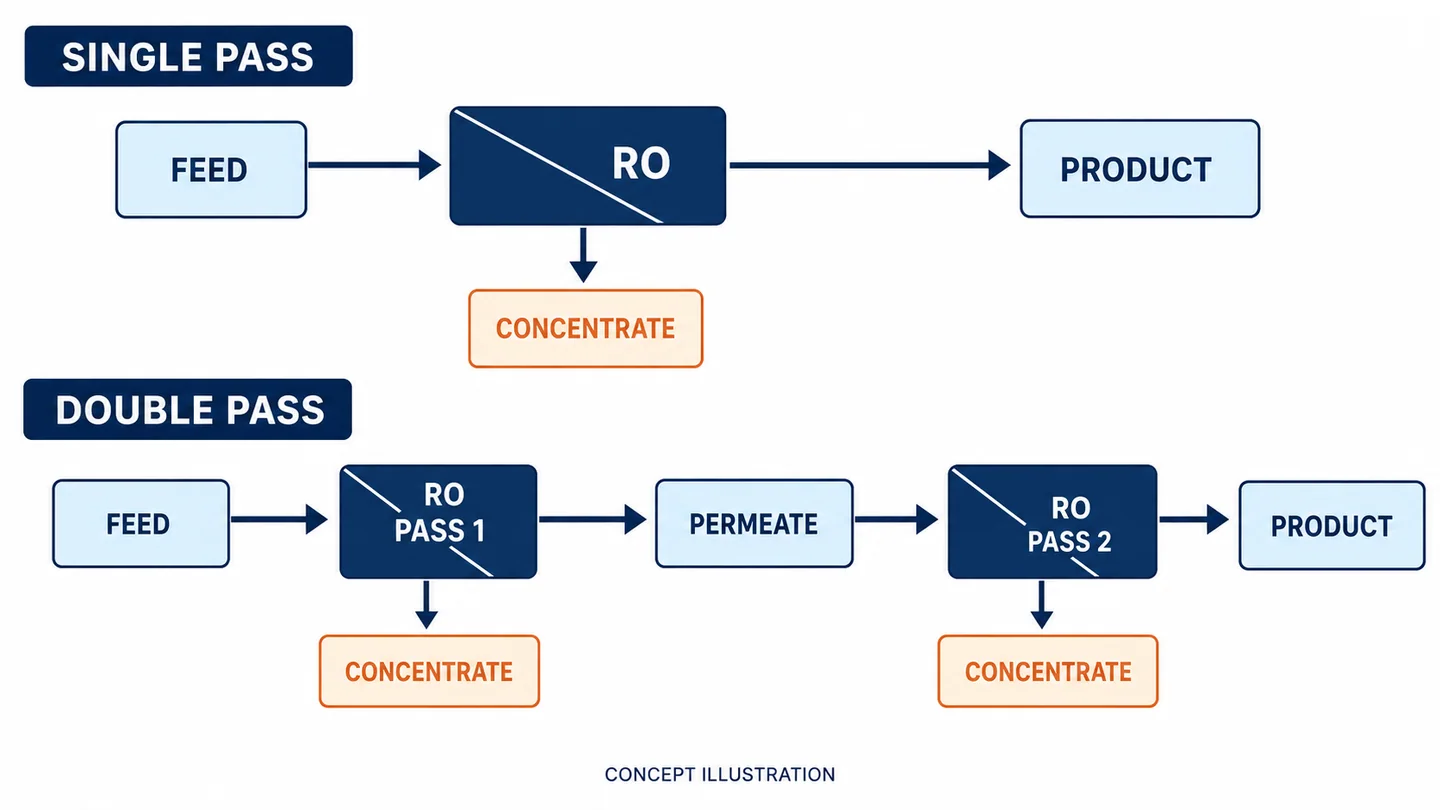
Single-pass RO treats the incoming feed through one RO process. Double-pass RO sends first-pass permeate through a second RO process to provide an additional membrane treatment barrier for the product water.
Choose between them by comparing a properly developed single-pass projection with the required water specification across the intended feed and operating range.
If single-pass RO can meet the requirement with an appropriate operating margin, a second pass may not be justified. If it cannot, double-pass RO should be compared with other suitable treatment arrangements.
Neither configuration automatically proves that water is suitable for drinking, pharmaceutical use, or an ultrapure-water application.
1. Understand “Pass” and “Stage” Before Comparing Quotes
A pass describes another treatment of the permeate
In a double-pass arrangement, the product water from the first RO becomes feed to the second RO.
The second pass is therefore treating a different water stream from the original source. It has its own feed conditions, membrane arrangement, recovery, and operating requirements.
A stage describes an arrangement within a pass
In a conventional staged RO arrangement, concentrate from an upstream stage feeds a downstream stage. Permeate from those stages is collected as product from that pass.
A single-pass system can contain multiple stages. A double-pass system can also contain more than one stage within either pass.
Lenntech’s technical explanation makes this distinction explicitly: staging routes concentrate onward, while another pass treats permeate again.RO stage versus pass
For procurement, ask for a process flow diagram identifying feed, permeate, concentrate, and recycle streams. A label such as “two-stage purification” is too ambiguous to settle the question.
Use “single-pass” and “double-pass” consistently in the specification, and ask the supplier to define any alternative terminology.
2. Start with a Point-of-Use Water Specification
“Pure water” is not a sufficient purchasing specification.
Identify the water user and the parameters that affect its operation. Depending on the application, these may include conductivity, particular ions, silica, organic contamination, particles, or microbiological requirements.
Also define:
- Where the sample is taken.
- The applicable temperature basis.
- Whether the limit is continuous or periodically tested.
- Normal and peak demand.
- Storage time.
- Distribution arrangements.
- The response to an out-of-specification result.
A process requiring consistent low ionic content may justify a different arrangement from equipment that only needs a moderate reduction in dissolved salts.
Avoid specifying the most demanding water quality mentioned in a brochure unless the manufacturing process actually requires it. Unnecessary treatment increases capital cost and operating responsibilities without automatically improving the product.
Conversely, do not reduce the specification to conductivity if a particular contaminant matters independently. A water stream can meet a general conductivity target while failing a process-specific requirement.
Ask the production or quality team to approve the specification before requesting final quotations.
3. Assess the Feed Range, Not One Convenient Sample
A single water analysis provides a snapshot. Industrial RO selection should consider whether that snapshot represents the conditions the equipment will encounter.
Relevant information may include:
- Water source and possible source changes.
- Seasonal temperature range.
- Conductivity or TDS variation.
- Major ionic composition.
- Hardness and alkalinity.
- Silica and other scaling-related constituents.
- Suspended or colloidal contamination.
- Oxidant exposure.
- Relevant organic contamination.
Tell the supplier if the feed is reclaimed industrial water rather than a stable freshwater source. The treatment history and potential abnormal contaminants can influence the design review.
Request calculations for agreed operating cases rather than a single attractive result. For example, compare normal conditions with the relevant cold-water capacity case and higher-salinity quality case.
Membrane suppliers provide projection tools specifically to connect feed information, product requirements, and system configuration. A supplier’s projection should therefore be part of the technical submission, not replaced by a generic membrane rejection percentage.Toray technical support and projection tools
The objective is an explicit operating envelope, not a claim that the system can process any water.
4. When Single-Pass RO Is a Reasonable Starting Point
Single-pass RO deserves consideration when the required product quality can be achieved throughout the agreed operating range without relying on unrealistic feed conditions.
Potential advantages include a simpler process arrangement, fewer equipment interfaces, and fewer operating variables to manage.
However, “simpler” should refer to the complete plant. A nominally simple RO skid may still require suitable pretreatment, product storage, instrumentation, cleaning provisions, and a distribution system.
Ask four questions:
- Does the projected product meet the actual specification?
- What operating assumptions are necessary?
- How does the result change over the defined feed range?
- What is the response if product quality moves outside the limit?
If the answer depends on exceptionally favorable source water or a laboratory membrane data-sheet condition, the apparent simplicity may be misleading.
Single-pass RO should also be evaluated alongside downstream equipment. If another process is already required for a particular contaminant, the most appropriate overall arrangement may differ from a comparison of RO skids alone.
5. When Double-Pass RO Deserves Consideration
Double-pass RO becomes relevant when an additional membrane treatment step provides a useful improvement in product quality or reduces the load on subsequent treatment.
Its justification should identify a specific requirement rather than simply describe two passes as “higher grade.”
Request:
- First-pass product composition.
- Second-pass feed conditions.
- Second-pass product projection.
- Required intermediate equipment.
- Any chemical adjustment.
- Reject-water routing.
- Operating and standby modes.
DuPont’s technical manual describes double-pass systems as permeate-staged arrangements and discusses their use where one pass does not provide the required product quality. It also highlights that dissolved carbon dioxide requires particular attention because it is not rejected like dissolved ionic salts.DuPont FilmTec technical manual
That does not mean a second pass is the answer to every quality problem. The supplier should explain which constituents the arrangement addresses and which need other measures.
If the application requires further polishing, review the complete route rather than assuming that double-pass RO alone produces the final required water.
For a separate comparison of polishing options, see RO, EDI, and mixed-bed treatment.
6. Calculate Overall Recovery Across the Correct Boundary
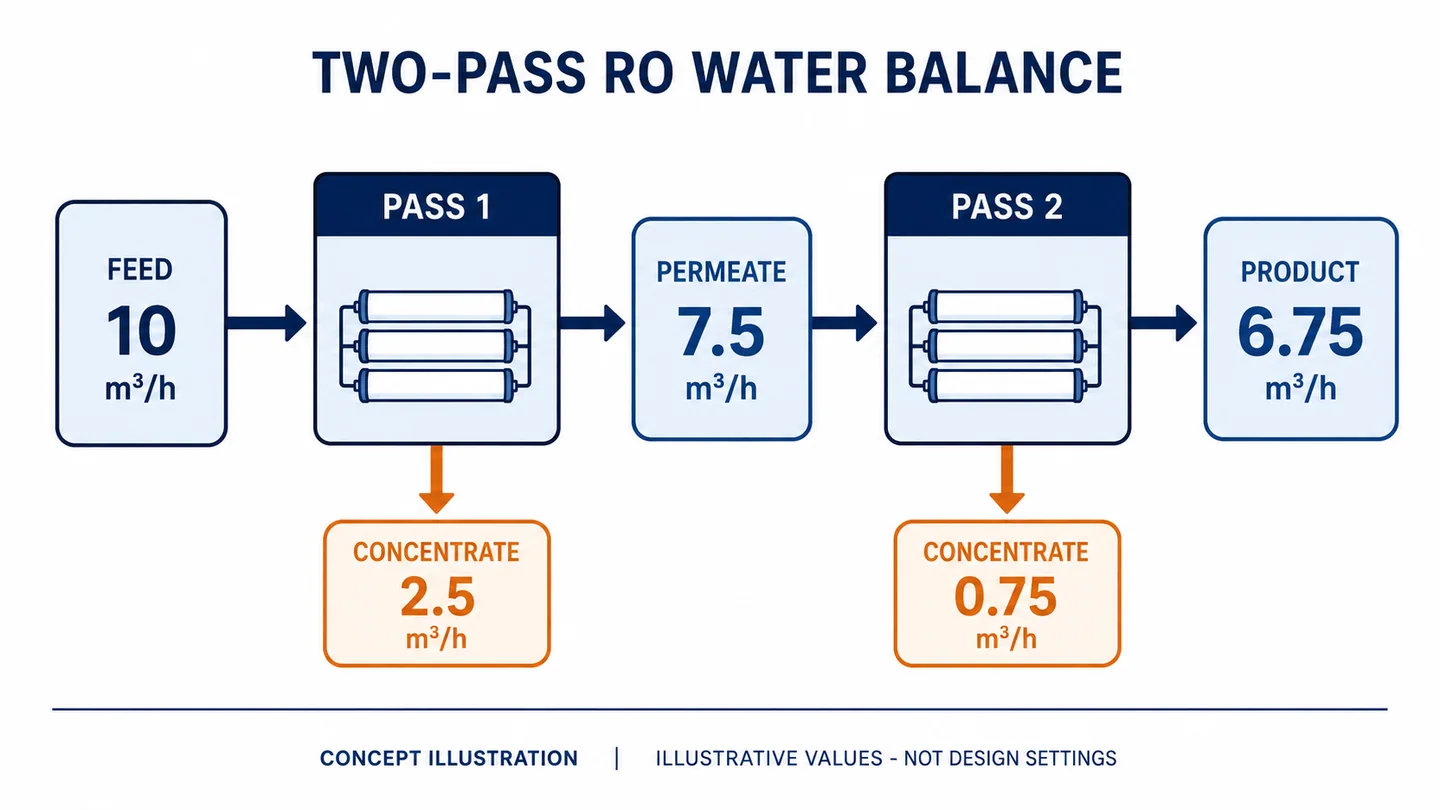
An illustrative double-pass water balance
Assume:
- First-pass feed: 10 m³/h.
- First-pass recovery: 75%.
- Second-pass recovery: 90%.
- No second-pass concentrate recycle.
- No additional losses included.
The water balance is:
| Stream | Calculated flow |
|---|---|
| First-pass feed | 10 m³/h |
| First-pass permeate | 7.5 m³/h |
| First-pass concentrate | 2.5 m³/h |
| Second-pass product | 6.75 m³/h |
| Second-pass concentrate | 0.75 m³/h |
Overall recovery is:
6.75 ÷ 10 × 100 = 67.5%
These values illustrate arithmetic only. They are not recommended recovery settings for a particular water source.
Recycling changes the calculation
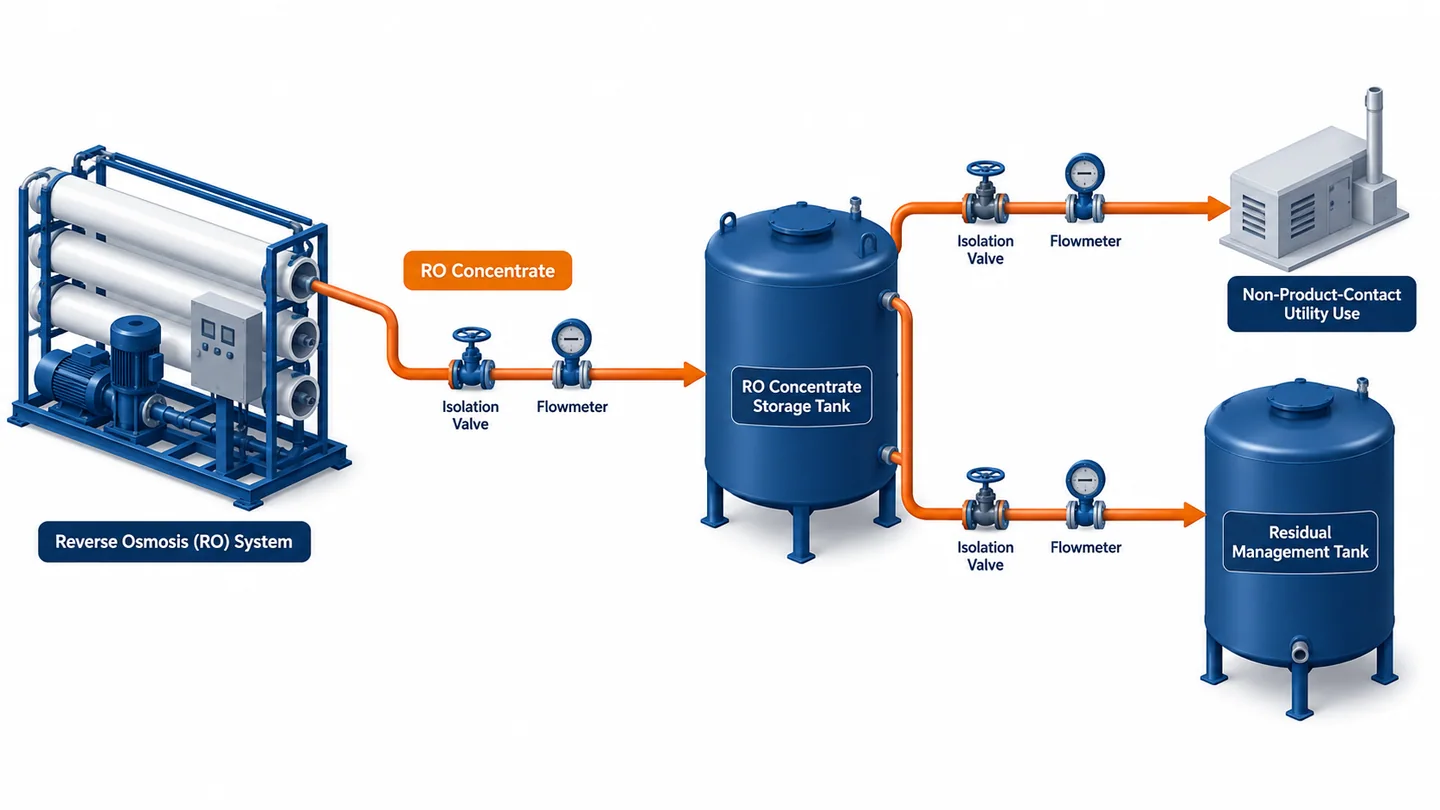
Some arrangements return second-pass concentrate upstream. In that case, the overall balance must account for the recycled flow and its composition.
Do not add the recoveries of the two passes. Also avoid reporting an individual pass recovery as though it were the complete plant recovery.
Toray defines RO recovery as permeate flow divided by feed flow and cautions against exceeding the design recovery during operation.Toray RO operation manual
For quote comparison, ask for net product water divided by incoming source water, with the included operating period and auxiliary losses clearly identified.
7. Do Not Use Conductivity as the Only Decision Variable
Conductivity is useful for monitoring ionic water quality, but it is not a complete description of every industrial water requirement.
The buyer should distinguish between:
- An online operating indicator.
- A laboratory quality specification.
- A particular contaminant limit.
- An application-specific hygiene requirement.
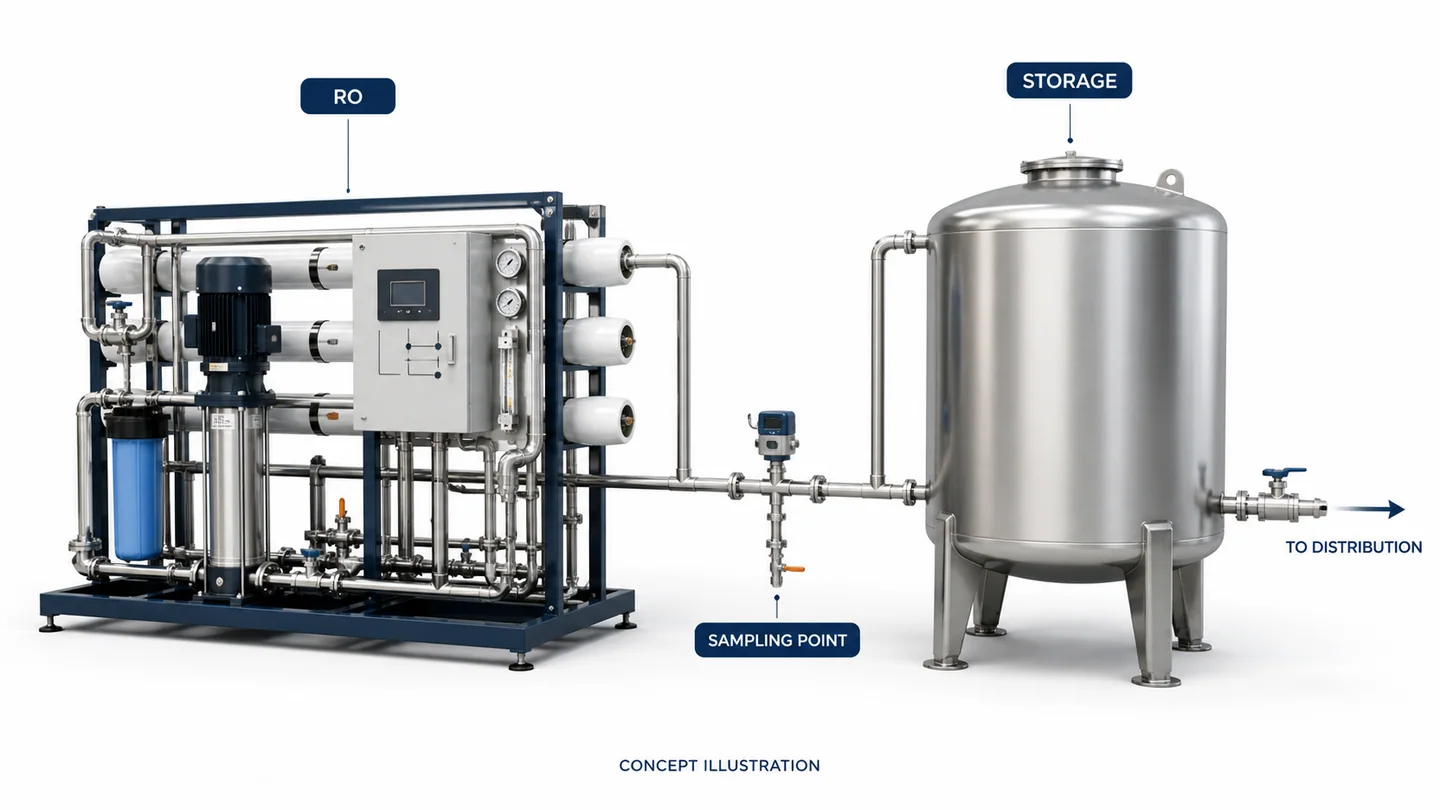
Also define the measurement arrangement. A value taken at the RO outlet may differ from a value taken after a storage tank or long distribution line.
When a proposal promises very low conductivity, ask for the conditions supporting that result. Review feed chemistry, temperature reporting, sample handling, and the intended location of the instrument.
For applications involving specific ions or non-ionic contaminants, include the relevant analytical parameters directly. Do not assume that a low general reading proves every constituent is acceptable.
The purchasing objective is water that supports the manufacturing process consistently—not the lowest isolated meter reading obtained under an unspecified condition.
8. Include Storage and Distribution in the Quality Boundary
RO selection does not end at the membrane outlet.
A product-water tank may help balance production and demand, but the complete arrangement must consider venting, turnover, cleaning access, instrument locations, and the intended water-quality requirement.
Review the distribution system with the same care:
- Pipe material and joining method.
- Dead-end sections.
- Return arrangements where applicable.
- Sampling locations.
- Maintenance access.
- Connections to equipment using the water.
These details should be specified according to the actual application. Avoid describing a generic industrial installation as a validated sanitary system without the necessary design and evidence.
The quality guarantee should say whether it applies at the skid outlet, storage outlet, or defined points of use. Otherwise, a buyer may expect a plant-wide result while the supplier has priced only an RO package.
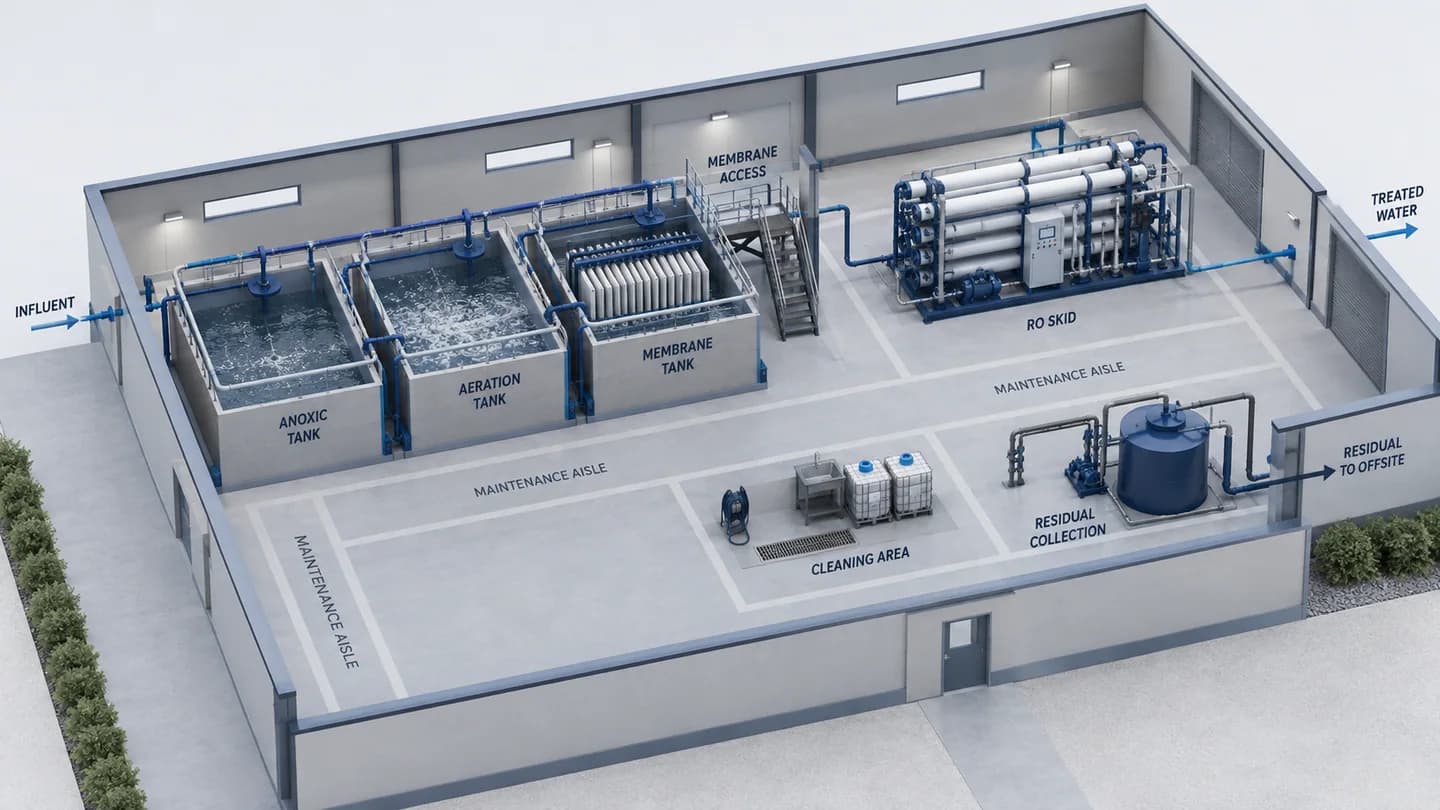
Installation preparation should include a coordinated layout showing where the RO, storage, polishing equipment, and customer distribution network meet.
9. Compare Operating Cost per Net Cubic Metre of Product
A double-pass package normally introduces additional equipment and operating tasks, but the meaningful comparison is the complete cost of producing acceptable water.
Ask suppliers to use the same boundary for:
- Electrical consumption.
- Incoming water.
- Concentrate management.
- Pretreatment chemicals.
- Cleaning requirements.
- Consumables.
- Maintenance.
- Operator time.
- Downstream polishing, if included.
Separate installed motor power from expected operating consumption. They answer different questions.
Also clarify whether the quoted production rate is instantaneous output under design conditions or net water available over the operating schedule.
A lower-priced system may become unattractive if it cannot meet the specification during an important feed condition. Conversely, an additional treatment pass may be unnecessary if the simpler route meets the real requirement reliably.
If demand is intermittent, review start-up, standby, and storage strategy. Equipment sized for a peak withdrawal does not necessarily need to produce that peak continuously if suitable storage is included and the quality requirements allow it.
10. Request Comparable Projections and a Clear Supply Scope
A technical proposal should identify the membrane configuration, flow balance, operating assumptions, and product-water quality basis.
It should also state what is supplied and what remains the customer’s responsibility.
Examples include:
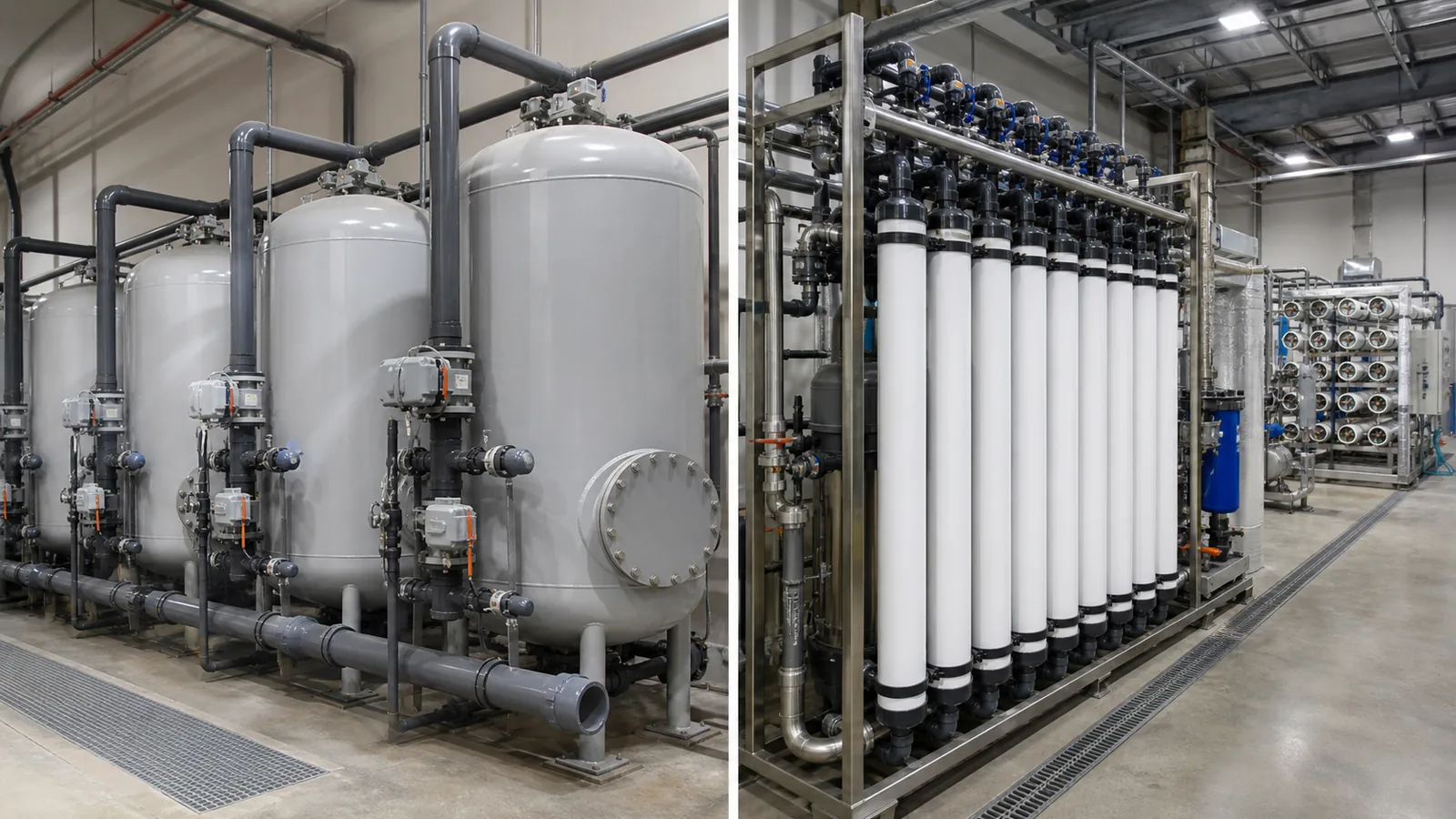
- Raw-water pretreatment.
- Feed tanks and pumps.
- Chemical dosing.
- Inter-pass equipment.
- Product storage.
- Final polishing.
- Cleaning equipment.
- Distribution pumps.
- Instruments and controls.
- Installation and commissioning support.
Ask the supplier to mark deviations from the RFQ instead of assuming every quotation includes the same items.
For future expansion, clarify whether the proposal reserves only floor space or also provides suitable electrical, hydraulic, and control provisions. A future second pass may require more than connecting another skid.
A clear scope makes supplier comparison more useful and reduces late changes during installation preparation.
11. Separate Equipment Testing from Water-Quality Acceptance
Factory testing can check assembly, wiring, alarms, operating sequences, instruments, and agreed functional tests. It should record the water used and the limitations of the test.
A clean-water factory run does not automatically establish performance on the customer’s source water.
Shipment inspection should confirm packing, component identification, protected connections, and documentation. Membrane storage and preservation requirements should follow the applicable manufacturer instructions and delivery arrangement.
At site, establish acceptance criteria for:
- Feed conditions.
- Product flow.
- Quality parameters.
- Sampling points.
- Measurement methods.
- Operating stability.
- Concentrate flows.
- Alarm and diversion functions.
If product water is outside specification, define whether it is diverted, retained for review, or prevented from entering the customer process.
These requirements should be agreed before delivery, not negotiated after the plant has been connected to production.
Frequently Asked Questions
Is double-pass RO the same as two-stage RO?
No. A second pass treats first-pass permeate. In a conventional staged arrangement, downstream stages treat concentrate from earlier stages within the same pass. Ask for a flow diagram if the terminology is unclear.
Does double-pass RO always produce ultrapure water?
No. The result depends on feed chemistry, design, operation, storage, and any downstream treatment. Ultrapure applications require defined quality criteria; the presence of two RO passes is not sufficient proof.
Can a single-pass system be upgraded later?
Possibly, but the upgrade must be reviewed as a system change. Available space, feed capacity, tanks, controls, electrical supply, reject routing, and product demand may all affect feasibility.
Does double-pass RO double water recovery?
No. Pass recovery and overall plant recovery are different quantities. Without concentrate recycle, the simple overall recovery is the product of the two pass recoveries, before other losses are included.
Should I choose the lowest conductivity offered?
Choose the water specification required by the application. An exceptionally low reading is not valuable if it is measured under unrealistic conditions or overlooks another important quality parameter.
What should I send for an industrial RO quotation?
Provide a representative feed analysis, source variation, temperature range, product specification, demand profile, operating hours, available utilities, and storage or distribution requirements. Identify any downstream polishing already planned.
Conclusion: Select the Simplest Route That Reliably Meets the Requirement
Single-pass and double-pass RO are different tools, not a universal good-and-better ranking.
The right choice connects the water specification to realistic feed conditions, a transparent water balance, and an agreed acceptance boundary. Evaluate the complete system, including storage and any polishing treatment, before comparing price.
Explore Baihuipu’s industrial reverse osmosis systems to discuss the equipment scope.