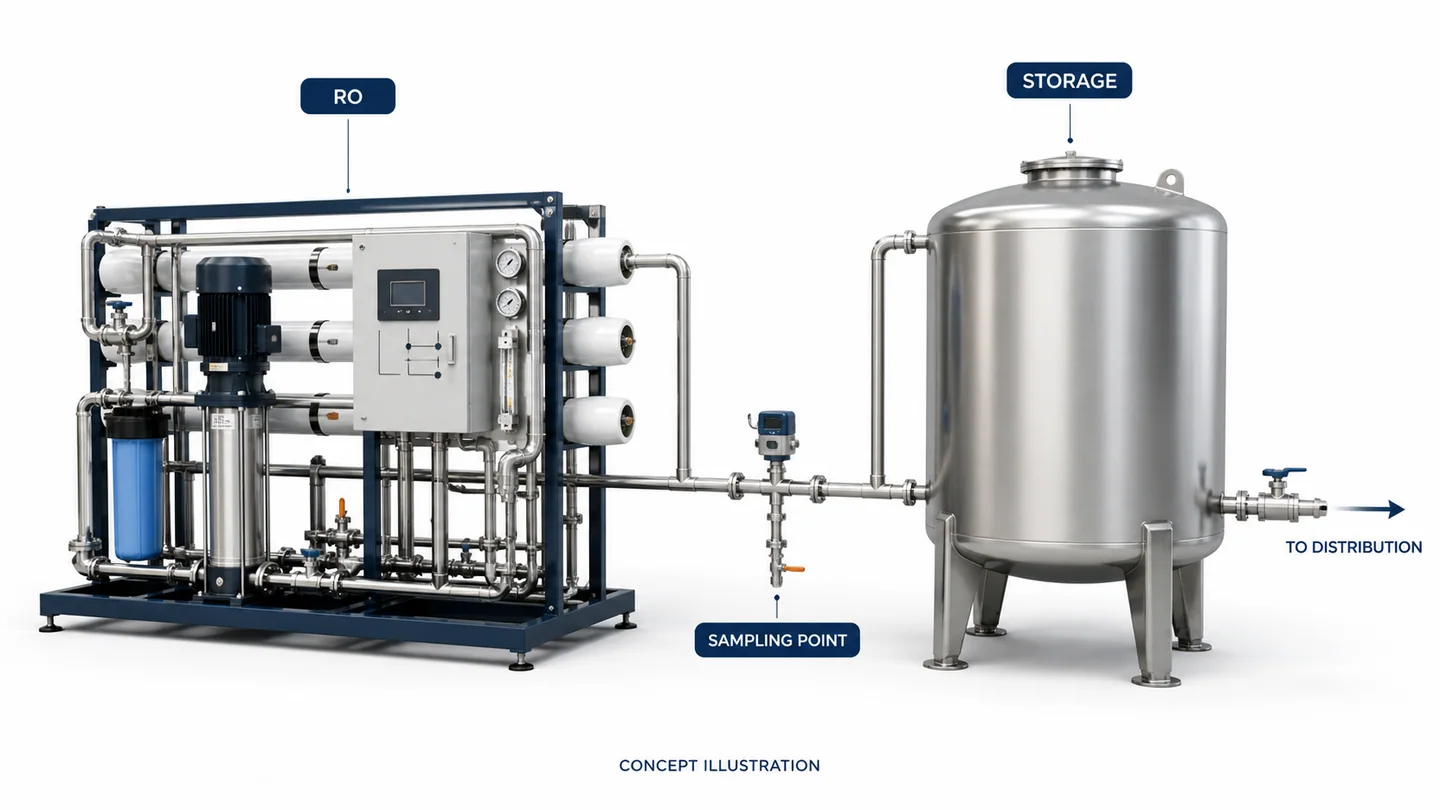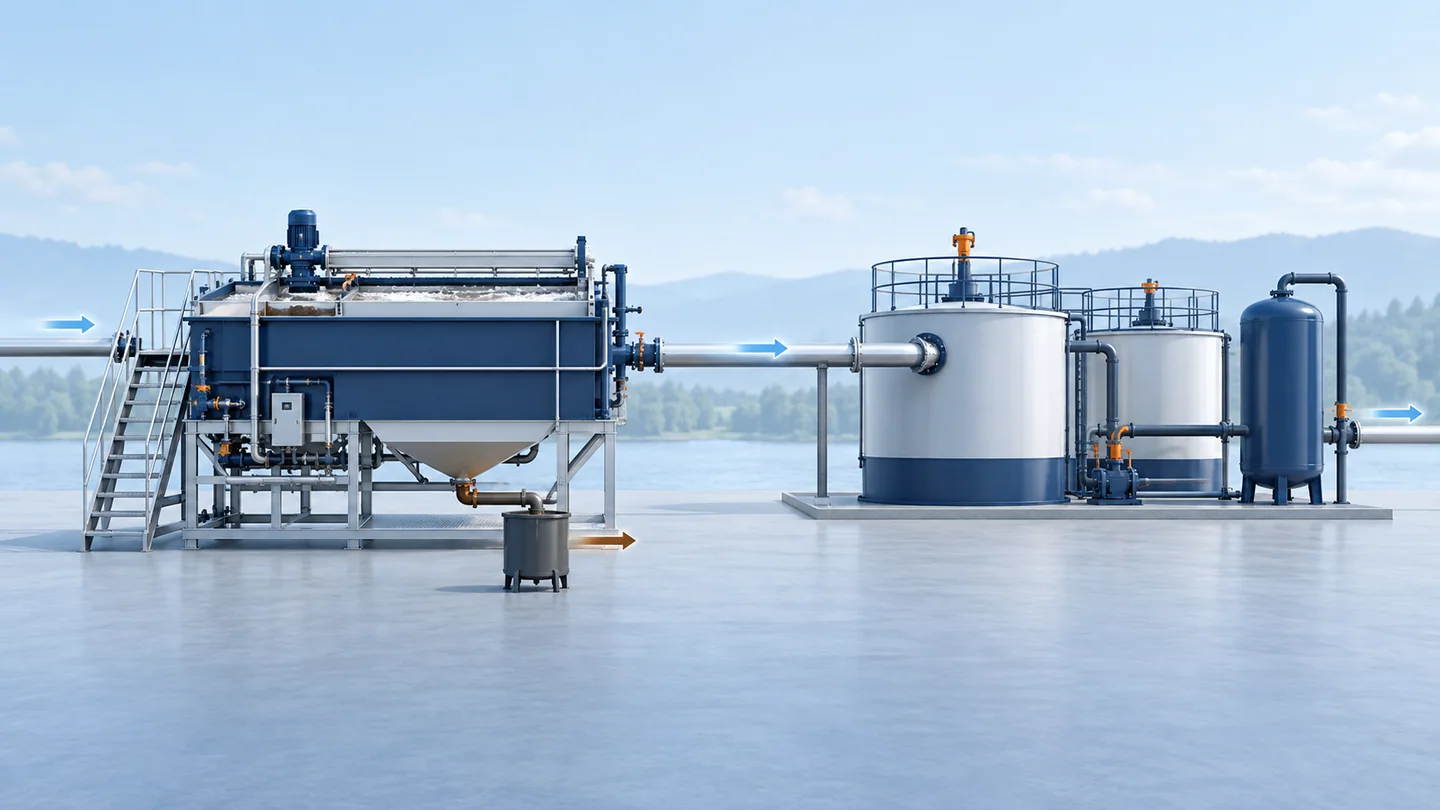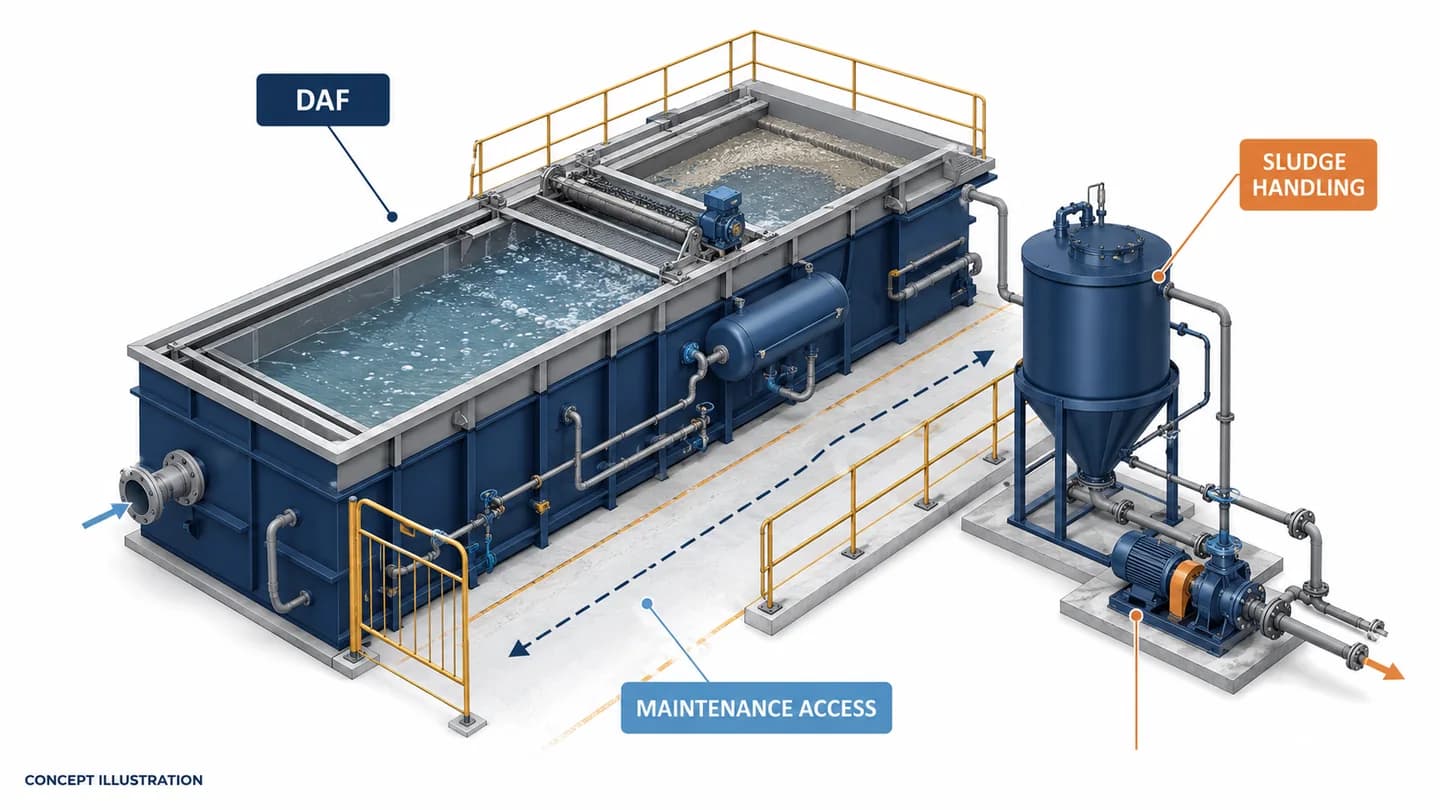
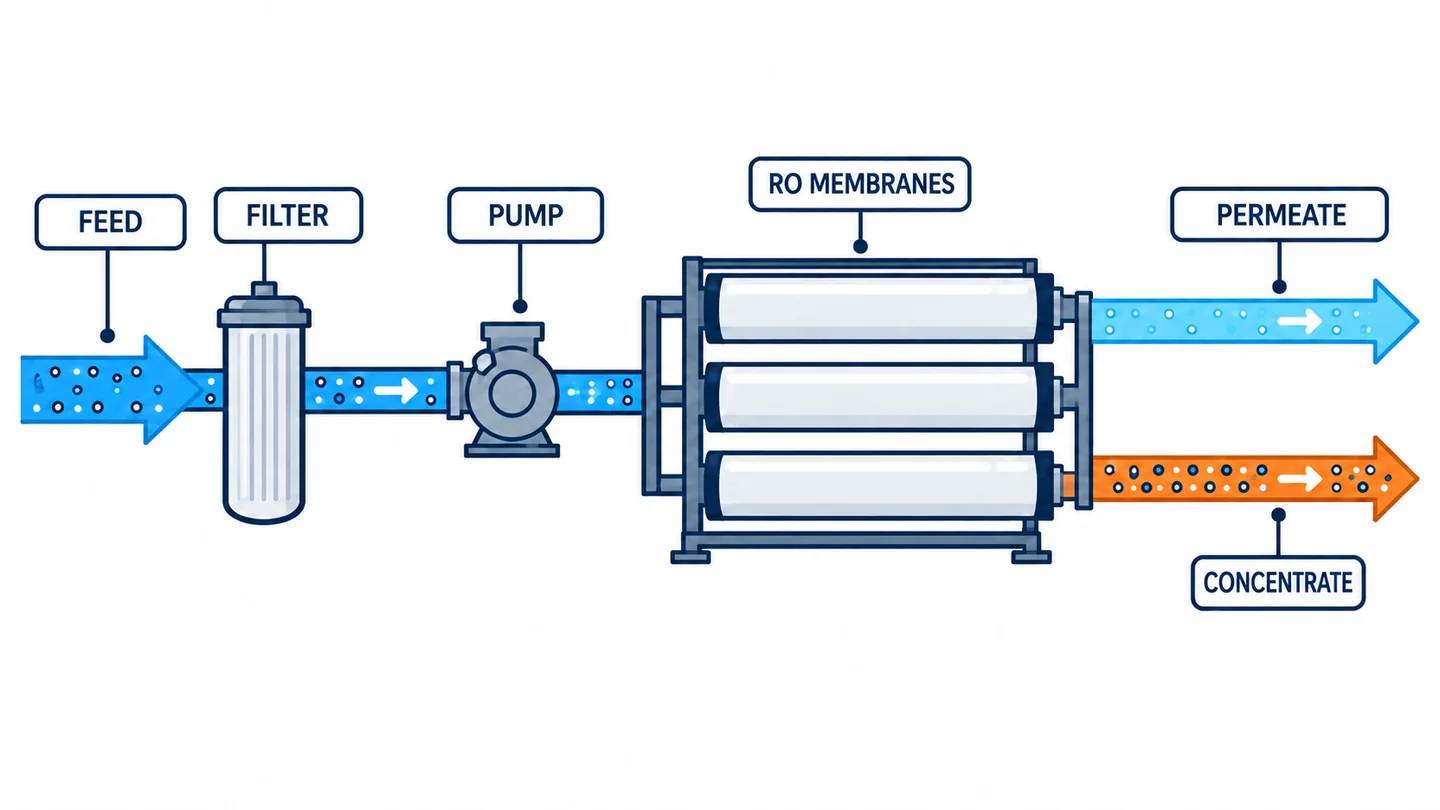
Reverse osmosis produces two water streams: permeate and concentrate. The permeate receives most of the attention because it supplies the production process. The concentrate, often called RO reject water, becomes a procurement issue when discharge capacity is limited, water purchases increase, or a factory wants to improve its water balance.
Reusing concentrate may be practical, but it should not begin with a pipe connection. Its composition depends on the original feed, pretreatment chemicals, membrane performance, and recovery. A stream suitable for one controlled utility application may be unsuitable for another.
This guide explains how to assess direct reuse, further treatment, and residual management without confusing internal recycling with actual water savings. Numerical examples are simplified planning calculations, not Baihuipu project results, equipment guarantees, or permission to reuse a particular stream.
Quick Answer: Can Industrial RO Reject Water Be Reused?
Sometimes. RO concentrate can be considered for a defined lower-quality application or additional recovery when its chemistry, variability, and available volume match the receiving process. The assessment must also confirm materials compatibility, microbial control where relevant, and the destination of the remaining contaminants.
Do not assume that clear concentrate is clean water. Do not return all concentrate to the original feed indefinitely. Salts and other retained substances require an outlet from the system unless another verified removal pathway is provided.
The correct starting point is a concentrate analysis and a demand-side water specification, followed by a site-wide water and constituent balance.
1. Understand What “RO Reject” Actually Contains
Concentrate is not the same as every RO wastewater stream
Keep routine concentrate separate in your records from membrane-cleaning waste, flushing water, pretreatment backwash, and softener regeneration waste. These streams can have different compositions, pH, and handling requirements.
A proposal based on routine concentrate may become invalid if cleaning chemicals are periodically discharged into the same collection tank. Establish whether existing drain connections mix streams before sampling or estimating reuse potential.
Record the original water source. Concentrate from a groundwater-fed utility RO system is not automatically comparable with concentrate from treated industrial wastewater. The latter may contain residual process chemicals and organics that are not adequately described by a conductivity result.
TDS is useful but incomplete
Total dissolved solids summarizes dissolved material without identifying which constituents control a reuse decision. Two samples with similar TDS can behave differently because of hardness, silica, chloride, sulfate, alkalinity, metals, or organic compounds.
Conductivity is a useful operating indicator, but a conductivity-to-TDS conversion is an estimate that depends on composition. Specify the measurement method rather than treating conductivity and laboratory TDS as interchangeable.
Include the pretreatment program in the review. Antiscalants, reducing agents, and pH-adjustment chemicals may affect downstream compatibility even when the membrane system itself is operating normally.
2. Build a Simple Water and Salt Balance
For a steady operating period:
Feed flow = permeate flow + concentrate flow.
RO recovery is:
Permeate flow ÷ feed flow × 100%.
Consider an illustrative RO system receiving 100 m³/day and producing 75 m³/day of permeate. Its concentrate flow is 25 m³/day and its recovery is 75%.
For a conserved dissolved constituent with negligible passage into permeate, the ideal concentration factor is approximately:
1 ÷ (1 − recovery expressed as a fraction).
At 75% recovery, that factor is four. An inlet constituent at 500 mg/L could therefore approach 2,000 mg/L in concentrate under these simplified assumptions.
This relationship is not a prediction for every compound. Membrane passage, chemical reactions, precipitation, dosing, and inconsistent sampling can change the result. Use a measured constituent balance when the distinction affects equipment design or acceptance.
For the general case:
Concentrate concentration = (feed flow × feed concentration − permeate flow × permeate concentration) ÷ concentrate flow.
Use consistent units and measurements from comparable operating periods. A concentration factor is a screening calculation, not a substitute for a membrane projection or laboratory analysis.
3. Start with the Receiving Application
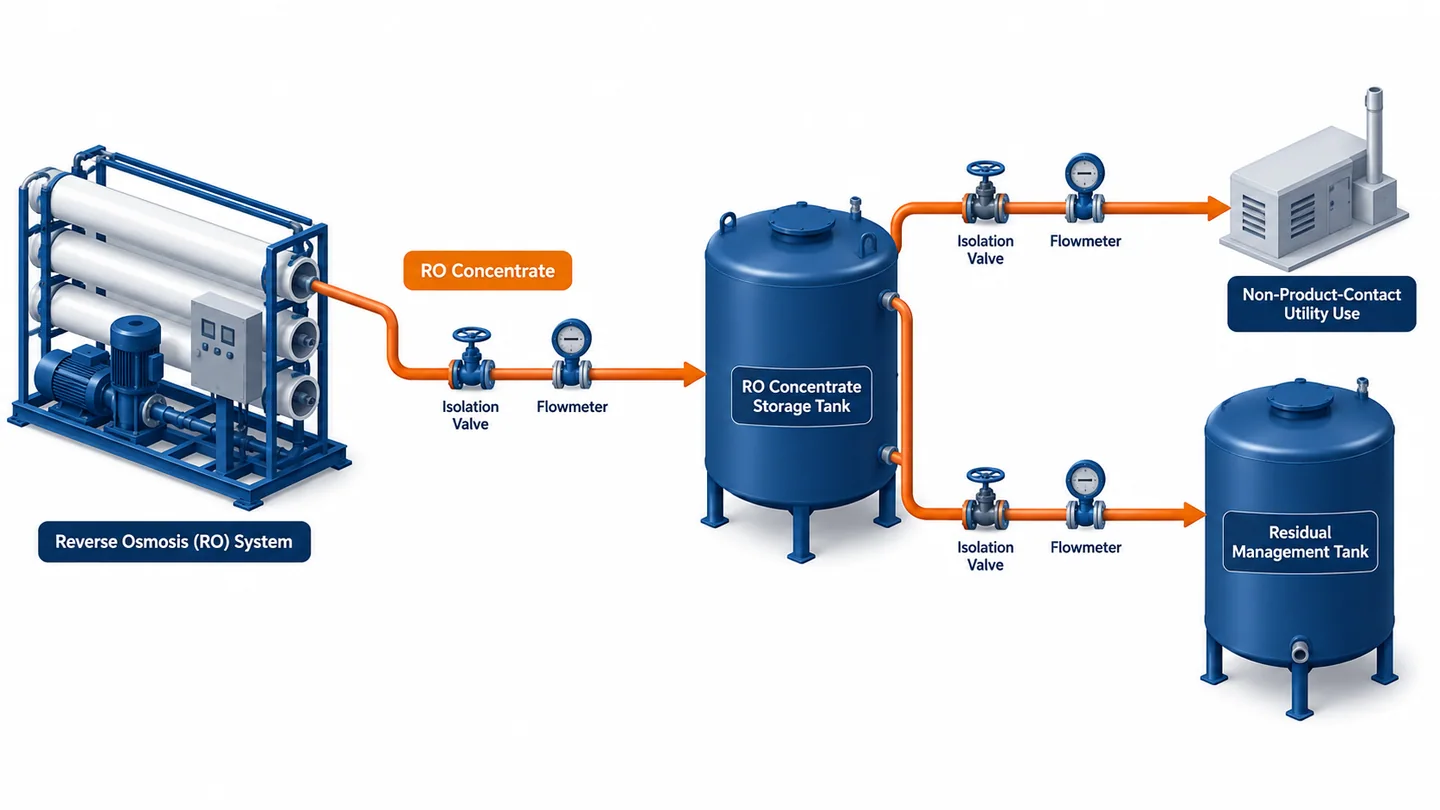
The best reuse destination is not necessarily the one located closest to the RO skid. It is the one with a compatible quality requirement and a predictable demand.
Create a short list of candidate uses and obtain their actual specifications. Possible candidates may include selected non-product-contact washing duties or some utility systems, but each requires a separate technical and safety review.
For each candidate, ask:
- Which constituents limit operation?
- Does the water contact products, workers, or the public?
- Could aerosols be generated?
- What materials and equipment will contact the water?
- Is continuous supply necessary?
- Where does the water go after use?
- Who can authorize the application at the site?
A floor-washing connection, for example, is not automatically low risk. Contamination may reach workers, drains, or production areas. Food-contact, potable, and similarly sensitive applications require their own validated requirements and should not be inferred from a general reuse article.
EPA describes reuse as treatment matched to an intended purpose, with requirements varying by source and application. That principle supports selecting a destination first, rather than assuming one reusable-water quality fits every factory. EPA basic information about water reuse
4. Check Whether the Demand Exists When Concentrate Is Produced
A daily volume match can conceal an hourly mismatch.
Suppose the example system produces 25 m³/day of concentrate, while a suitable utility use needs only 10 m³/day. Even if water quality is acceptable, direct reuse is capped by that demand unless another destination is available.
If the application operates only three days per week, a storage tank does not create additional weekly demand. It only shifts the timing of supply. Oversized storage may introduce additional cleaning, monitoring, and water-quality management obligations.
Prepare an hourly or shift-based balance for representative operating days. Include production shutdowns, seasonal changes, maintenance, and the receiving process's backup supply.
Define what happens when reuse demand disappears. The RO system needs an acceptable concentrate outlet or a controlled operating response. A reuse scheme that works only while every receiving valve remains open is not a robust production-water system.
5. Evaluate Direct Reuse Before Adding Another Membrane
Direct reuse can avoid an unnecessary treatment step when concentrate already satisfies a legitimate application requirement. However, pumping, storage, monitoring, and separation from potable or sensitive networks still need design attention.
Do not treat dilution as a universal solution. Blending changes concentration but does not destroy or remove contaminant mass.
For an illustrative blend, combine 10 m³/day at 2,000 mg/L of a conserved constituent with 30 m³/day at 200 mg/L:
Blended concentration = (10 × 2,000 + 30 × 200) ÷ 40 = 650 mg/L.
This number says nothing about suitability until it is compared with a verified application limit. It also says nothing about other constituents in the blend.
If blending is proposed, specify minimum and maximum flows, monitoring, failure response, and the destination of the mixed water after use. Confirm that the arrangement is acceptable for the intended purpose; dilution should not be assumed to satisfy discharge or reuse obligations.
6. Understand the Limits of Additional RO Recovery
Concentrate can sometimes be treated in a further membrane system, but it is a more demanding feed than the original water. The design must address concentration, scaling potential, fouling, pressure requirements, and membrane operating limits.
Ask the supplier for a complete ionic analysis and a projection covering relevant seasonal conditions. A recovery target chosen before the chemistry is reviewed is only an aspiration.
DuPont's FilmTec technical guidance emphasizes feedwater analysis and concentrate chemistry when evaluating scaling. Its design tools also support recovery and recycle calculations. These are reasons to request a documented projection, not evidence that a particular recovery is achievable at every site. FilmTec technical manual
Calculate overall recovery correctly
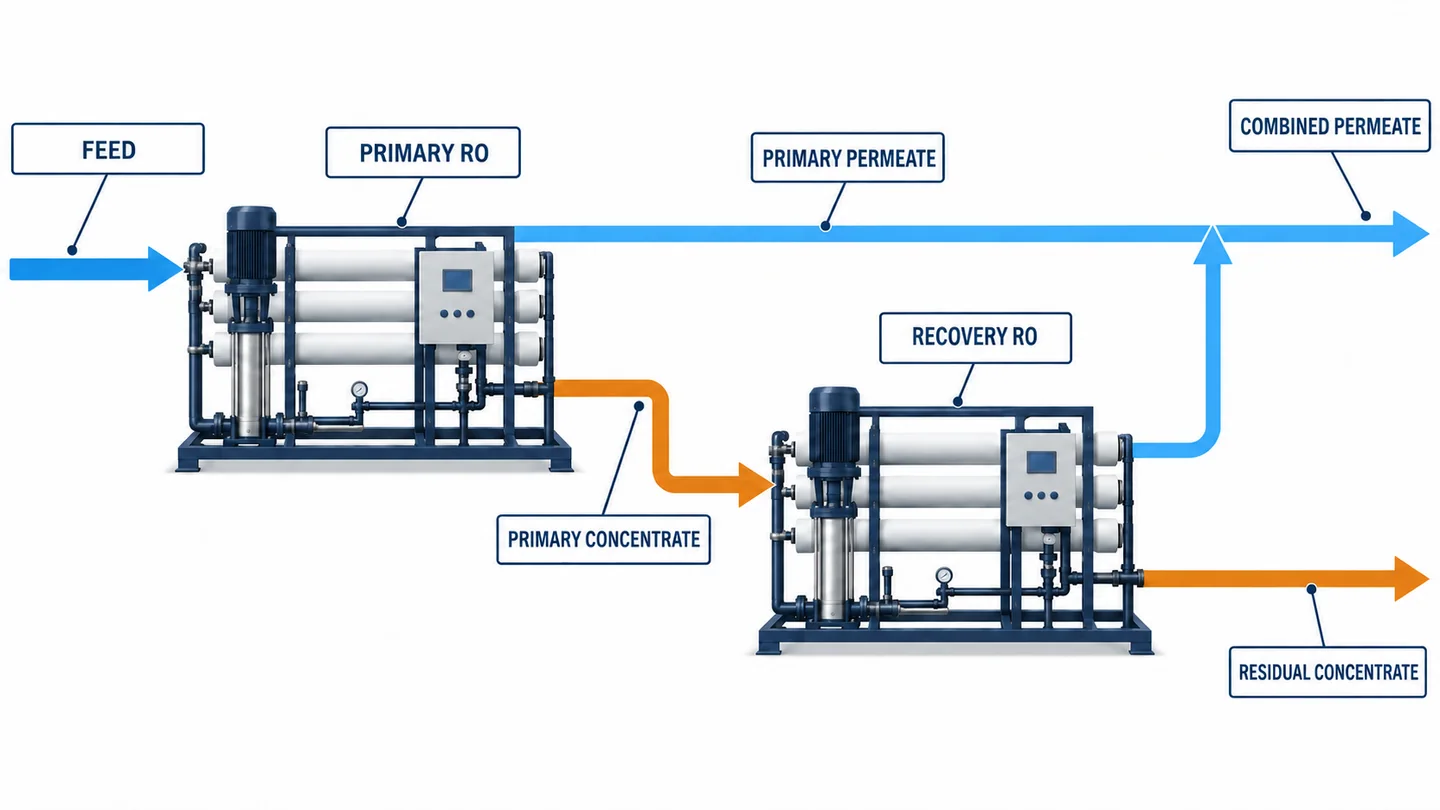
Return to the 100 m³/day example. The primary RO produces 75 m³/day and leaves 25 m³/day of concentrate.
If a second recovery unit converts 50% of that concentrate into additional permeate:
- Additional permeate: 12.5 m³/day.
- Remaining concentrate: 12.5 m³/day.
- Combined permeate: 87.5 m³/day.
- Simplified overall recovery: 87.5%.
The overall recovery is not 75% plus 50%. Each percentage applies to a different inlet flow.
This example ignores flushing, cleaning, pretreatment losses, and downtime. Net annual useful production will be lower if these losses occur or the additional permeate cannot always be used.
A second recovery unit is not necessarily a second pass
A second-pass RO typically treats first-pass permeate to improve product-water quality. A concentrate-recovery unit treats the rejected stream to recover additional water.
Confusing the two can produce quotations for the wrong duty. State which stream feeds the new equipment and what product quality it must achieve. The existing single-pass versus double-pass RO guide explains the product-quality distinction.
7. Why Complete Concentrate Recycling Is Not a Closed Water Balance
Returning concentrate to the feed can increase internal circulation while making little improvement in useful water production.
If dissolved salts enter continuously and leave negligibly in permeate, they need another exit. Without a purge, separation process, or other verified pathway, the system accumulates salts rather than reaching the assumed steady condition.
Internal recirculation, membrane-stage recovery, and whole-plant recovery must therefore be reported separately. A high number calculated from internal pump flow can be misleading when the objective is to reduce purchased water.
Purpose-designed recycle arrangements can be valid. However, they require mass-balance calculations and equipment checks. DuPont's WAVE documentation explicitly treats recycle as a design configuration to be modeled, rather than a pipe modification that can be assumed safe for any installation. DuPont concentrate-recycle documentation
8. Keep the Final Residual Route in the Project Scope
Recovering more water reduces concentrate volume but can increase the concentration of retained substances. Less liquid does not necessarily mean easier or cheaper disposal.
Review the remaining stream for the actual receiving facility or treatment process. Depending on the site, further concentration, evaporation, off-site treatment, or another authorized route may require evaluation. Do not select a route merely because it is common in another country or industry.
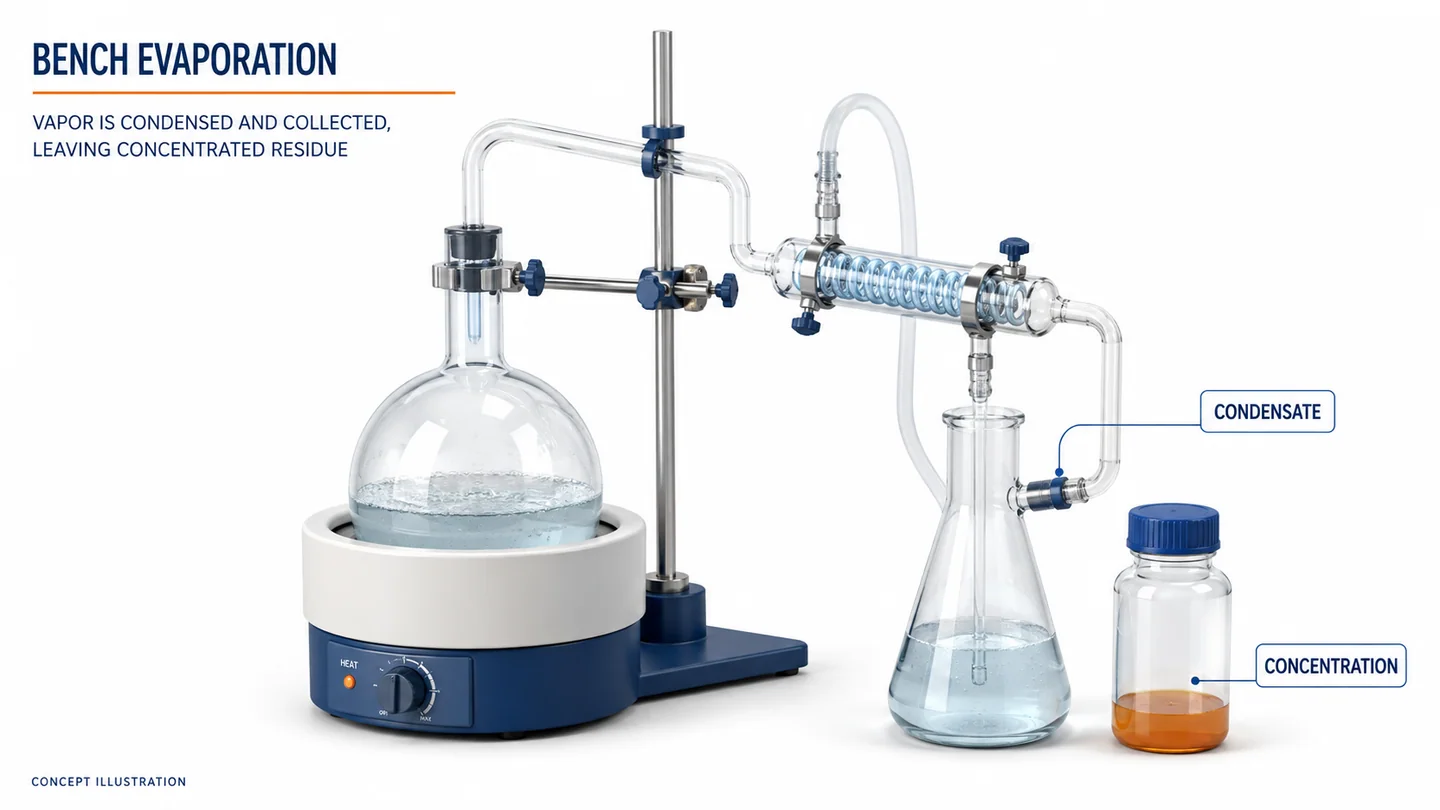
An evaporator also needs feed-specific evaluation. Scaling, foaming, corrosion, volatile carryover, and condensate quality can affect suitability. Producing condensate does not automatically establish a usable water product, and evaporation alone does not define a complete ZLD system.
Include a contingency route during cleaning, commissioning, and upset conditions. Ask who manages concentrate when the recovery equipment is unavailable. A plant that loses its production-water supply during routine maintenance may carry costs far beyond the water savings.
9. Compare Cost per Cubic Meter Actually Reused
Calculate savings from useful water delivered to an approved application, not from gross flow moving around the treatment plant.
Include electricity, chemicals, membrane replacement, maintenance, analysis, operator time, storage, and residual handling. Distinguish avoided variable costs from fixed charges that will remain on the utility bill.
For an illustrative evaluation, assume a project delivers 20,000 m³/year of useful water. Assume the verified avoided water and discharge costs total USD 2.00/m³, while incremental operation costs USD 0.80/m³.
The simplified annual operating benefit is:
20,000 × (2.00 − 0.80) = USD 24,000.
These are hypothetical values, not market prices. A USD 100,000 installed investment would have a simple payback of about 4.2 years under those assumptions, before financing, taxes, and other adjustments.
Run a sensitivity case with lower utilization, higher cleaning frequency, and increased residual cost. If the project only looks attractive at maximum utilization, obtain stronger evidence for the receiving demand before purchasing equipment.
10. Specify Testing, Delivery, and Acceptance
Provide the supplier with source-water and concentrate analyses, operating logs, membrane details, cleaning history, chemical products, and customer requirements for the intended use.
Testing should reproduce meaningful operating conditions. A pilot for additional recovery should monitor normalized membrane performance, pressure loss, permeate quality, concentration, and cleaning response. Short-term water production alone does not establish a sustainable operating cycle.
Factory testing should verify the agreed functional scope: instruments, alarms, valves, pumps, control sequences, and diversion logic. Shipment inspection should check protection, component identification, spare parts, and documentation. These checks support reliable delivery but do not replace concentrate treatability testing.
Installation preparation should confirm tie-in locations, cross-connection protection, tank access, drains, electrical supply, and maintenance space. Keep sensitive networks clearly separated according to the applicable site requirements.
Agree on acceptance conditions before ordering. Specify feed limits, net useful output, product quality, residual volume, monitoring periods, and procedures for off-spec water. Document which results require laboratory analysis and which can be verified with calibrated online instruments.
FAQ
Can RO concentrate be used in a cooling tower?
It may be a candidate, but not automatically. Cooling concentrates dissolved constituents further, so evaluate the proposed makeup composition, allowable operating conditions, corrosion, scaling, and biological-control program with the responsible utility specialist.
Is RO reject water the same as untreated wastewater?
No. It is the concentrated stream leaving an RO separation process. Its contents depend on the original water and treatment history. Concentrate from clean source water and concentrate from industrial wastewater can have very different reuse limitations.
Will another RO unit eliminate all concentrate?
No. Additional recovery still produces a residual stream and may create cleaning or pretreatment wastes. The practical limit depends on chemistry, equipment, operation, and the final residual route.
Does adding fresh water make concentrate safe to reuse?
Blending lowers concentrations but does not remove contaminant mass. Suitability must be established for the specific use, including contaminants not represented by TDS and the consequences of blend-control failure.
What information should be sent for a quotation?
Provide representative analyses of all three RO streams, flow and operating schedules, current membrane and chemical details, the receiving application's specification, and the accepted destination for residuals. Include available space and utilities for any new treatment package.
Conclusion: Match Concentrate to a Real Use, Not a Recovery Target
RO reject reuse is strongest when it begins with measured chemistry, a real receiving demand, and a complete residual pathway. Direct reuse may be sufficient; further recovery may be justified; some streams may have no practical on-site destination.
Compare alternatives using net useful water, whole-system cost, and an agreed acceptance basis. Do not mistake internal circulation for water savings.