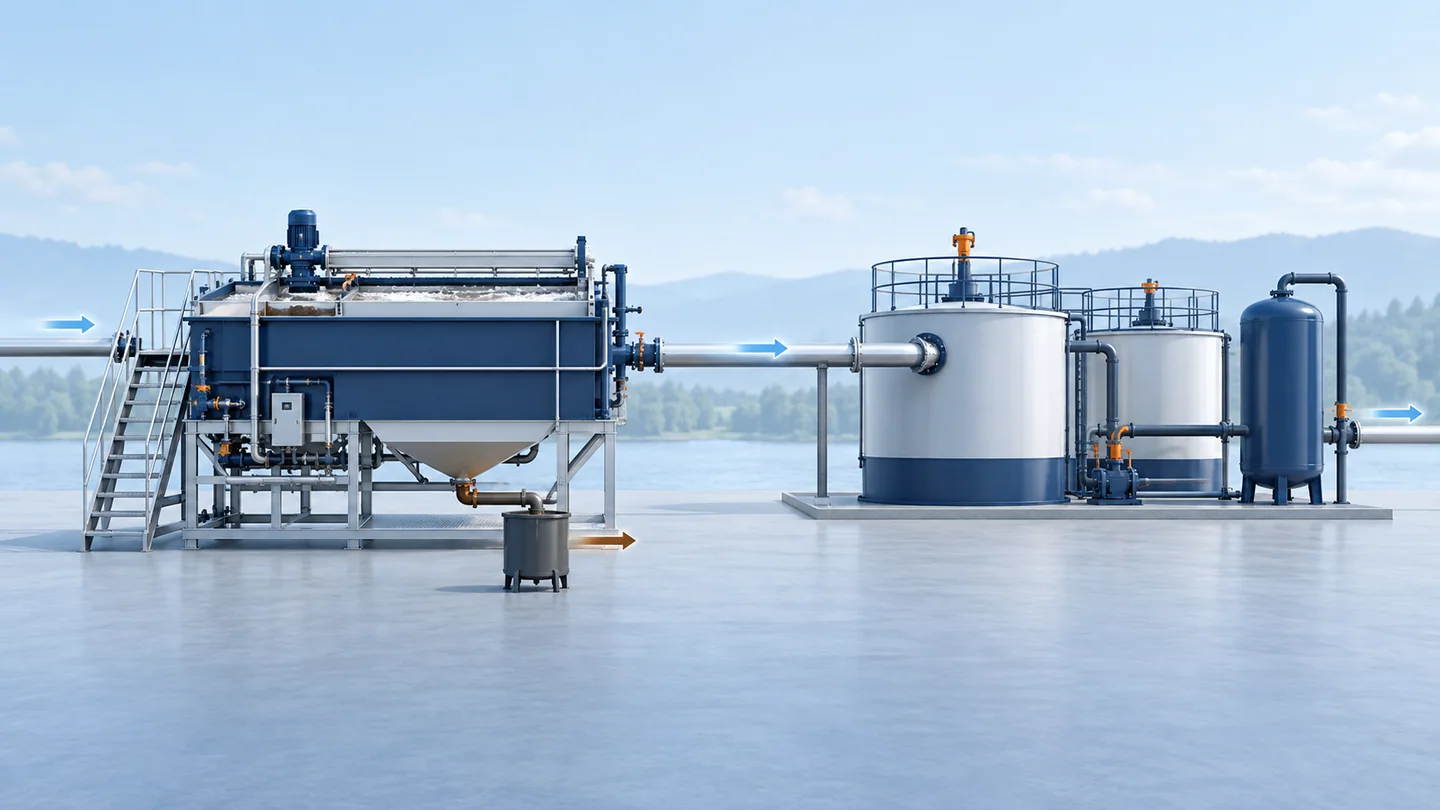
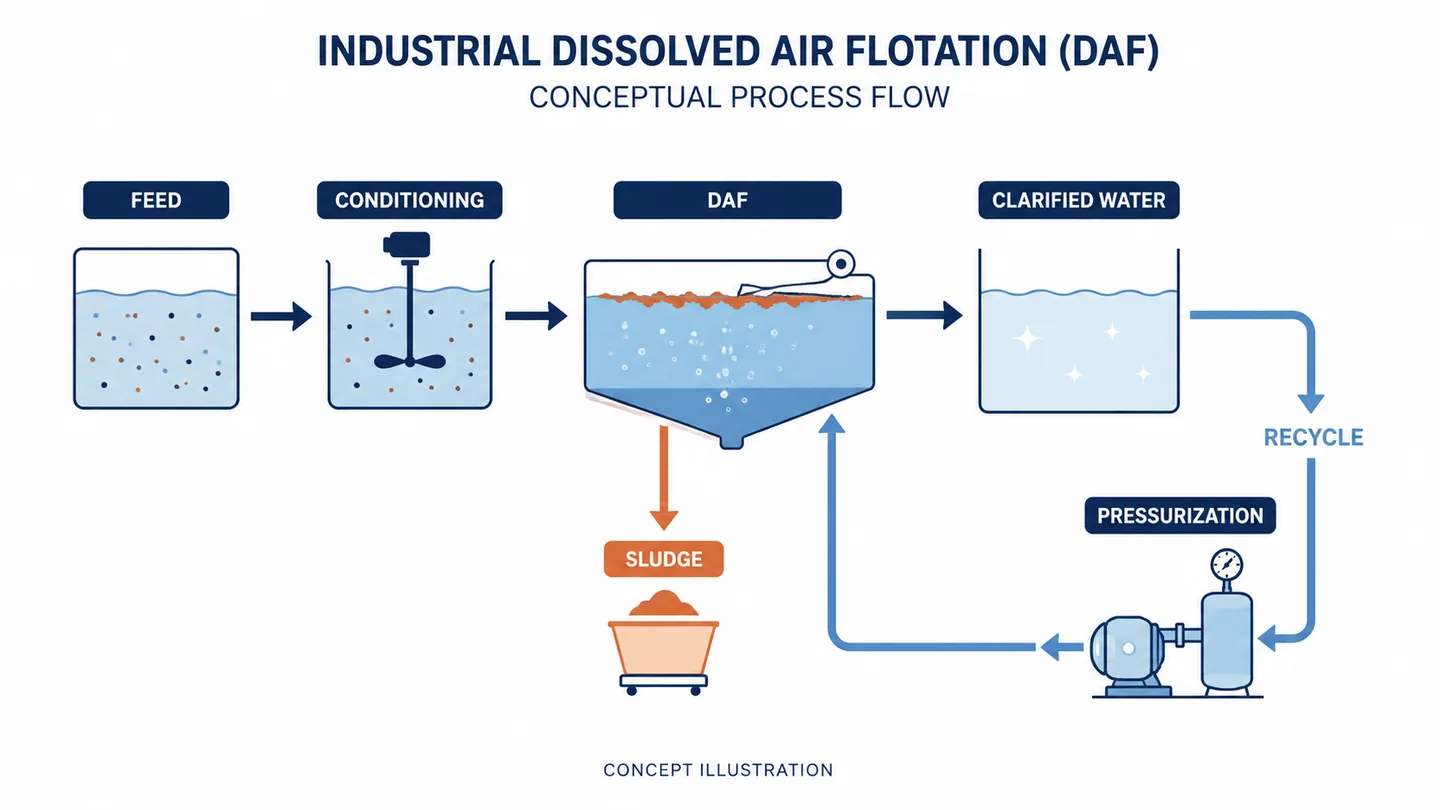
Buying a dissolved air flotation system by its advertised flow capacity is a common starting point—but an incomplete purchasing decision. Two wastewater streams flowing at the same rate can place very different demands on a DAF unit. One may contain relatively little suspended material. The other may carry concentrated solids, emulsified oil, or additional sludge created during chemical treatment.
For an industrial buyer, the objective is not simply to select a larger flotation tank. It is to define the conditions under which the complete system must consistently achieve the required outlet quality.
This guide explains how to develop a practical sizing basis, interpret supplier calculations, plan useful flotation testing, and establish acceptance requirements. The calculation examples are illustrative engineering exercises, not Baihuipu project results or recommended design limits.
Quick Answer: What Determines DAF System Size?
A DAF system should be selected against at least two loads: the wastewater flow entering the separation process and the mass of solids that must be separated. The final configuration also depends on flotation response, chemical conditioning, recycle-water arrangements, sludge handling, and the required effluent quality.
Start with representative flow and wastewater data. Establish normal, sustained-peak, and abnormal conditions separately. Then ask the supplier to demonstrate how hydraulic capacity, solids capacity, air delivery, and sludge removal remain compatible across the agreed operating range.
A flow label such as “30 m³/h” is not a complete performance specification.
1. Define the Treatment Duty Before Selecting Equipment
Clarify what the DAF must remove
The treatment objective should describe measurable pollutants and a defined downstream requirement.
For example, a food processor may need to reduce suspended solids and fats before biological treatment. A metal-finishing facility may use flotation to separate chemically precipitated solids. Another plant may need pretreatment before a membrane process.
These duties should not share an assumed removal target simply because all three use DAF equipment.
DAF is principally a separation process. It should not be presented as a universal solution for dissolved salts or all dissolved organic contamination. Chemical treatment may convert some contaminants into separable material, but that is a process-specific result that requires verification.
Industrial DAF suppliers distinguish between applications involving suspended solids, fats, oils, and different levels of chemical conditioning. Equipment arrangements also vary with the separation duty.Nijhuis industrial DAF overview
Specify the acceptance location
Write down where outlet quality will be measured:
- Directly after flotation.
- After an additional filtration step.
- Before biological treatment.
- At the final discharge point.
A supplier should not be expected to guarantee a downstream result that depends on equipment outside its scope. Equally, the buyer should not accept a flotation-outlet claim as proof that the complete wastewater plant will meet its final objective.
2. Build a Flow Profile, Not Just a Daily Average
Daily wastewater volume is useful for a water balance, but DAF equipment operates against hourly and shorter-term conditions.
Suppose a factory generates 240 m³ per day. Dividing by 24 gives 10 m³/h. However, if most wastewater is released during an eight-hour production shift, the treatment requirement may be very different.
Collect information on:
- Production operating hours.
- Cleaning and washdown periods.
- Batch tank discharges.
- Shift changes.
- Seasonal production differences.
- Planned expansion.
- Available equalization capacity.
An equalization tank may allow the DAF feed rate to be controlled more steadily. Its benefit depends on usable storage volume and an operating strategy that actually buffers the incoming variation.
Do not automatically combine the highest recorded flow with the highest concentration if they occurred under unrelated conditions. Equally, do not ignore a cleaning event where both increased together. Identify credible combinations from the production schedule and sampling records.
For background on upstream buffering, see industrial wastewater equalization tank sizing.
The purchasing specification should distinguish a continuous design duty from a short event handled through storage, controlled feeding, or a separate treatment arrangement.
3. Convert Concentration into Solids Mass Loading
Use a transparent calculation
For suspended solids, a basic mass-load calculation is:
Solids load, kg/h = Flow, m³/h × TSS, mg/L ÷ 1,000
Consider an illustrative feed:
| Condition | Flow | TSS | Incoming TSS load |
|---|---|---|---|
| Normal production | 30 m³/h | 800 mg/L | 24 kg/h |
| Higher-flow production | 45 m³/h | 800 mg/L | 36 kg/h |
| Concentrated cleaning discharge | 30 m³/h | 1,500 mg/L | 45 kg/h |
The third condition has the same flow as normal production but almost twice the incoming solids load.
This is why selecting only against cubic metres per hour can miss an important limitation.
Account for treatment-generated solids
Raw-water TSS is not always the entire solids burden entering flotation. Coagulation, precipitation, and other upstream reactions may generate additional dry solids.
Ask the supplier to identify whether its calculation includes:
- Incoming suspended matter.
- Solids formed by chemical precipitation.
- Coagulant-related solids.
- Other material separated into the float.
Avoid simply adding every laboratory parameter together. Oil and grease, TSS, and chemically generated solids may overlap depending on the analytical definitions and process. A defensible calculation explains what is included and avoids double counting.
Also distinguish solids entering the DAF from solids expected to be captured. Both matter, but they are not interchangeable quantities.
The most useful supplier submission contains a mass balance that connects measured feed conditions, chemical treatment, expected outlet concentrations, and sludge production.
4. Ask What “Hydraulic Loading” Includes
A hydraulic loading calculation relates flow to an identified separation area. Before comparing two proposals, confirm that both suppliers use the same definitions.
Important questions include:
- Does the stated flow include pressurized recycle water?
- Which area is used in the calculation?
- Is the area based on an open tank or an internal plate arrangement?
- What evidence supports the selected loading for this wastewater?
- What happens at the sustained peak condition?
For illustration, a feed flow of 30 m³/h with recycle equal to 25% of that feed introduces another 7.5 m³/h into the relevant process arrangement. The resulting combined flow is 37.5 m³/h. This arithmetic does not establish a recommended recycle rate or tank size; it shows why the calculation boundary matters.
A compact package is not necessarily undersized, and a larger tank is not automatically reliable. Internal design, flow distribution, and validated operating conditions need to be considered together.
Xylem’s DAF guidance explicitly notes that hydraulic and solids loading criteria vary with the industrial application and treatment objective. A single loading value should not be copied across all food or industrial wastewaters.Xylem DAF technical FAQ
5. Separate Chemical Screening from Flotation Verification
What a jar test can establish
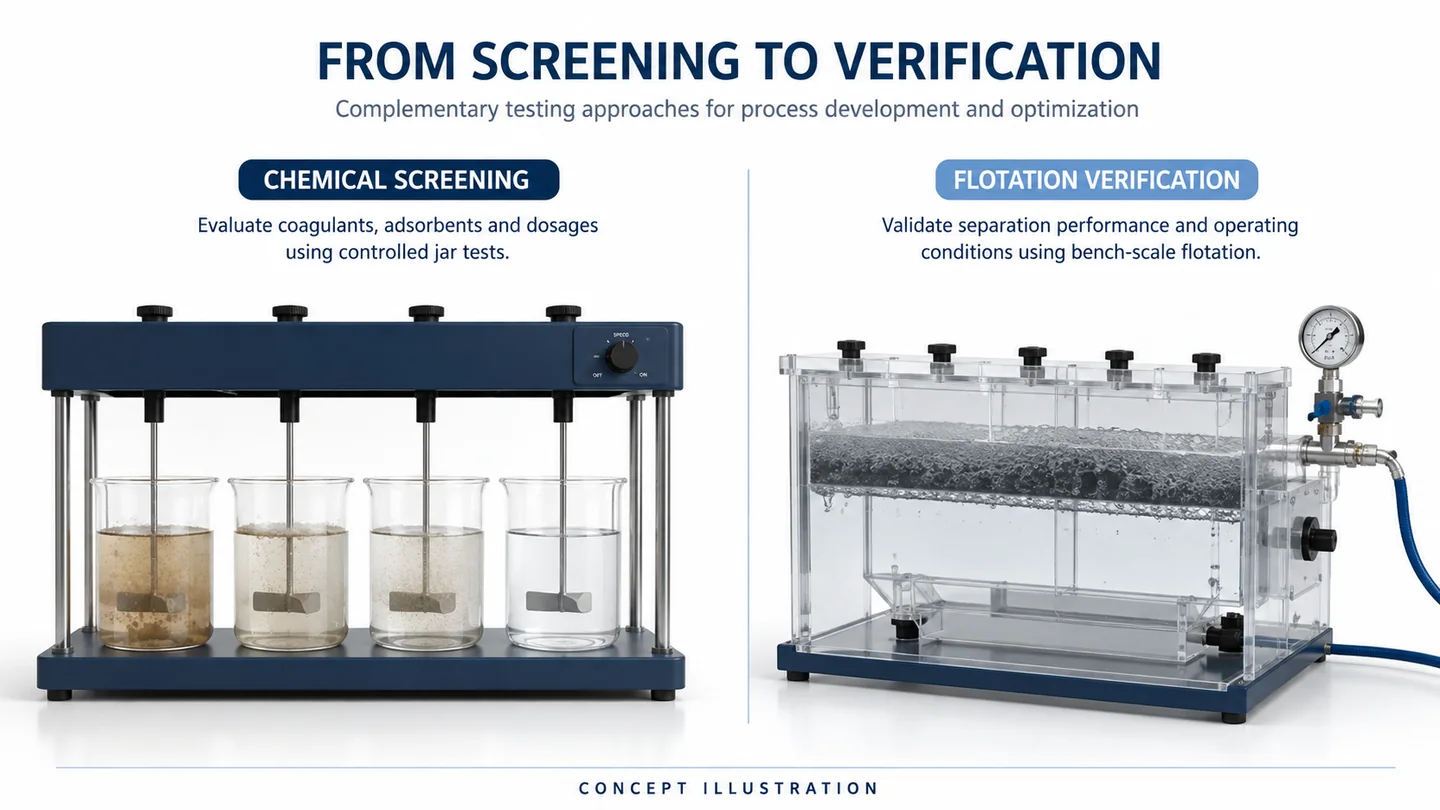
A jar test can help compare chemical sequences and observe whether the wastewater responds to coagulation and flocculation.
Useful records include:
- Sample identity and collection conditions.
- Initial wastewater characteristics.
- Chemical identity and preparation.
- Dosing sequence.
- pH before and after treatment.
- Mixing conditions.
- Observed floc formation.
- Analytical results from the separated liquid.
However, a settling jar does not reproduce the air-release and separation conditions inside a DAF.
What a flotation test should add
Where flotation is the proposed separation method, the test plan should investigate how conditioned particles respond under flotation conditions.
Ask how the test represents bubble introduction, recycle arrangements, contact conditions, and the intended separation objective. Record not only liquid clarity, but also residual pollutants, float characteristics, and any sensitivity to changes in feed composition.
A successful test on one conveniently selected sample does not define the complete operating range. Include representative production and cleaning conditions where these are materially different.
Photographs can document observations, but clear-looking water is not an analytical result. The acceptance decision should rely on measured parameters relevant to the customer requirements.
For a broader explanation of testing stages, see jar tests, bench tests, and pilot tests.
6. Review the Air and Recycle Package as Part of the System
The flotation vessel should not be evaluated separately from the equipment that produces and distributes the pressurized recycle stream.
Request a description of:
- Recycle-water source.
- Recycle flow measurement and control.
- Pump operating range.
- Air supply arrangements.
- Pressure indication.
- Release-device access.
- Alarm and interlock philosophy.
An air-to-solids calculation is meaningful only when the supplier defines the air quantity, solids basis, and conditions behind it. A number copied from another application is not a substitute for a process justification.
The buyer should also ask what happens when the wastewater load changes while flow stays relatively constant. A package designed around one fixed operating point may require a control strategy to handle a wider duty.
During technical review, compare the equipment list with the proposed operating method. If the process description depends on adjustment or measurement that the package does not provide, clarify the gap before ordering.
7. Size Sludge Handling Alongside Flotation
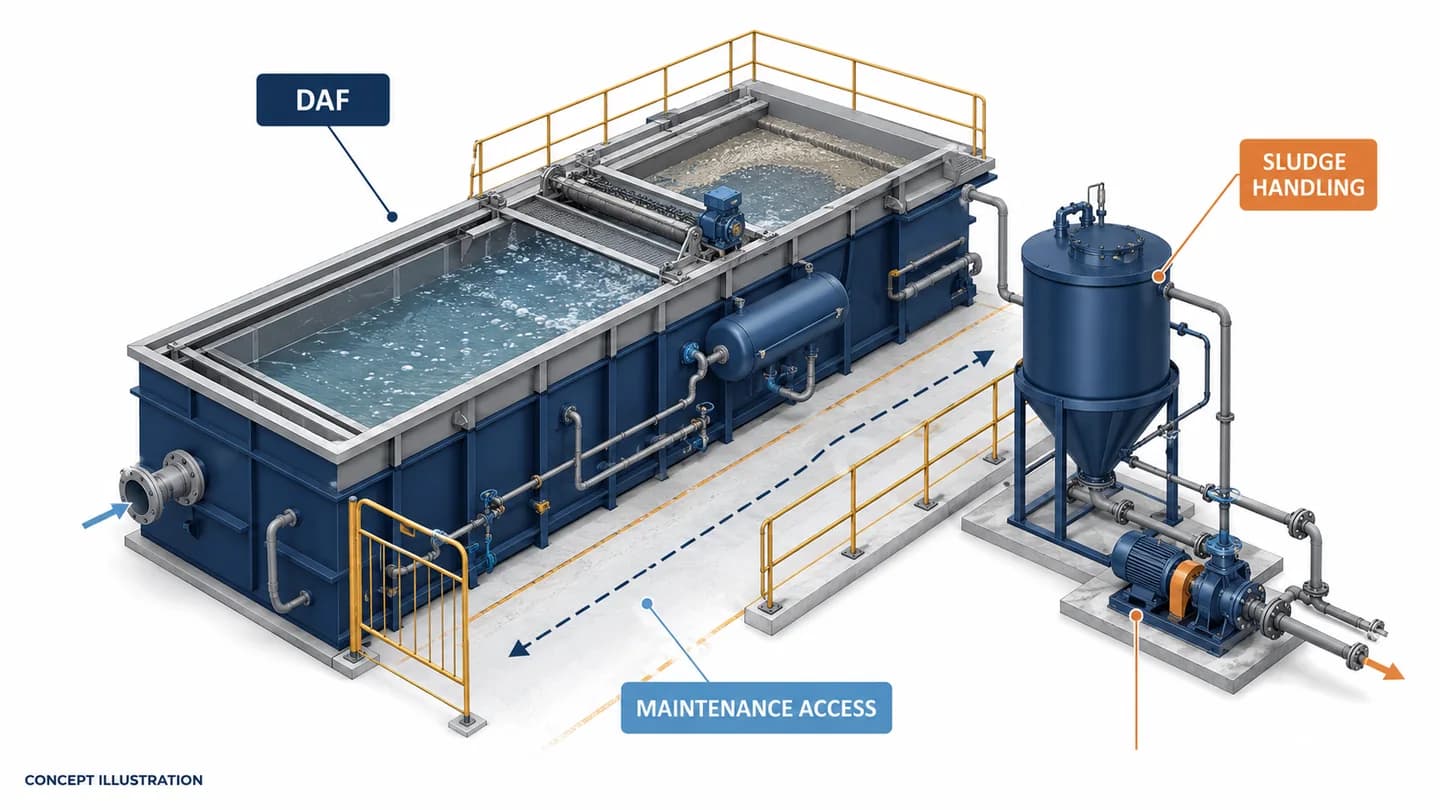
Removing solids from the water transfers them into another stream. The sludge system therefore belongs in the same purchasing discussion.
Clarify:
- Expected dry-solids production.
- Anticipated float consistency and its uncertainty.
- Sludge discharge frequency.
- Intermediate storage needs.
- Transfer-pump selection.
- Downstream dewatering arrangements.
- Return-water routing.
A proposal may offer sufficient flotation capacity while providing inadequate storage or transfer capacity for the captured material.
Avoid treating a single sludge-solids percentage as a guaranteed property of every wastewater. Chemical conditions and operating practice can change the amount of water carried with the float.
Ask for the basis of sludge-volume estimates and identify which figures are measured, calculated, or assumed.
Where dewatering is supplied separately, define the interface clearly: who provides the feed pump, who controls the transfer, and where filtrate or drainage returns. Otherwise, the buyer may discover after installation that the packages were sized against different assumptions.
8. Check Operability at Both High and Low Loads
A plant rarely operates continuously at its maximum design condition.
Review the expected minimum feed rate, reduced-production periods, weekend operation, and restart after shutdown. The supplier should explain whether the proposed equipment operates continuously, intermittently, or under a controlled feed schedule.
Practical questions include:
- Can chemicals be dosed consistently at low flow?
- How is feed interrupted when downstream equipment is unavailable?
- What prevents untreated bypass during an alarm?
- How are tanks drained and inspected?
- Which instruments require routine calibration?
- Can maintenance be performed without unsafe access?
Installation preparation should also address electrical supply, chemical storage, containment, drainage, access, and available lifting arrangements.
These details may not change the nominal DAF area, but they influence whether the selected system can achieve useful availability in the actual factory.
Do not let an attractive layout replace a maintenance review. Ask the operator who will use the equipment to examine access and routine tasks before approving the final arrangement.
9. Compare Quotations Using a Common Design Basis
A useful comparison sheet should show more than price and capacity.
Include:
| Comparison item | What the buyer should request |
|---|---|
| Feed envelope | Normal, peak, and excluded conditions |
| Treatment objective | Parameters, sampling point, analytical basis |
| Flow basis | Feed only or feed plus recycle |
| Solids basis | Incoming and treatment-generated solids |
| Testing | Samples, conditions, results, limitations |
| Chemicals | Proposed products, assumptions, supply scope |
| Sludge | Production estimate and handling interfaces |
| Controls | Included instruments, alarms, automatic actions |
| Acceptance | Test conditions and responsibilities |
| Exclusions | Civil work, utilities, downstream treatment |
Ask each supplier to identify deviations from the same specification. This is more informative than comparing differently defined “30 m³/h” packages.
For expansion, distinguish between equipment installed now and provisions reserved for a future duty. Empty space beside a DAF does not demonstrate that the existing pumps, air system, controls, or sludge equipment can support an increased load.
10. Define Factory and Site Acceptance Separately
Factory testing can verify equipment identity, assembly, instrument response, control sequences, alarms, and specified clean-water functions.
It does not automatically establish pollutant removal on a wastewater that was never tested.
Shipment inspection should verify packing, identification, protected openings, loose components, and documentation. These checks protect delivery quality but should not be presented as process-performance evidence.
Site commissioning introduces the actual utilities, wastewater, chemicals, and operating team. Performance acceptance should then use the agreed feed envelope, sampling locations, analytical methods, and observation period.
Specify what happens if the incoming wastewater falls outside the agreed conditions during the test. The contract should also explain responsibility for chemical supply, laboratory analysis, operator availability, and downstream restrictions.
A clear acceptance plan reduces the chance that the buyer and supplier use different definitions of successful operation.
Frequently Asked Questions
Can I size a DAF system from daily wastewater volume alone?
Not reliably. Daily volume does not show the hourly flow profile or solids mass loading. Provide production hours, batch discharges, concentration data, and the role of upstream equalization.
Is a larger DAF always the safer choice?
No. Extra separation area does not correct unsuitable chemical conditioning, insufficient air delivery, poor flow distribution, or inadequate sludge handling. The complete package must match the wastewater and operating range.
Can DAF remove dissolved COD?
DAF primarily separates floatable material. It may remove a portion of COD associated with captured solids, oil, or material converted through chemical treatment. Dissolved COD removal should not be assumed without relevant testing.
Is a successful jar test enough to buy a DAF?
It can support chemical selection, but a settling test alone does not verify flotation behavior or full-scale capacity. The required next step depends on wastewater variability, process risk, and the evidence already available.
Should the design include recycle water?
The supplier should show where recycle enters the process and how it is included in each hydraulic calculation. Comparing proposals requires consistent definitions rather than assuming every supplier uses the same basis.
What information should accompany a quotation request?
Send flow records, representative wastewater analysis, the treatment objective, production and cleaning schedules, site constraints, and available test results. Identify whether the quotation includes chemicals, sludge handling, installation, and performance testing.
Conclusion: Buy a Defined Treatment Duty
A well-specified DAF system connects flow, solids loading, flotation response, air delivery, and sludge handling to a measurable outlet requirement.
The strongest purchasing decision is not based on the largest tank or the lowest price per cubic metre per hour. It is based on a transparent design basis, appropriate verification, and clear operating responsibilities.
Baihuipu’s dissolved air flotation systems can be discussed within a broader industrial wastewater treatment scope.