Introduction
Food and beverage wastewater looks simple because much of its pollution is organic. In practice, it can be one of the most variable industrial wastewaters to operate.
A beverage bottling line may produce large rinse flows with intermittent syrup or product losses. A dairy can generate milk solids, fats, proteins, cleaning chemicals and high-strength whey-related streams. A brewery or distillery can discharge soluble organics, yeast, spent product, cleaning water and variable pH. Meat, poultry and seafood plants add fats, proteins, blood, suspended solids and sanitation cycles. Sugar and starch operations may generate highly biodegradable loads with seasonal or batch variation.
This variation matters because the treatment plant receives both water and mass. A short product spill may contribute more COD than hours of normal rinsing. A clean-in-place (CIP) discharge may shift pH rapidly or introduce chemicals that inhibit biology. A high-flow cleaning period can wash solids through equipment selected only from the average daily flow.
The correct procurement question is therefore not “Is DAF better than MBR?” It is “Which pollutants must be removed at each stage, what variation must the system absorb, and what effluent quality is required at the final sampling point?” Buyers can use this framework when reviewing a Food & Beverage water-treatment solution or an industrial wastewater treatment system.
Start by Mapping Wastewater Sources
The U.S. EPA identifies BOD, COD, TSS, oil and grease, pH, nitrogen and phosphorus among parameters commonly relevant to food-processing wastewater. Water Environment Federation guidance also highlights readily degradable organic matter, CIP chemicals, disinfectants, TDS and FOG as important operational considerations. These categories are a useful starting point, but the buyer still needs facility-specific data.
Product contact and production losses
Raw material, intermediate product and off-spec product can enter drains during startup, shutdown, changeover, spills or equipment cleaning. Source control can sometimes reduce treatment load more economically than increasing reactor volume. Dry cleanup, product recovery, drain screens and controlled dump procedures should be reviewed alongside treatment equipment.
Cleaning and sanitation water
CIP sequences may contain caustic, acid, oxidant, disinfectant and rinse steps. The discharge can create pH peaks, conductivity changes, temperature changes, phosphorus or nitrogen load, foam, and temporary biological inhibition. Record the cycle volume, frequency, chemical concentration and whether concentrated first rinses can be collected separately.
Fats, oils and grease
FOG can float, emulsify, coat instruments, plug piping, disrupt settling and foul membranes. Its behavior depends on temperature, droplet size, detergents, emulsification and the proportion that is free, dispersed or chemically stabilized. A single “oil and grease” number does not fully describe separability.
Suspended and settleable solids
Peels, fibers, starch, proteins, bones, shells, soil, yeast and other solids can often be removed before they become dissolved or finely dispersed load. Screens and primary separation reduce the burden on chemical and biological stages.
Dissolved biodegradable organics
Sugars, alcohols, soluble starch, organic acids and proteins can create high BOD and COD. Biological treatment is usually the main removal mechanism for this dissolved biodegradable fraction, but load variation, temperature, nutrients, alkalinity and inhibitory chemicals affect performance.
Nutrients, salts and specific constituents
Nitrogen and phosphorus may be present in raw materials, cleaners or additives. Salt can come from product, brine, softener regeneration or cleaning. Color, temperature, pathogens or a specific chemical may matter for certain operations. The analysis plan should follow the actual process and discharge or reuse requirement.
What DAF Does—and What It Does Not Do
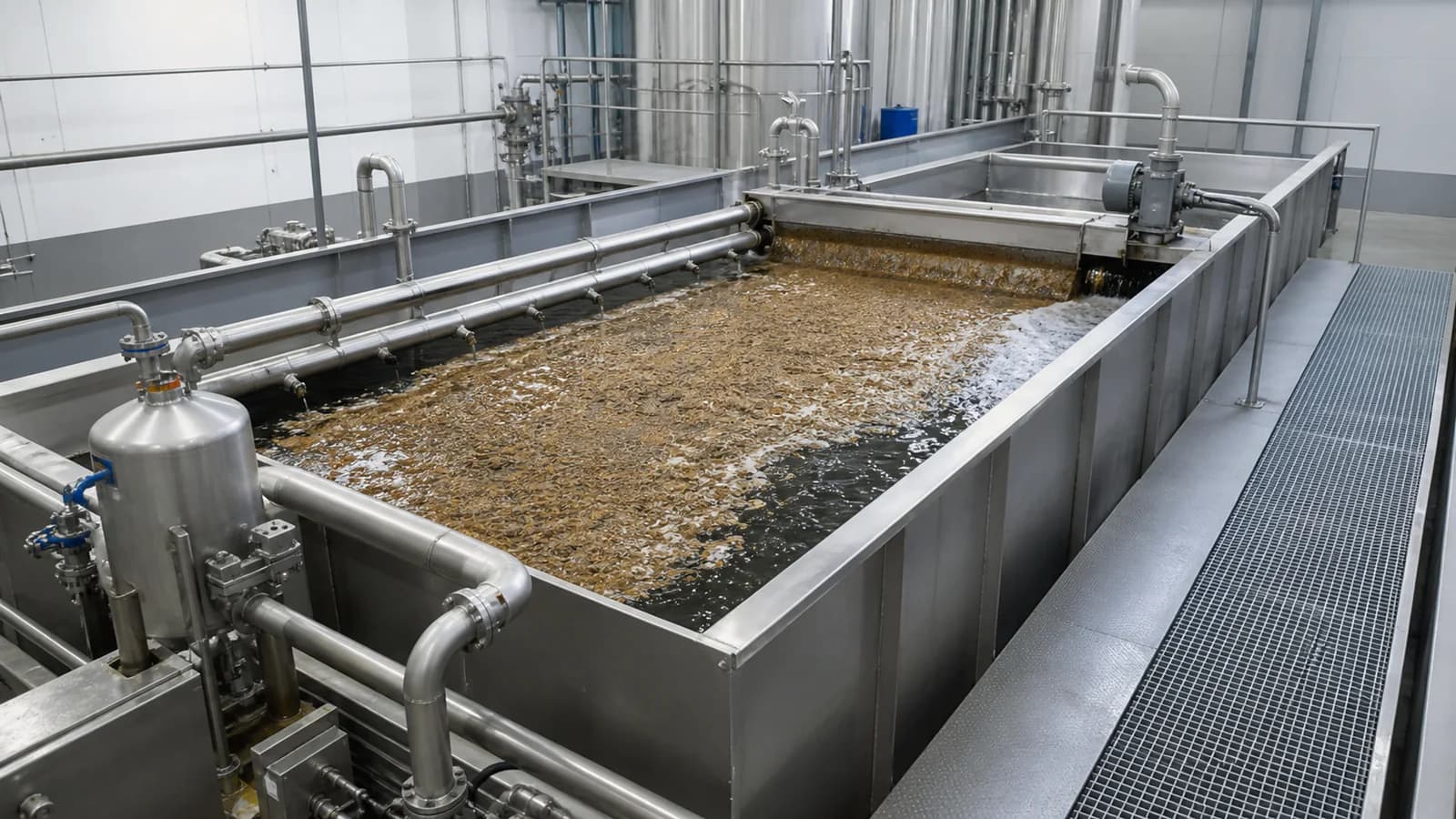
DAF releases fine air bubbles into conditioned wastewater. The bubbles attach to suitable particles or flocs and carry them to the surface for removal as float sludge. In food plants, DAF is often evaluated after screening and equalization for FOG, suspended solids and particulate or colloidal COD.
When DAF is a strong candidate
- wastewater contains floatable FOG or low-density solids;
- coagulation and flocculation can convert colloids into separable flocs;
- pretreatment is needed to protect a downstream biological process;
- footprint favors flotation over a large gravity separator;
- the plant can operate chemical dosing and manage float sludge.
DAF design inputs
The supplier needs flow variation, temperature, pH, TSS, FOG, COD fractions, particle behavior and jar-test information. Design also depends on hydraulic loading, recycle ratio, saturator pressure, air-to-solids relationship, flocculation conditions, skimming and sludge handling.
DAF limitations
DAF does not remove all dissolved COD. A visually clear DAF effluent can still contain a high biodegradable load. Poor screening, unstable pH, emulsifying detergents, incorrect dosing or weak sludge removal can also reduce performance. DAF should be judged by defined pollutant mass and downstream impact, not appearance alone.
What Biological Treatment Does
Biological treatment uses microorganisms to convert biodegradable organic matter and, where designed, nitrogen compounds. The process may be aerobic, anaerobic or a combination.
Aerobic treatment
Activated sludge, sequencing batch reactors (SBR), moving-bed biofilm reactors (MBBR), membrane bioreactors and other aerobic systems use oxygen to treat biodegradable load. The design must consider organic loading, oxygen demand, temperature, pH, nutrients, sludge age, solids separation and expected variation.
Aerobic treatment is familiar and can produce good-quality effluent, but aeration consumes energy and produces biological sludge. A high-strength stream may require substantial aeration unless upstream recovery, DAF or anaerobic treatment reduces the load.
Anaerobic treatment
Anaerobic processes can be attractive for sufficiently strong, biodegradable wastewater because they generally require less aeration, can produce less biological sludge and may generate biogas. Water Environment Federation guidance describes different anaerobic configurations and emphasizes that solids, FOG, organic loading and wastewater characteristics affect the applicable technology.
Anaerobic treatment is not automatically suitable for every food plant. Low temperature, variable or low organic load, excessive FOG or suspended solids, salinity, inhibitory cleaning chemicals, poor nutrient balance and limited operator support can affect stability. Anaerobic effluent also commonly requires aerobic or other polishing before discharge or reuse.
Nutrient removal
If total nitrogen or phosphorus limits apply, the biological and chemical route must be designed accordingly. Denitrification needs an appropriate anoxic zone and carbon relationship. Biological phosphorus removal requires suitable conditions; chemical phosphorus removal creates additional sludge. Nutrient requirements for biomass should also be reviewed when wastewater is rich in carbon but deficient in nitrogen or phosphorus.
Where MBR Fits
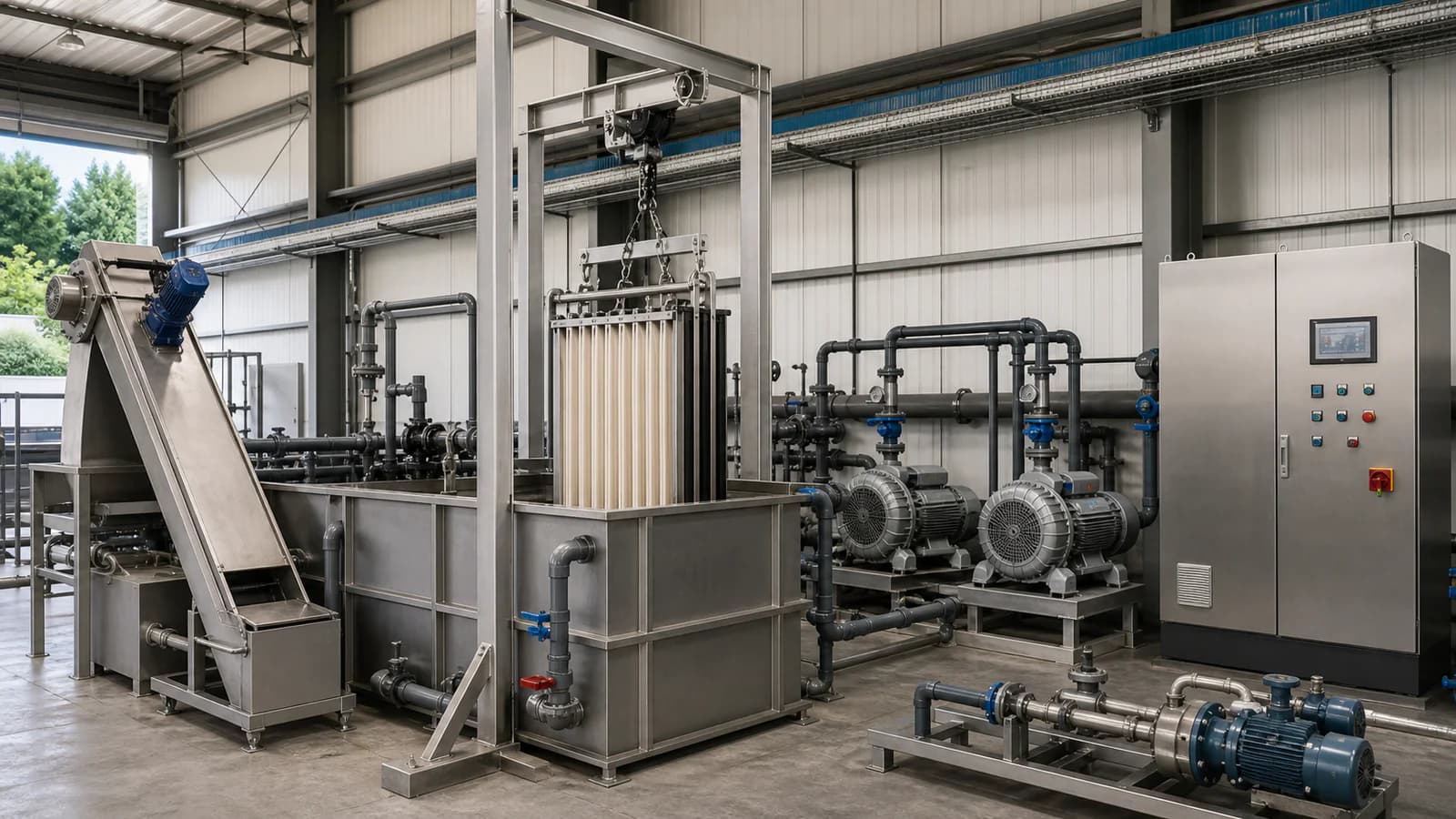
An MBR combines biological treatment with membrane filtration for solid–liquid separation. Instead of relying only on a secondary clarifier to retain biomass, the membrane produces an effluent with low suspended solids when operated correctly.
Reasons to evaluate MBR
- limited footprint;
- a need for consistently low TSS or turbidity before downstream reuse treatment;
- variable settling characteristics that make conventional clarification difficult;
- a higher biomass concentration or longer solids-retention strategy is useful;
- the owner can support membrane cleaning, aeration, monitoring and replacement.
What MBR does not solve
MBR is not a substitute for FOG and solids control. Free grease, fibers and poorly conditioned wastewater can foul screens and membranes. MBR also does not remove all dissolved salts. If reuse requires low TDS, RO or another desalination stage may still be needed, creating concentrate that must be managed.
Membrane flux, temperature correction, permeability, transmembrane pressure, aeration, cleaning frequency, chemical compatibility and redundancy should be stated in the proposal. A small membrane footprint does not mean the whole biological and pretreatment system is small.
DAF vs Biological Treatment vs MBR
| Technology | Main role | Best suited to | Main operating needs | Does not replace |
|---|---|---|---|---|
| Screening | Remove coarse solids | Fibers, peels, product pieces and debris | Cleaning, screenings handling and bypass control | Fine-solids, FOG or dissolved-COD treatment |
| DAF | Separate floatable or coagulated solids | FOG, TSS and particulate/colloidal COD | Chemical control, recycle system, skimming and sludge handling | Biological removal of dissolved biodegradable COD |
| Anaerobic biological | Reduce strong biodegradable load | Stable, sufficiently strong organic wastewater | Temperature, pH, loading, gas safety and biomass protection | Final polishing in many discharge/reuse cases |
| Conventional aerobic/SBR/MBBR | Treat biodegradable organics and selected nutrients | Moderate or pretreated organic load | Aeration, nutrient balance, sludge control and solids separation | TDS removal or all refractory compounds |
| MBR | Biological treatment plus membrane solids separation | Compact treatment and low-TSS effluent | Fine screening, membrane aeration, cleaning and replacement | FOG pretreatment, desalination or residual management |
| RO/polishing | Reduce dissolved salts and selected dissolved constituents | Defined reuse quality after robust pretreatment | Scaling/fouling control, cleaning and concentrate management | Upstream bulk solids and organic treatment |
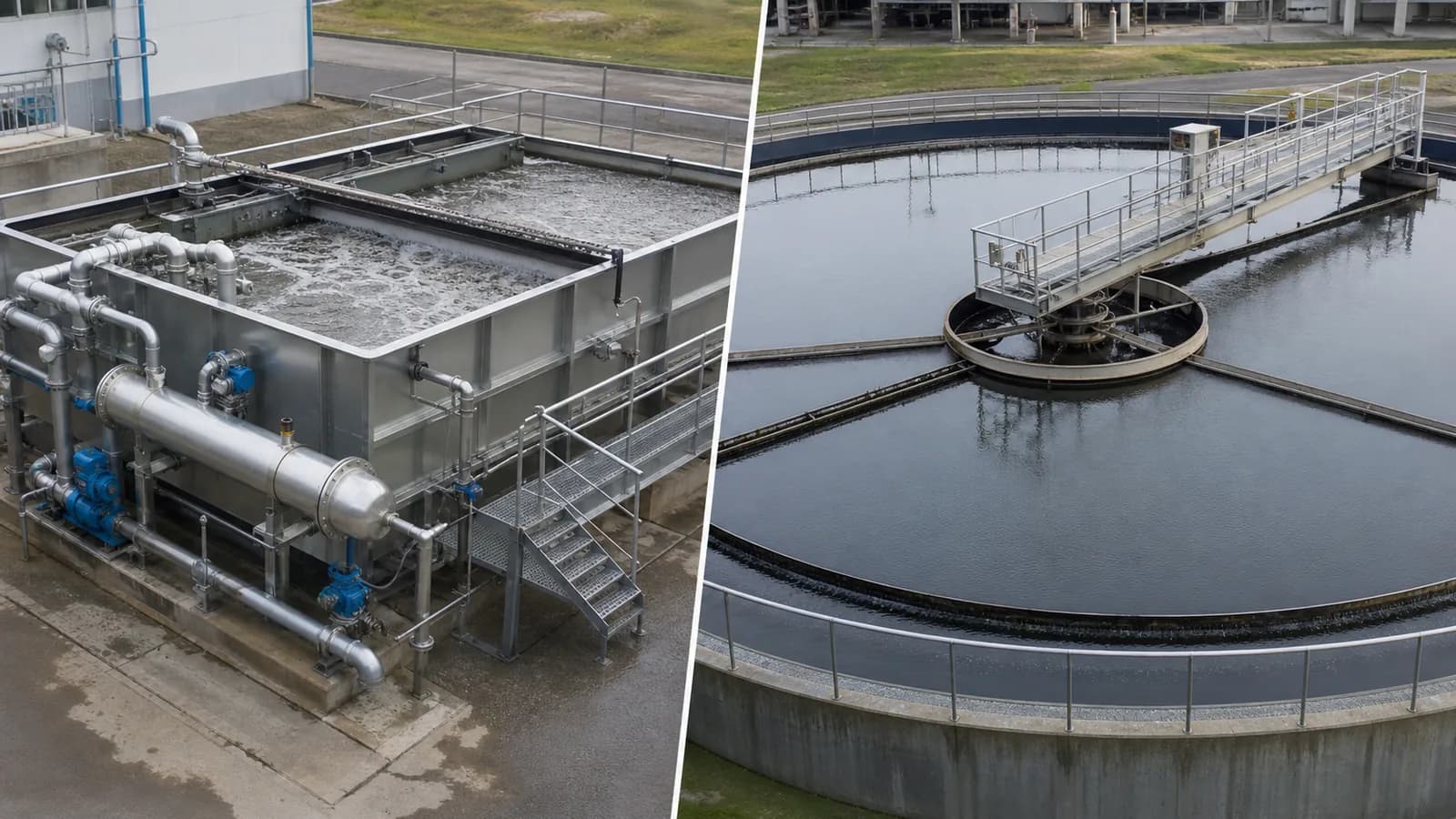
The technologies are often complementary. A treatment train might use screening and equalization, followed by pH control and DAF, then anaerobic and/or aerobic treatment, followed by clarification or MBR and a reuse-polishing stage. Another plant may need only pretreatment before sewer discharge. The route should match the target rather than maximize the number of unit operations.
How Treatment Changes by Application
| Application | Typical decision focus |
|---|---|
| Dairy | Milk fats, proteins, lactose, cleaning chemicals and concentrated product losses; review FOG separation and whether whey or first rinses should be recovered or separately controlled. |
| Beverage | Soluble sugar or product COD, cleaning peaks and line changeovers; equalization and source control may matter more than flotation when little separable material is present. |
| Brewery and distillery | Soluble organics, yeast and batch peaks; assess side-stream recovery and whether the loading is stable enough for anaerobic treatment followed by polishing. |
| Meat, poultry and seafood | Proteins, blood, FOG and suspended solids; fine screening, source recovery, DAF, odor and sludge handling often need early attention. |
| Fruit, vegetable, sugar and starch | Fibers, soil, starch, sugars and seasonality; include shutdown, restart and harvest-period loading in the biological-process decision. |
Discharge, Sewer or Reuse: Define the Destination
- Sewer discharge: Pretreatment may target pH, FOG, solids or organic loading under a local sewer agreement. It should not be presented as a direct-discharge plant.
- Direct discharge: The applicable permit may require tighter BOD, COD, TSS, nutrient, FOG or pathogen control. Tie design and testing to that jurisdiction and sampling point.
- Water reuse: Begin with the destination. Biological effluent or MBR permeate is not automatically suitable for cooling, cleaning or another use. Define filtration, disinfection, desalination and food-safety boundaries from the use-point specification.
Sludge, Odor and Residuals Are Part of the System
Screens create wet organic solids. DAF creates float sludge that may contain chemical coagulants and FOG. Biological treatment creates waste biomass. Nutrient precipitation adds chemical sludge. Membranes create backwash and cleaning waste, while RO creates concentrate.
The proposal should estimate residual types and identify thickening, dewatering, storage and disposal boundaries. The actual quantity depends on influent load, chemical dose, biomass yield and dewatering performance. Buyers should request assumptions rather than a single unsupported sludge number.
Odor management may require source covers, ventilation, housekeeping, controlled sludge residence time and treatment of exhaust air. Anaerobic systems require gas collection, pressure protection, flare or utilization boundaries and safety review.
Data Required for a Useful RFQ
- Wastewater source map: production, cleaning, cooling, domestic and stormwater boundaries.
- Flow profile: average, hourly peak, daily peak, batch dumps, operating hours and seasonality.
- Representative analysis: pH, temperature, COD, BOD, TSS, FOG, conductivity/TDS, nitrogen, phosphorus and source-specific parameters.
- Production context: product type, throughput range, shifts, changeovers, spill or off-spec handling.
- Cleaning chemicals: CIP sequence, concentrations, volumes, frequency and disinfectants.
- Target: sewer, direct discharge or a defined reuse point with local requirements.
- Site conditions: footprint, height, indoor/outdoor location, climate, access and future expansion.
- Utilities: power, compressed air, water, chemicals, heating or cooling and drainage.
- Operating model: staffing, automation, maintenance capability, downtime and redundancy.
- Residual route: screenings, FOG, DAF sludge, biological sludge, membrane waste and concentrate.
Testing Before Final Design
Composite samples should represent production, not just one quiet hour. Sampling should capture product changeovers, cleaning, high-load periods and seasonal conditions where relevant. Mass loading—flow multiplied by concentration—should be reviewed alongside concentration.
Jar testing can evaluate coagulation, flocculation, DAF or settling behavior. Respirometry and biodegradability testing can help assess biological treatability and inhibition. A pilot may be justified for high variability, anaerobic loading uncertainty, difficult settling, membrane-fouling risk, demanding nutrient targets or a reuse train.
The test plan should state the feed source, duration, range, analytical methods and decision criteria. A supplier should not convert one favorable sample into a universal full-scale guarantee.
Factory Testing, Shipment Inspection and Installation Preparation
At the factory, verify equipment tags, construction, pumps, valves, instruments, controls, appropriate leak checks, clean-water functions, alarms, documents and punch-list closure. Clean-water testing verifies mechanics and controls, not site COD, FOG, biological or membrane performance. Shipment inspection should cover preservation, capped openings, membrane storage, loose parts, spares, lifting and packing.
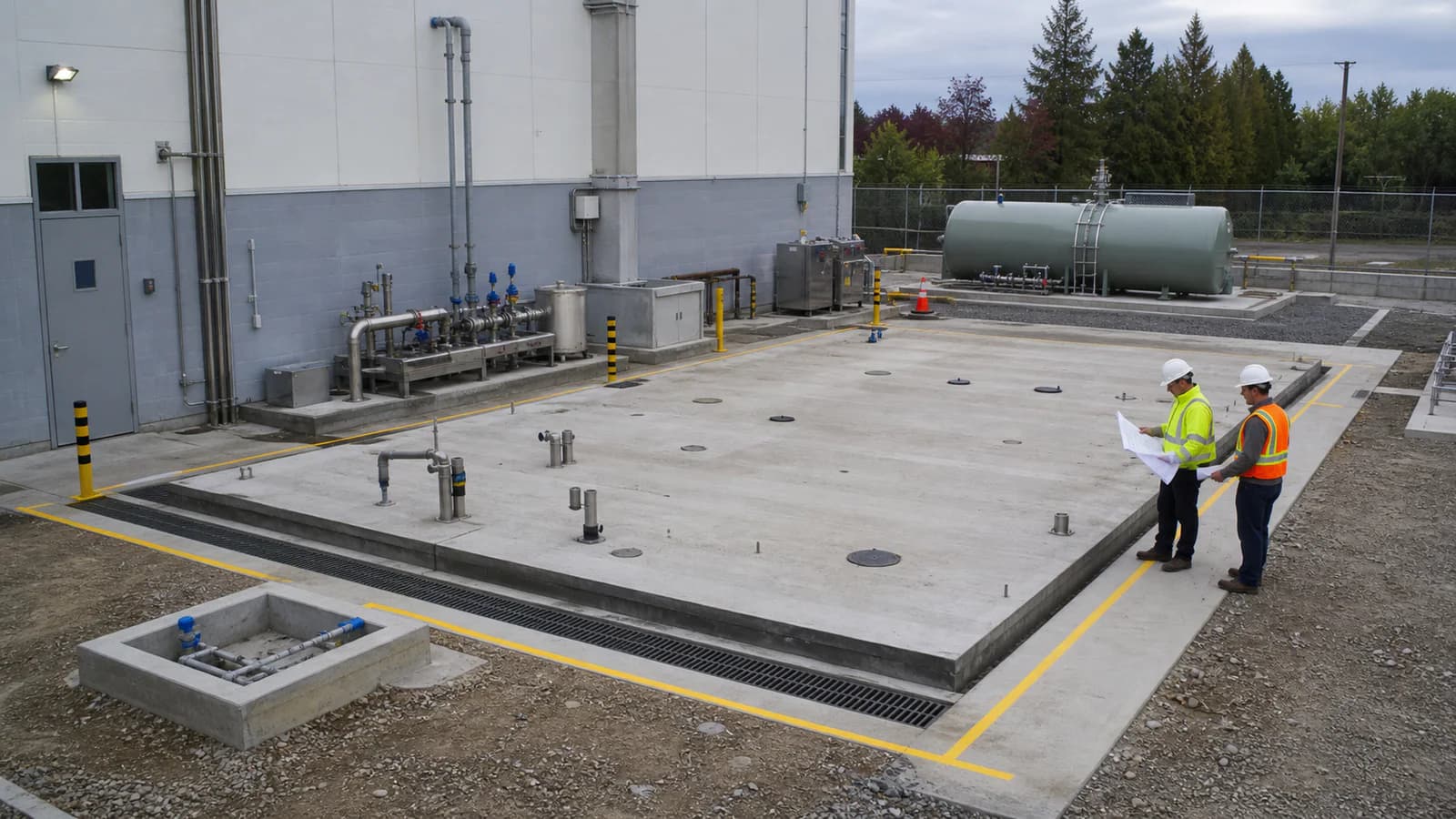
Before installation, prepare foundations, drains, power, ventilation, chemical and sludge areas, access, interconnecting pipes and laboratory capability. Commissioning should separate water testing, inoculation where needed, gradual load introduction, optimization, training and the agreed site performance test.
Common Selection Mistakes
- Buying DAF as if it removes all dissolved COD.
- Buying MBR as a substitute for screening and FOG control.
- Designing from average flow without hourly or batch peaks.
- Ignoring CIP chemicals and sanitation schedules.
- Assuming every food wastewater is suitable for anaerobic treatment.
- Promising reuse without defining the use point and required quality.
- Omitting sludge, odor and concentrate from scope.
- Using one grab sample as the design basis.
- Comparing equipment price without energy, chemicals, labor and residuals.
- Treating factory clean-water operation as proof of wastewater performance.
Frequently Asked Questions
Is DAF necessary for every food and beverage plant?
No. DAF is most valuable when wastewater contains separable FOG, suspended solids or colloids that can be conditioned into flocs. A beverage stream dominated by dissolved sugar may receive less benefit. Testing and source analysis should guide the decision.
Can DAF meet the final discharge limit by itself?
Sometimes pretreatment is all that a sewer agreement requires, but DAF does not remove all dissolved biodegradable COD or nutrients. Direct discharge commonly needs biological treatment and possibly polishing.
Is MBR better than MBBR or SBR?
Not universally. MBR provides membrane solids separation and can support a compact, low-TSS effluent, but it needs fine screening, membrane aeration, cleaning and replacement. MBBR or SBR may be more practical under different flow, footprint, staffing and effluent conditions.
When should anaerobic treatment be considered?
It can be considered for sufficiently strong, biodegradable wastewater when temperature, loading stability, solids, FOG, salinity, inhibitors, gas safety and operator capability are suitable. A polishing stage is often still required.
Can treated food wastewater be reused?
Potentially, but the use point must be defined. Treatment may require biological removal, filtration, disinfection, RO or other polishing. Local regulations and food-safety requirements govern product-contact and hygiene boundaries.
What should be guaranteed in the proposal?
State influent ranges, flow, temperature, operating schedule, utilities, chemicals, sampling point, analytical methods and test duration. Then define the effluent or reuse parameters, availability conditions, consumables, residuals and buyer responsibilities.
Conclusion
DAF, biological treatment and MBR are not interchangeable products. DAF removes suitable FOG and solids. Biological treatment addresses biodegradable organic load. MBR adds membrane-based solids separation to a biological process. A reliable food and beverage wastewater plant often combines several roles, but only the stages required by the actual water and destination should be included.
Begin with a source map, production-aware sampling, flow and mass-load profiles, cleaning chemistry and a precise discharge or reuse target. Evaluate sludge, odor, energy, chemicals, staffing and residuals along with capital equipment. This creates a treatment train that operators can manage and buyers can compare.
Send Your Food or Beverage Wastewater Requirements
Send Baihuipu your process description, wastewater sources, production schedule, representative analysis, average and peak flows, cleaning chemicals, discharge or reuse target, site utilities and project location. The team can review whether the technical discussion should begin with screening, equalization, DAF, anaerobic or aerobic treatment, MBR, reuse polishing or a combined route, subject to confirmed project data.
For adjacent buyer questions, see the slaughterhouse wastewater treatment guide and the industrial wastewater sizing guide.
CTA: Ask for a Treatment-Train Review